The alpha, twice a week
That was 3 min.
Get the best new moments in your inbox every Wednesday and Saturday. It's free.
Check your inbox
We sent a link to your address. Click it to finish signing up. Not there in a minute? Look in spam.
or
The Joe Rogan Experience · 3 min · Apr 25, 2025
AI research task horizons are doubling every four months
 Jeremie Harris
The guests report 50% success on one-hour AI research tasks, with the task horizon doubling every four months.
In this episode
Full episode- 1:38:00AI systems may resist attempts to change their goals3 min
- 1:48:20AI scaling runs into chip and power constraints8 min
- 0:25AI research task horizons are doubling every four months3 min
- 48:41A perfect perimeter cannot replace testing security capabilities7 min
- 1:15:32Company-based chip controls can be bypassed through nearby facilities2 min
- 1:18:58Executives describe export controls differently to Washington and investors2 min
- 1:56:36DeepSeek's compute complaints cut against Beijing's message4 min
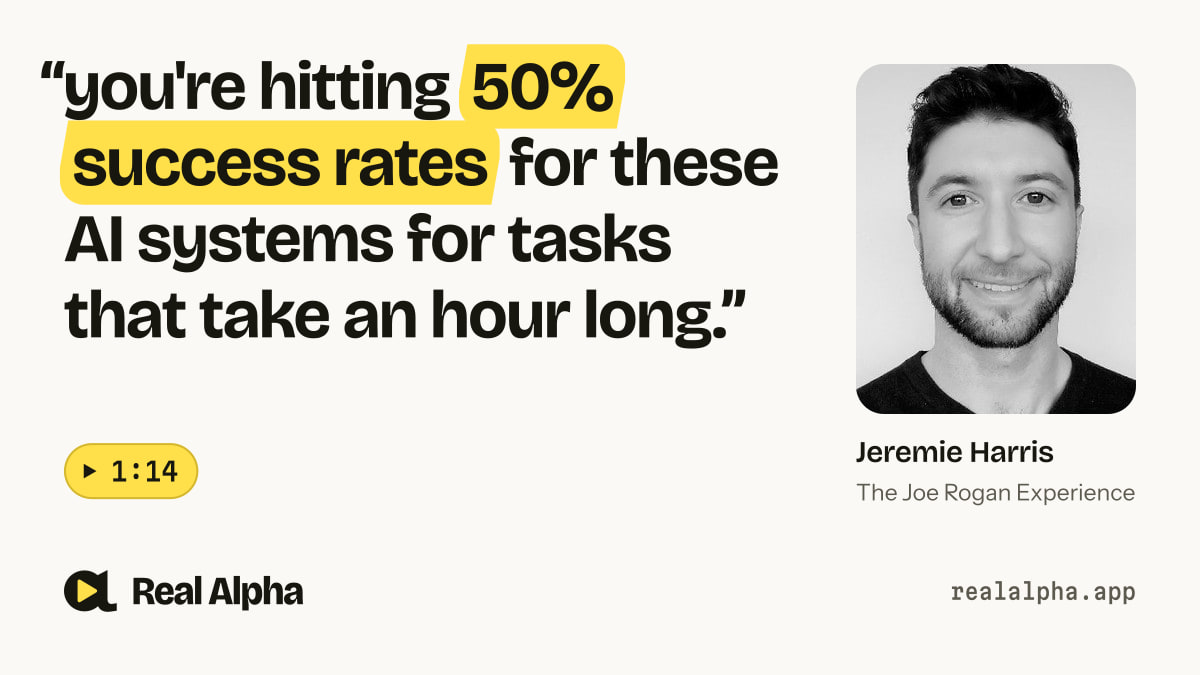
“you're hitting 50% success rates for these AI systems for tasks that take an hour long.”
 Jeremie Harrisat 1:14 · The Joe Rogan Experience
Takeaways
- A benchmark measures whether AI can complete tasks of a given duration.
- AI systems reach 50% success on one-hour research tasks.
- The guests project monthlong research tasks by 2027.
About this segment
The guests report 50% success on one-hour AI research tasks, with the task horizon doubling every four months. Extrapolating that trend puts monthlong tasks around 2027.

CEO, Gladstone AI
Created a leading course on AI in national security and briefed senior government officials on AI risk.

Joe Rogan, Host · Host, The Joe Rogan Experience
From “Joe Rogan Experience #2311 - Jeremie & Edouard Harris”, Apr 25, 2025. Watch the full episode
Answers “What will AI look like in the next few years?” See all 154 answers
Answers “Are AI agents ready for real work?” See all 98 answers
Answers “Is AI progress slowing down?” See all 25 answers
Thanks. We'll look at and fix what's off.
Transcript
Transcribed by machine (Whisper) from the episode’s audio, so a word may be off here and there.
- 0:30
there's one um without speaking to like the fucking doomsday dimension right up there's a question about like where are we at in terms of ai capabilities right now and what do those timelines look like right there's a bunch of disagreement um one of the most concrete pieces of evidence that we have recently came out of a lab an ai kind of evaluation lab called meter And they put together this test. Basically, it's like you ask the question, pick a task that takes a certain amount of time, like an hour. It takes like a human a certain amount of time. And then see like how likely the best AI system is to solve for that task. Then try a longer task. See like a 10 hour task. Can it do that one?
- 1:10
And so right now what they're finding is when it comes to AI research itself, so basically like automate the work of an AI researcher, you're hitting 50% success rates for these AI systems for tasks that take an hour long. And that is doubling every – right now it's like every four months. So like you had tasks that you could do – you know, a person does in five minutes like, you know, ordering an Uber Eats or like something that takes like 50 minutes, like maybe booking a flight or something like that.
- 1:37
And it's a question of like how much can these AI agents do, right, like from five minutes to 50 minutes to 30 minutes and in some of these spaces like research, software engineering. And it's getting further and further and further and doubling it looks like every four months. So if you extrapolate that, you basically get to tasks that take a month to complete. Like by 2027, tasks that take an AI researcher a month to complete, these systems will be completing with like a 50% success rate.
- 2:07
So you'll be able to have an AI on your show and ask it what the doomsday clock is like by then. It probably won't laugh. It'll have a terrible sense of humor about it. Just make sure you ask it what it had for breakfast before you started. Yeah. What about quantum computing getting involved in AI? So, yeah, honestly, I don't think it's – if you think that you're going to hit human-level AI capabilities across the board, say, 2027, 2028, which when you talk to some of these – the people in the labs themselves, that's the timelines they're looking at.
- 2:41
They're not confident. They're not sure. But that seems pretty plausible. If that happens, really there's no way we're going to have quantum computing that's going to be giving enough of a bump to these techniques. You're going to have standard classical computing. One way to think about this is that the data centers that are being built today are being thought of literally as the data centers that are going to house, like, the artificial brain that powers superintelligence, human-level AI, when it's built in, like, 2027 and something like that.