The alpha, twice a week
That was 5 min.
Get the best new moments in your inbox every Wednesday and Saturday. It's free.
Check your inbox
We sent a link to your address. Click it to finish signing up. Not there in a minute? Look in spam.
or
All-In · 5 min · Mar 17, 2026
AI returns require redesigning company processes
 Michael Dell
 says AI can improve productivity by 20% or more, but only after companies rethink processes, tools and data from the top down.
The episode’s best minutes
Full episode- 3:10Physical businesses can be built like an atoms-based computer3 min
- 44:16AI returns require redesigning company processesPro pick 5 min
- 1:03:55Michael Dell committed $6.25 billion to children’s accounts5 min
- 5 more moments in the full episode
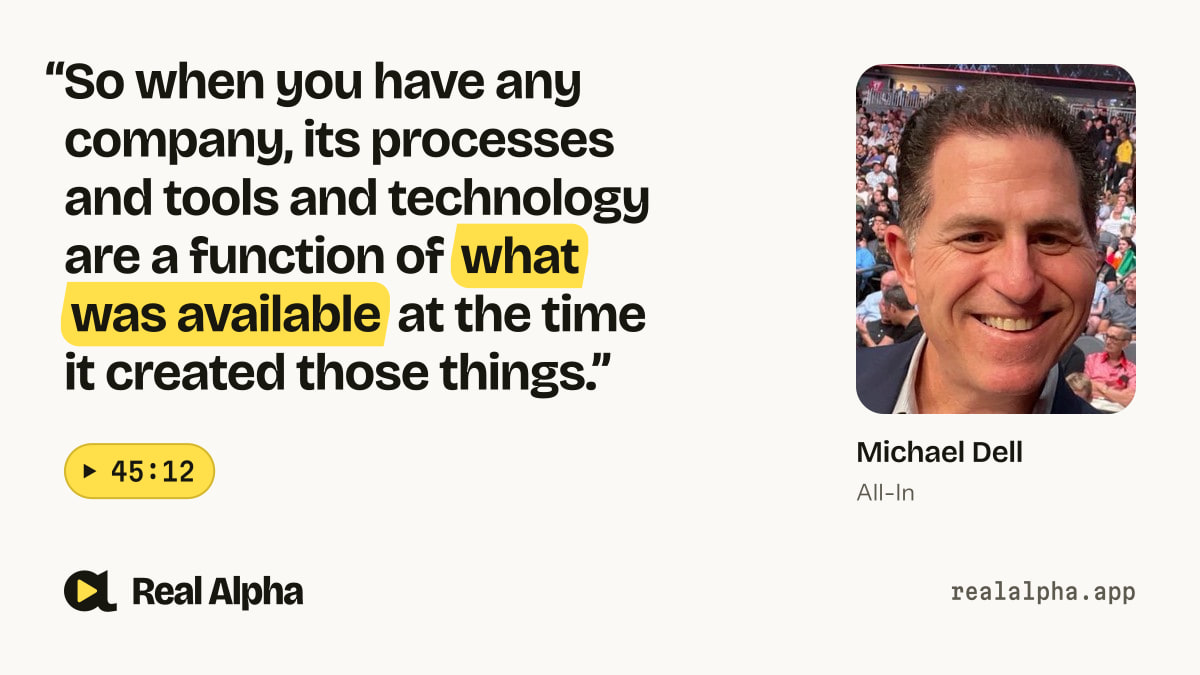
“So when you have any company, its processes and tools and technology are a function of what was available at the time it created those things.”
 Michael Dellat 45:12 · All-In
Takeaways Pro pick
- AI gains require process work, not just installing tools.
- Redesign processes and consolidate tools and data before applying AI.
- Leadership and willingness to change determine adoption.
One of Pro's picks, open to you here. Try Pro free for 7 days
One of Pro's picks. The rest of the summary and the 3 takeaways are in Real Alpha Pro; the video, the quote and the transcript stay free.
Read it with Pro, 7 days freeAbout this segment
Michael Dell says AI can improve productivity by 20% or more, but only after companies rethink processes, tools and data from the top down. The main adoption barrier is leadership and culture, not technology.

Chairman & CEO, Dell Technologies
Founded Dell Technologies and committed $6.25 billion to investment accounts for 25 million American children.

Chamath Palihapitiya, Host · Founder & CEO, Social Capital
Led Facebook's growth team; his firm backed Slack and AI chipmaker Groq.

Jason Calacanis, Host · Founder & CEO, LAUNCH
Early Uber angel; sold Weblogs Inc. to AOL; hosts This Week in Startups.

David Sacks, Host · Co-founder & partner, Craft Ventures
PayPal's first COO, founded Yammer; White House AI & crypto czar 2025–26.

David Friedberg, Host · CEO, Ohalo
Founded The Climate Corporation, sold to Monsanto for about $1.1B in 2013.
From “Two Legendary Founders: Travis Kalanick & Michael Dell Live from Austin, Texas”, Mar 17, 2026. Watch the full episode
Answers “Is AI paying off for companies?” See all 45 answers
Thanks. We'll look at and fix what's off.
Transcript
Transcribed by machine (Whisper) from the episode’s audio, so a word may be off here and there.
- 44:23
How much is that helping versus how are you seeing folks rationalize the investment relative to the return they're going to make and over what time scale? This is still the big question. Is the money really there? The hyperscalers, maybe they're starting to come up, but end usage, end states, are we kind of, hey, wait and see? We don't know yet. Or folks are getting 20% ROIC starting in year one after they've made the investment?
- 44:50
You know, I can tell you in our business, in our company, we definitely see plenty of use cases where the ROI or the improvement in productivity efficiency is 20% or greater. Right away, it gets there. I mean, it's not like you just hit a button and you get 20%, right? There's work required in thinking through the processes. And it's worth a little bit describing that. So when you have any company, its processes and tools and technology are a function of what was available at the time it created those things.
- 45:31
And so what you sort of have to do is step back and say, all right, what's the trajectory of the improvement of the tools? What outcome are we trying to create? And now let's simplify and standardize the processes, get all the tools together, get all the data together, and then apply the technology. And this really has to be done in kind of a tops down way. You can't sort of do it spontaneously, you know, in silos are not going to spontaneously improve themselves. And often that means that you're completely changing the way the organization works. It's like a wholesale re-architecture. It's a re-imagining of the way a company works. And, you know, I mean, the way I described this to our team about three years ago is, you know, we were going to have a new competitor five years from now, that would be
- 46:26
two years from now, you know, that was in every business that we're in, except they were going to be faster and more innovative and more successful and lower cost. And they were going to put us out of business. And the only way we were going to prevent that is, is we're going to become that company and here's how we're going to do it and you know it excited some people it scared some people but i actually believe that that's what's going to happen and and so we've been dramatically changing our business i would say the biggest benefit by far is speed we're much faster at being able to apply innovations and so you know you look at our at our infrastructure business last quarter grew 73 percent well that's kind of unusual for a business of this size and uh you know this quarter we guided that it would grow even faster like 100 so you've lived
- 47:24
through a couple of paradigm shifts here the pc revolution obviously you led that and then you of course had a you know client server the network revolution online uh internet internet cloud mobile yeah so each one of those we saw massive disruption we're talking in the green room about hey we used to have a typing pool there was a mail room all these things got abstracted away by the pc and networked pc revolution um but it took a decade or two and this one's happening a lot faster yeah yeah this one i think it's it's like um you know A quarter is like a year. Maybe it's five times faster or something like that. But back to your question, I would say maybe 10 or 15% of large companies have really figured this out. And the rest of them are kind of fumbling around. And, you know, there's a tendency when you hear about a new technology to like, oh, let's just go do it. You know, show the boss, hey, we did AI.
- 48:23
You know, the board said we got to do AI. We got to do AI. Are you proud of me, boss? Yeah. And look at what I made. Exactly. And I also think, you know, it's an important point about about this, which is, you know, the barrier to technology adoption is not technology. It's culture and leadership and courage. Right. And so willingness to change. Yeah. And, you know, if you're in a business that you don't think is changing very much or, you know, change is really hard, right?
- 49:00
You have to be very uncomfortable. You're like, well, we're going to stop doing that. Well, we don't need this anymore. Particularly if your bonus is dependent on not messing things up.