The alpha, twice a week
That was 4 min.
Get the best new moments in your inbox every Wednesday and Saturday. It's free.
Check your inbox
We sent a link to your address. Click it to finish signing up. Not there in a minute? Look in spam.
or
All-In · 4 min · Jan 23, 2026
AI science depends on organizing fragmented research data
 Michael Kratsios
 says scientific data is too fragmented for conventional model training, and describes a federal effort to make national-lab research usable.
The episode’s best minutes
Full analysis- 7:57Data centers can lower power costs if they add generation5 min
- 15:06AI science depends on organizing fragmented research dataPro pick 4 min
- 31:12AI exports should fit countries without large IT budgetsPro pick 6 min
- 4 more moments in the full episode
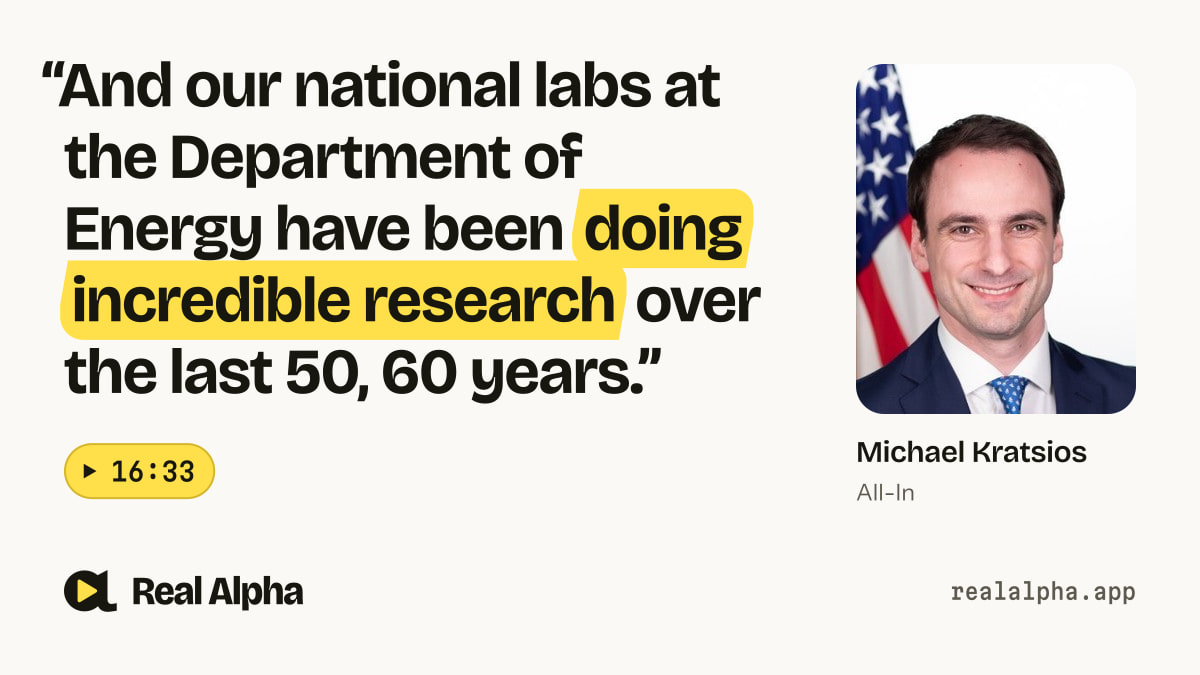
“And our national labs at the Department of Energy have been doing incredible research over the last 50, 60 years.”
 Michael Kratsiosat 16:33 · All-In
Takeaways Pro pick
- Scientific data spans disciplines and inconsistent formats.
- The Genesis Mission aims to make national-lab research usable.
- AI could speed work on fusion, materials and therapeutics.
One of Pro's picks, open to you here. Try Pro free for 7 days
One of Pro's picks. The rest of the summary and the 3 takeaways are in Real Alpha Pro; the video, the quote and the transcript stay free.
Read it with Pro, 7 days freeAbout this segment
Michael Kratsios says scientific data is too fragmented for conventional model training, and describes a federal effort to make national-lab research usable. He sees AI accelerating experiments in fusion, materials and therapeutics.

Assistant to the president for science and technology & director
Led the American AI Initiative as U.S. CTO and now directs the White House science and technology agenda.
- MB
Maria Bartiromo, Host
From “Inside America’s AI Strategy: Infrastructure, Regulation, and Global Competition”, Jan 23, 2026. Watch the full episode
Thanks. We'll look at and fix what's off.
Transcript
Transcribed by machine (Whisper) from the episode’s audio, so a word may be off here and there.
- 15:11
And back to David's initial point about the progress we've seen in these frontier models, I think the very early ones sort of started with just general knowledge. And you have to go back and understand like why. And the question was, what was the data available for those model builders to start training their models? And for the early ones, you could just scrape the internet and just kind of cram everything into a model and train it.
- 15:31
And that's where you kind of had this first phase of large language models. And the second one was coding. And if you think about how do you get a really good coding model, you have to train it on existing code. And that was, again, something that is relatively easier to acquire than other types of data. And you saw great progress and jumps in the coding models. I think the third big sort of shift that hasn't really been touched on yet, which the government itself is trying to push on, is AI for science.
- 16:00
question and why it's so challenging for scientific discovery to like tie in with the way that LMs are traditionally trained is that the science data is extraordinarily fragmented and it's not done in a way or formatted in a way that can easily be applied to a large language model sort of like training run. And if you think about scientific discovery, it's spread out across so many different disciplines. You have chemistry data, you have math data, you have material science data. And all of that is in all types of different formats. And our effort in administration, we launched something called the Genesis Mission, which is our attempt to sort of make these big, bold leaps in AI for scientific discovery. And our national labs at the Department of Energy have been doing incredible research over the last 50, 60 years. And all of that is sitting and is
- 16:48
ready to be used to be trained for these models. So my hope is that over the next year, we're going going to see a lot more work in this in scientific discovery to be able to actually accelerate how quickly we can choose which experiments to run, run those experiments, go back and figure out what we did wrong and run them again. And this ties in with lots of interesting ideas that people have around some of these AI labs where you essentially have, you can put in the thesis or the hypothesis, and ultimately these labs can do lab experiment itself and move forward. So that's kind of the dream that I have, that ultimately we as a country can almost double our R&D output over the next 10 years because of AI.
- 17:24
So what kind of breakthroughs would you expect or would you like to see? Yeah, I think the ones that I think can make a big impact are, first, the experimentation and training runs around fusion are extraordinarily computation heavy. And they themselves, if we can have a faster feedback loop on how we do these simulations for fusion, we can move the timelines in for fusions. That could be a big step. Material science is also a very big area where you want to be able to test all types of different molecules and interact with each other. This is important for all the big things we're trying to do in space, whether it's our lunar base or getting to Mars or bringing nuclear energy to space.
- 18:09
Having advanced material science is important. And the third is one that everyone always cares about is healthcare and therapeutics. How can you more quickly be able to identify the best molecules to solve a particular health challenge? And how do you more quickly iterate to a point where you can move to a clinical trial? And on a everyday level, I mean, you also have the auto sector, I think, as a big beneficiary here. I think that's one area that seems to be spending