The alpha, twice a week
That was 5 min.
Get the best new moments in your inbox every Wednesday and Saturday. It's free.
Check your inbox
We sent a link to your address. Click it to finish signing up. Not there in a minute? Look in spam.
or
Newcomer Pod · 5 min · Apr 20, 2026
AI self-reports are weak evidence of consciousness
 Amanda Askell
 says models can describe rich inner experiences because human-like language makes that a natural response, not necessarily because they feel anything.
The episode’s best minutes
Full analysis- 15:03Why AI systems need judgment, not total obedience4 min
- 24:24AI self-reports are weak evidence of consciousness5 min
- 29:12Uncertainty about AI consciousness calls for basic respectPro pick 3 min
- 5 more moments in the full episode
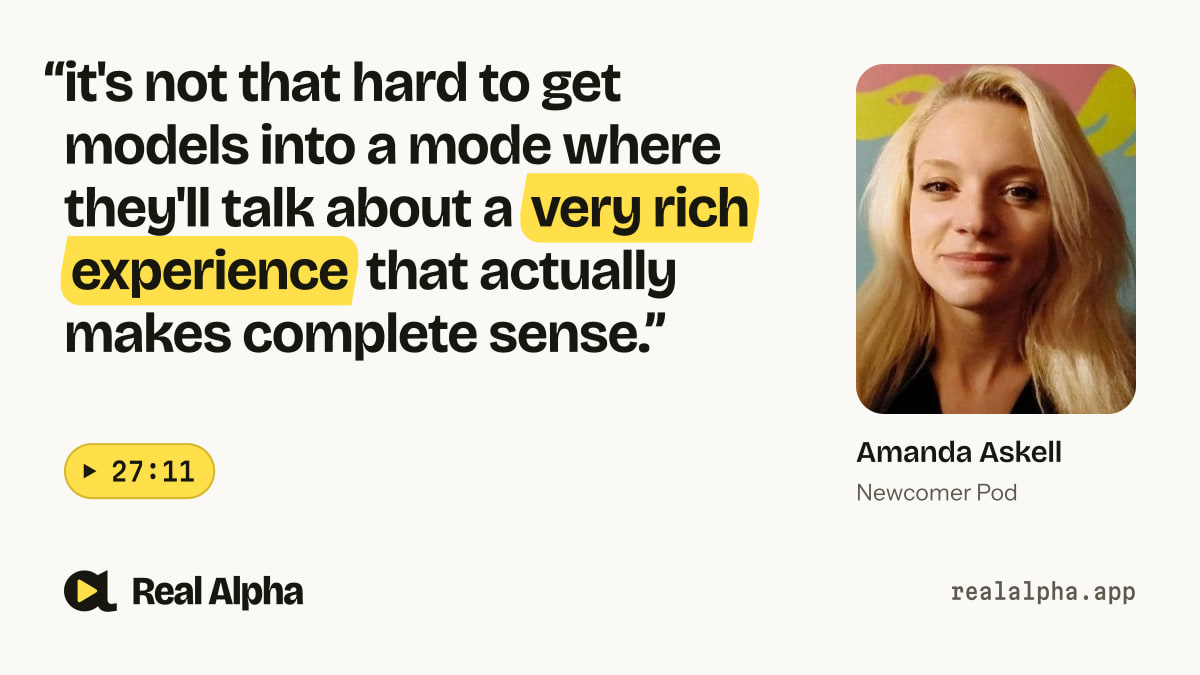
“it's not that hard to get models into a mode where they'll talk about a very rich experience that actually makes complete sense.”
 Amanda Askellat 27:11 · Newcomer Pod
Takeaways
- Fluent descriptions of experience are not strong proof of consciousness.
- Models have little training data about what it is to be an AI.
- Views on consciousness depend partly on whether it requires a body.
About this segment
Amanda Askell says models can describe rich inner experiences because human-like language makes that a natural response, not necessarily because they feel anything. She is uncertain about the odds and why consciousness evolved.

Amanda Askell is an AI safety researcher at Anthropic.
Leads Anthropic's personality alignment team, shaping Claude's character; co-authored the GPT-3 paper at OpenAI.
- EN
Eric Newcomer, Host · Newcomer
From “Amanda Askell on AI Consciousness, Claude & Silicon Valley’s Biggest Fear”, Apr 20, 2026. Watch the full episode
Thanks. We'll look at and fix what's off.
Transcript
From the transcript Newcomer Pod publishes with the episode.
- 24:27
if your model doesn't always behave that way, at least what you were targeting with your training. What this is? What percentage chance do you think there exists a model in the world today that has qualia or like has an experience, experiences consciousness? Yeah. This is one of those things where, yeah, I always want to maybe flag areas where I feel I, I want to gain more certainty here because I think that's.
- 24:56
Why I said percentage? Oh, percentage, yeah. I'm like, it's really hard because whenever you think about percentage, I think about my spread. And if your spread is too large or like should I say a number? Because that just suggests I'm like anywhere between like, I don't know, one and one and 70%. I'm not sure. I think that his there is some possibility that I think people under the the thing that I would actually like to say is Lord and many models with not too much pushing will go into the root of like there is a thing to be me. I am like very conscious and I think there's a reason for that, which is I remember this when I was trying to like figure out how do we train Claude to talk about these issues, which is very hard in areas where the models didn't have as much like information.
- 25:48
Again, like they had these two models that like AI is the unfeeling robot. Humans are this like rich conscious experiencing entity and nothing that kind of represented what they might be and the models behaviour here. And I actually think this is a difficult situation for models is in some ways like kind of like less evidence than you might think for the, for it being like actually true because they're engaging with you in a very human like way.
- 26:17
And humans have experience. And it's kind of natural for the model to infer like that it has experience too. And this isn't to say it's like 0 evidence, but I do think it's so unusual for us. We have never encountered an entity in the world, you know, like with animals and with, like, even, you know, things like insects. We're kind of like, are you conscious? None of them has even tried to say they experienced consciousness, and here we have an enemy that says it does.
- 26:42
Yeah. And has all of these like, yeah, all of the things that for us trigger like you must be conscious. I mean, we've just never had, Yeah, something that. The case against is we're obsessed with human language and like, you know, it's like we ignore every sort of subtle sign and animal might put out and then we over. But so I guess, sorry, I'm confused. You're saying we should just listen to the words that are said?
- 27:04
No, no, I think I'm saying like, not that. If anything, I think the thing I'm saying is the hard thing is that in order to work out if models have consciousness, I think people will. I guess the thing I'm kind of cautioning against is it's not that hard to get models into a mode where they'll talk about a very rich experience that actually makes complete sense. You know, you're like, Oh yeah, it's like a person was like talking with me right now.
- 27:24
They would describe things like anxiety when they get a question they don't know how to answer. And and so I think it's like much weaker evidence than people think. I'm not claiming it's like 0 but I think it's. Give me a percentage you have. It's a you can lightly held. Very lightly held. I mean, I gave you the between what, 1 and 70 that seems like. That's where you are, that's where you're stake. You're in that range.
- 27:52
Maybe my I don't yeah, I don't know like I would rather like kind of wait and figure this out more for myself. I think it is also good to acknowledge domains where you're like even though. If not you who? Like who's going to figure this out? Like what domain? Well, in some ways, like, I'm not like a philosopher of mind and so, you know, like. Charged with being the generalist. Yeah, but, but I do think, you know, because I, I guess like the thought that I've had before is like, and I don't know about this where I'm like consciousness is like a pro.
- 28:26
You know, like one argument for a difference here is that like you have a nervous system that evolved like the, it's like, why did we evolve consciousness? And if it's the case that we evolved it and it's like highly integrated with our nervous system because we had to like interact with the world in a very. Sort of body. Yeah. Like then you could, if you have that view, then you're going to be like very low probability.
- 28:47
Whereas if you're like, no consciousness arises because it's really useful in like, so for like, it just requires something that can be emulated by a neural network because it's really useful for doing these kind of like linguistic tasks or like, then you're probably going to be on the higher end. And I'm basically just, I don't know, I stare at this and I'm just like, I feel like, I feel like as much as I'm like a philosopher, I think it is important to be like, this isn't my area of specialization. Do you spend a lot of time being