The alpha, twice a week
That was 8 min.
Get the best new moments in your inbox every Wednesday and Saturday. It's free.
Check your inbox
We sent a link to your address. Click it to finish signing up. Not there in a minute? Look in spam.
or
Uncapped · 8 min · Nov 24, 2026
AI shifts hard-tech advantage toward mechanical engineers
 Chetan Puttagunta
 traces defense investing to open-source board work and explains why procurement now values million-unit scale.
The episode’s best minutes
Full analysis- 19:15AI shifts hard-tech advantage toward mechanical engineers8 min
- 31:55Legacy systems face an AI-driven security gapPro pick 6 min
- 6:27Markets need time to price a new business modelPro pick 5 min
- 4 more moments in the full episode
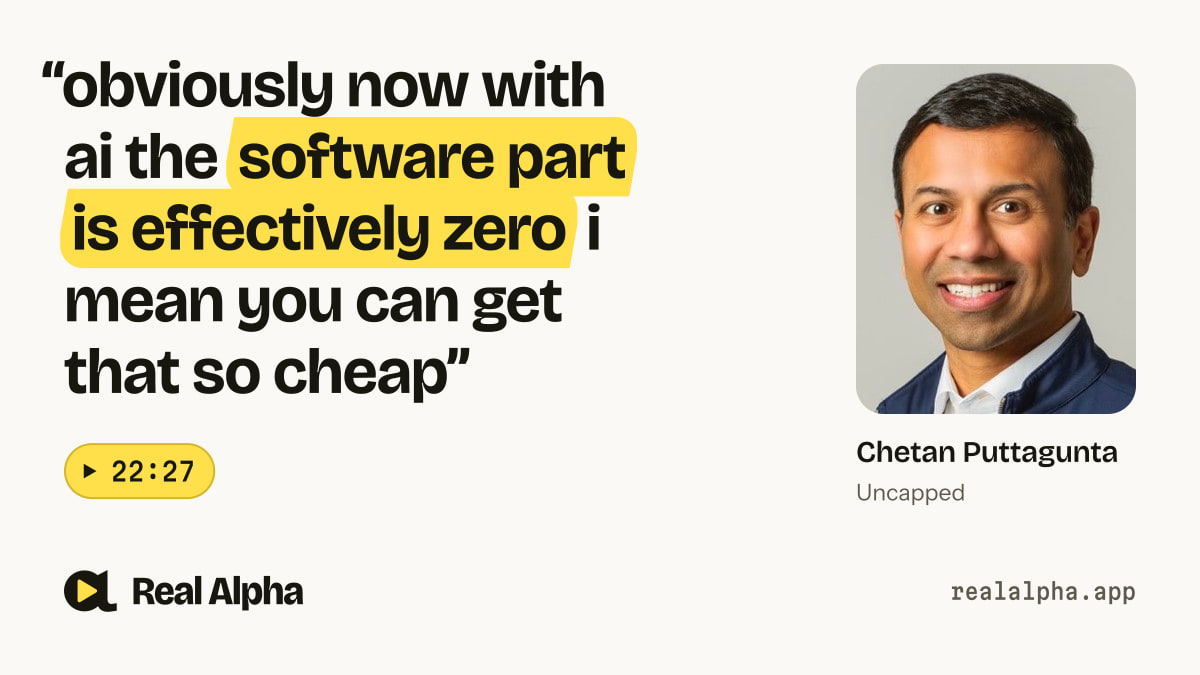
“obviously now with ai the software part is effectively zero i mean you can get that so cheap”
 Chetan Puttaguntaat 22:27 · Uncapped
Takeaways
- Defense procurement increasingly asks for million-unit output at lower cost.
- AI cuts software build costs, changing which skills are scarce.
- Fast prototypes and contracts can compress hardware timelines.
About this segment
Chetan Puttagunta traces defense investing to open-source board work and explains why procurement now values million-unit scale. AI makes software cheaper, raising the premium on mechanical engineering and execution.

Chetan Puttagunta is a Benchmark partner.
Led Benchmark investments in Legora, Airbyte and Modern Treasury, and chairs Elastic.

Jack Altman, Host · General partner, Benchmark
Co-founded Lattice and ran it until 2023, then started his fund, Alt Capital.
From “Benchmark Breakfast 11/24/26: Anthropic IPO, Cybersecurity, NVIDIA, and Hero Investments”, Nov 24, 2026. Watch the full episode
Thanks. We'll look at and fix what's off.
Transcript
Transcribed by machine (Whisper) from the episode’s audio, so a word may be off here and there.
- 19:19
that's right um actually this is a good segue into like talking about you know you've done some investing recently in like hard tech frontier defense i think a lot of that stuff historically has been obviously a lot more capital intensive i don't think that's like why you're interested in and it happens to connect to this conversation, but how did that start? Because it's all in the last few years, I guess, right?
- 19:40
Yeah, my initial exposure into defense is actually through our last generation of open source companies like MongoDB, Blasticsearch, MuleSoft, Confluent, et cetera, is that I think this wasn't particularly well-known, but if you were on the boards, you knew, is that the defense sector in the United States and globally I don't know. They were early adopters of interesting open source infrastructure.
- 20:06
And so you got to meet all the people involved in that ecosystem. You got exposure to the procurement process and how you get into a real program and how a deal shows up and all that kind of stuff. And so on the software side, we have been investors in lots of dual use technology for a long time. What's really interesting is there was never really this push against cost and efficiency of the hardware.
- 20:36
There was always cost and efficiency against software. And so that's why there was a lot of pull for open source. But, you know, people would talk about, you know, we need more efficient hardware, but there was never sort of action against it. And of course, that's dramatically changed now. People use the words such as magazine capacity. they talk about, can you produce a million of a thing, not just sort of like 10 of a thing or a hundred of a thing? How fast can you produce a million of a thing? And so scale and cost efficiency has now entered the conversation in these defense procurement processes. And as a result, startups are very good at this because this is where the incumbents in the defense sector have spent decades basically consolidating themselves and as a result you have a couple
- 21:26
of defense primes but one of the things that we've all now realized is that they're very very good at making incredibly complex incredibly exquisite machines that do just truly remarkable things but like you can get a hundred of those and if you want a million of those it's just like well you can't it's it's too much it's too much engineering it's too complex etc and so you just need a million of something and this is where startups have have started to to jump in and what i think is happening is you have this hardware revolution happening alongside this ai revolution in software i think part of what makes it super attractive from a venture perspective is that previously if you were going to build a brand new system you would have had to have geniuses on the hardware side and and you know 10 15 20 hardware engineers and then you'd have to
- 22:22
have a giant software team that would then have to also build a system the software part of the system and then you'd have to integrate the two and that's how you get your hardware system going obviously now with ai the software part is effectively zero i mean you can get that so cheap and this is where incredible mechanical engineers are back like if you can engineer a system and know exactly what to do and like how to make this exact part or where to buy it and how to put it in this like vertical system and you can put it together and you can launch it and it works the first time the value of that has has gone up so much relative to somebody that's like two levels below you in terms of competence and so that's the part that's really exciting to me about defense or hard tech is that if you're great at mechanical engineering and if you're two to two
- 23:18
clicks better than your competition that shows up so dramatically now because it's it's the only vector of competition like the software part has commoditized and gathering a big software team and being really good at like systems integration that's all still a little important but not as important as just being incredible mechanical engineers and so that part's really exciting to me that the second part of it which relates to our last conversation around the public markets is there's just way more appetite in both private and public markets to fund these things because we're starting to see results yeah you can see a company that's building hardware And we have a case of this that, you know, we're not talking about it publicly yet, but like they go from funding to prototype to success to like a big program contract in one, two, three years.
- 24:15
Totally unheard of in hardware. But now you can do it because software part is zero and the mechanical side of this thing is like so differentiated. That's right. Yeah, I mean, I think you have, you've got obviously SpaceX and Anduril. Yeah. And so you've got examples of hardware companies doing really well. But then you also have the government now wanting to work with these companies in a way that they didn't used to and being willing to make these huge contracts, huge purchase orders.
- 24:39
You know, they're collaborating. You see, you know, like Hill and Valley. You know, it's like there is a merger there happening that I think is also really important. And then, like we talked about, then the Capitol River goes and you just get the ability to do a lot of stuff. You also, I guess now, I don't know, in L.A. and some other places, you also just have, like, the talent working on it. So you do have a lot of the confluence of these things.
- 24:58
I'm very excited when you get to talk about the one that you're talking about publicly. Yeah. Such a cool company. And then the part about the public markets, too, is there's just so much more acceptance of new technology. And I think the part that public markets get a bad rap on is that the view, at least here in Silicon Valley, is that, oh, public markets are very short-term oriented. They only care about quarterly results, et cetera.
- 25:24
Actually, that's not true. every company that's come to the public market and said i have this investment frontier and this is how much capital it's going to take yeah those have worked very well i mean biotech has figured this out which is like biotech companies go public very early in the life and then they set out this investment frontier and they raise capital against milestones in the public markets and they do it really well and then you get these once in a while just giant outcomes in the public markets where you bought the company at like a $200 million market cap, and it then becomes a $200 billion market cap all in the public markets. And so if you lay out a company that way, I think that's totally reasonable. And I think the other thing is, you know, we have a bunch of companies
- 26:10
in our portfolio that have gotten pretty big pretty quickly. And what's really interesting to me is how much public markets are pulling them to go public much earlier than a trillion dollars yeah as an example which is good and i think i i'm hopeful that next year we'll start to see just a bunch of that broadly and i think like you know we can talk about whatever the the trading of it was but like the public markets are open like people can do it and there's a lot of capital there that wants to be involved so actually um the the next topic i was sort of thinking um that