The alpha, twice a week
That was 4 min.
Get the best new moments in your inbox every Wednesday and Saturday. It's free.
Check your inbox
We sent a link to your address. Click it to finish signing up. Not there in a minute? Look in spam.
or
Bloomberg Surveillance · 4 min · Oct 26, 2026
AI spending could turn into a broader growth risk
 Peter Tchir
 says Treasury strength amid AI-spending concerns may signal worries about slower growth, not just less debt supply.
The episode’s best minutes
Full analysis- 2:11AI spending could turn into a broader growth risk4 min
- 8:05AI beneficiaries extend beyond the companies building it3 min
- 21:35Higher yields make bonds and international stocks more attractive5 min
- One more moment in the full episode
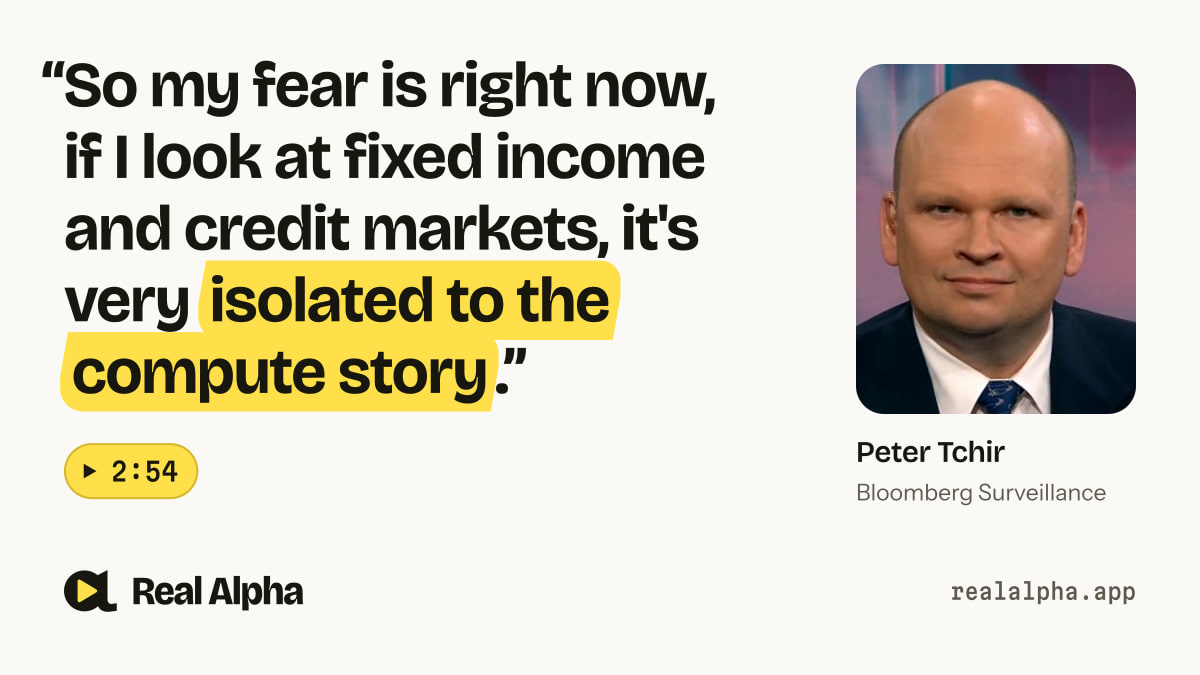
“So my fear is right now, if I look at fixed income and credit markets, it's very isolated to the compute story.”
 Peter Tchirat 2:54 · Bloomberg Surveillance
Takeaways
- Treasury strength may reflect concern about slower growth.
- AI investment has become a significant contributor to GDP growth.
- Broader credit widening could be difficult for equities to absorb.
About this segment
Peter Tchir says Treasury strength amid AI-spending concerns may signal worries about slower growth, not just less debt supply. He warns that broader credit widening could hurt equities.

Head of Macro Strategy, Academy Securities
Leads Academy's macro research on fixed-income and credit markets, drawing on decades of trading experience.
- TK
Tom Keene, Host · Bloomberg
- PS
Paul Sweeney, Host · Bloomberg
From “Market Uncertainty Ahead of the Midterms | Bloomberg Surveillance”, Oct 26, 2026. Watch the full episode
Answers “Will AI boost economic growth?” See all 34 answers
Thanks. We'll look at and fix what's off.
Transcript
From the transcript Bloomberg Surveillance publishes with the episode.
- 2:14
You know, I think it's not as much of a concern. We bring it up a little bit more. I think people are now more focused on the cost of the debt, the rollout. The one thing that, you know, I think you talked about, we had the divergence last week. What I'm starting to concern myself with is AI spend has been such a big part of the economy. One thing that really caught my eye was Treasuries rallied last week while we were seeing the AI compute spend crisis, you know, questions come up. I think that's part because one, the good part would be if there's less AI debt coming out, it would help treasuries because there's not as much other supply that they're competing with. But is the treasury market starting to whiff out that they might see some sort of slowing down in the economic growth, right? Compute spend
- 2:52
has been such a huge part of our GDP growth. If that slows, what happens to our economy? So my fear is right now, if I look at fixed income and credit markets, it's very isolated to the compute story. maybe a little bit to France, that we start pricing in some risk that the economic slowdown starts, then we get a more widespread credit widening, and I do not think equities can handle that.
- 3:13
Peter, you've been talking a long time about kind of this onshoring aspect and for security.
- 3:19
How concerned are you that maybe there is some. Pushback on these data centers across the country here? That's something I don't think we thought about initially. No, it's something I thought was going to be like a 2028 election issue. And it's, you know, come up right away. I also think there's been a lot of inconsistencies with our policy, right? One day you have Besson saying how important it is to build out data centers and AI.
- 3:38
And at the same time, then we're tariffing aluminum from Canadian and other countries and aluminum is making the cost of the data centers go higher. So I think we're going through some growing pains in what we're trying to do. I think you're seeing the chip industry grow here. You're seeing this.
- 3:52
What's been really exciting to me is actually I think this concept production for security or what we've been calling ProSec, it's going global. Ruta talked about the need to build refineries. You've seen Australia announce refineries. I think every single country across the world is going to look a little bit more like a vertically integrated nation.
- 4:07
So bond yields have tended to correlate with oil futures since April and when markets bottomed in late March. But we saw a little bit of a break with that last week. Do you think that's temporary or do you think that's something that can sustain itself?
- 4:19
You know, I think it's going to be hard for bond yields to go much lower if oil prices keep going up and, you know, particularly diesel prices. Having said that, I do think there is this little bit of a break where all of a sudden for the first time people are starting to say, if we don't do the spend, if oil prices stay high, will we see an economic slowdown? And I think that's what's starting to get priced in for the first time. And it's just a little whiff of it. I don't know that it's going to become the core trade, but I do see that potential, right?
- 4:46
If you see questions about the AI spend, some questions about the economy, again, some of the stuff that was designed with the big, beautiful bill is starting to run off as well. So.
- 4:54
Well, what do you think people are underestimating when it comes to because we'll have Microsoft reporting after the bell on Wednesday after the Fed decision alphabet as well. And then we'll have Amazon on Thursday, Apple next Monday after the closing bell. But what do you think people are underestimating when it comes to these types of earnings? Because it feels like each earnings season, there's the concern about the data center debt and the spending. But what's the other side of that?
- 5:16
You know, I think the other side of what we're all trying to figure out, right? We have some of the most transformational technology ever. We have no idea what this is going to look like two years from now or five years from now. Will the same chips be involved? Will the same things? Will we be able to fit a data center into the size of a suitcase if Quanta comes around? Yeah. We are trying to price in this earnings and we all get these, okay, earnings are good and we've locked in a year's worth of supply.
- 5:36
Or two years. The reality is I don't think we really know what this is going to look like in three to five years. You're starting to get more and more people question, are we even getting the benefit? If we spend on AI as a corporation, are we really saving that much money? So I think there's so many things about this narrative that the earnings are only a temporary relief and then we get back to what's this really going to look like?
- 5:55
And I think for the first time we're getting some pushback. Even Elon Musk is pushing back on some sorts of it.