The alpha, twice a week
That was 6 min.
Get the best new moments in your inbox every Wednesday and Saturday. It's free.
Check your inbox
We sent a link to your address. Click it to finish signing up. Not there in a minute? Look in spam.
or
Bloomberg Tech · 6 min · Oct 23, 2026
AI spending worries hinge on financing and future revenue
Jordan Klein says investors are uneasy about financing vast AI build-outs and proving they can earn returns.
The episode’s best minutes
Full analysis- 9:59AI spending worries hinge on financing and future revenue6 min
- 23:57AI financing risks are concentrated among a few major companies3 min
- 28:00A generalist VC looks for opportunity outside the consensusPro pick 4 min
- 5 more moments in the full episode
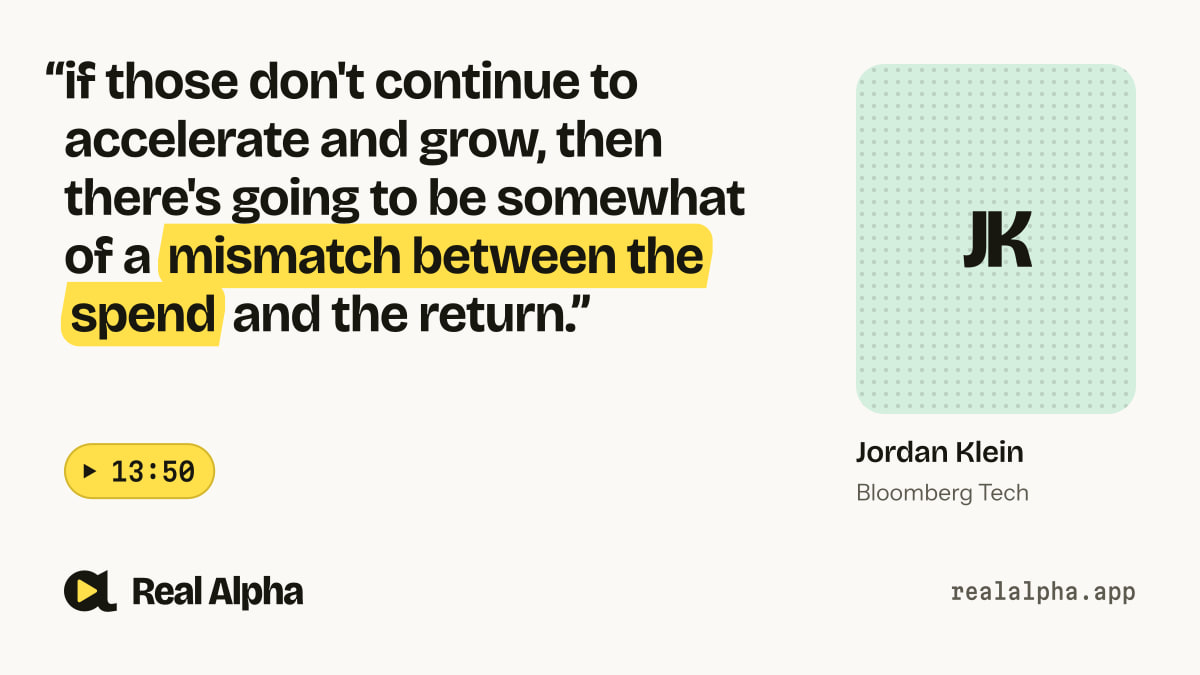
“if those don't continue to accelerate and grow, then there's going to be somewhat of a mismatch between the spend and the return.”
Takeaways
- Compute demand is driving large infrastructure plans.
- Investors question whether AI revenue can support the spending.
- A major IPO may pull capital from other tech stocks.
About this segment
Jordan Klein says investors are uneasy about financing vast AI build-outs and proving they can earn returns. An Anthropic IPO could also force managers to reshuffle portfolios.

Ed Ludlow, Host · Host & correspondent, Bloomberg
Hosts Bloomberg Tech and reports on technology, supply chains, deals and finance for Bloomberg News.
From “OpenAI Moves Toward a $1.25 Trillion Value | Bloomberg Tech”, Oct 23, 2026. Watch the full episode
Answers “Is AI a bubble?” See all 99 answers
Thanks. We'll look at and fix what's off.
Transcript
From the transcript Bloomberg Tech publishes with the episode.
- 10:01
make sense of the trade, not just this week, but past week. Explain how you see this as being vibes, not fundamentals. Yeah, thanks, Ed.
- 10:13
Well, I feel like ultimately fundamentals should drive stock performance. but lately it's more stocks moving and the price determining the narrative. You know, we're in the midst of earnings season and, you know, as an analyst, I think myself and my clients that I speak to are trained and their job is to understand what's going on with these companies, what they're saying, the forecasts, the estimates, and those are all looking pretty good, but yet the stocks are not trading as such. Actually, they're selling, you know, good beats and raises, or maybe if the beats aren't big enough, they're selling off, but I think it's just more everyone's nervous that there might be smoke in the movie theater and they don't want to be caught getting burned up if things start going lower faster.
- 10:59
Can I just ask you about SpaceX in the context of what we learned bigger picture? Their reach goal for next year is to have 20 gigawatts of computer capacity, right? And, you know, a lot of people would say, do we extrapolate out from what SpaceX said in the same way we would do with the hyperscalers to give us a sort of confidence level of what the next 12 months looks like? What was your take on that?
- 11:26
Well, I think even their base case of adding 10 additional gigawatts is, you know, probably 70 to 80%. It's a lot more than what people had thought. You know, whether they can get to 20 is another story. That probably is... dependent more on the availability of the power source as opposed to anything else. But no, I think it sets a very bullish tone, and it probably sends a message to the industry that, like, look, we're going all in. I think Mark Zuckerberg at Meta is doing something similar where he'd rather have more compute than less because both SpaceX and I think Meta and all these guys are working on new capabilities, new features. Things like agentic AI and they know that those are going to be very compute hungry and they need to have basically the plans in place to get this compute set up
- 12:14
now or else they could fall behind and then not be able to monetize these capabilities.
- 12:20
There are some warning signals in credit markets, for example. There has been sustained pressure in aggregate over two weeks. On the AI trade. I know that you've said that this is being done on vibes, not fundamentals, but what is the origin or the source of the anxiety around the AI trade right now that you're hearing each morning at the desk? Yeah, well, it's a couple of things.
- 12:44
I mean, first and foremost, I think People are nervous that all this massive amounts of trillions of dollars of spending is unsustainable. And that's because either you can't finance it. Right. So that people watch the credit markets and rates, particularly for these. tier two and tier three, um, compute vendors like a Neo cloud. And then secondly, like why would anyone build all this and spend the money if there wasn't enough monetization or revenue potential?
- 13:13
Right. I mean, it is still an economic decision. Uh, you know, you don't, invest in something where you're not sure you're going to get the return. And so much of AI is new, it's novel, it's evolving. And so it's hard for investors to see that far out and say, well, if they're spending $ 2 trillion, let's say, per year, they can get a return on that. And every three to five months, basically, we see new features and capabilities that AI can come in and do or save And I think that changes the dynamic, but that's why people are so, I think, laser focused on these frontier model revenue run rates, right? The anthropic and OpenAI, ARR numbers, because they're like, if those don't continue to accelerate and grow, then there's going to be somewhat of a mismatch between the spend and the return.
- 14:02
Actually, John, let's keep talking about that. I mean, the more imminent thing is an anthropic IPO, which the reporting is they'd like to pull off before Thanksgiving. Again, how does that impact your day-to-day right now and your clients' day-to-day in terms of something they're bracing for, what they think will happen to equity markets more generally?
- 14:26
I think that's a good question, and it's twofold. One, They need to see this deal, which is like the most high-profile AI frontier model company, be successful. And by that, I mean there's various definitions of successful. But I think in the first 30 days, it's got to trade well and not basically go down from the first opening price. There has to be demand. There has to be people thinking this is a good investment, and that's going to be dependent upon the valuation. I think we'll know all the fundamentals by the time it goes public. Secondly, and this is also not to be underestimated, is that if you're a portfolio manager and you're looking at, should I buy this or own this new issuance, you've got to find room in your portfolio, in your book, so to speak, to fund that. And people are going
- 15:15
to want to know, does that come at the expense of another competitor or a SpaceX, a Tesla, you know, some of the semi companies, it's unknown, right? Because it's going to be pretty big. And if you're a relative manager and you're trying to keep up with a benchmark, you may need to have some exposure. If you're a hedge fund, you don't have to own it unless you think it's going to give you, you know, alpha.
- 15:36
Well, that's interesting in the irony, you know, SpaceX's fast track inclusion in some of the indexes. Those managers had the same calculus before SpaceX went public. Jordan Klein of Missouri,