The alpha, twice a week
That was 5 min.
Get the best new moments in your inbox every Wednesday and Saturday. It's free.
Check your inbox
We sent a link to your address. Click it to finish signing up. Not there in a minute? Look in spam.
or
Modern Wisdom · 5 min · Dec 14, 2024
AI systems could solve human-doable problems by 2028
 Marc Andreessen
 says AI is unusually hard to forecast, but expects systems to solve human-doable problems by 2028 as reasoning improves.
In this episode
Full analysis- 21:13Elon Musk focuses on the company’s biggest bottleneck8 min
- 52:12Video models may be learning how the physical world worksPro pick 4 min
- 1:02:10Self-driving cars can be safer before they are perfect5 min
- 37:22Startup failures often begin when the team breaks apart4 min
- 56:25AI systems could solve human-doable problems by 20285 min
- 1:20:54UK policy and culture push startup founders toward the US3 min
- 1:07:18Battery limits and safety rules slow autonomous electric aircraft6 min
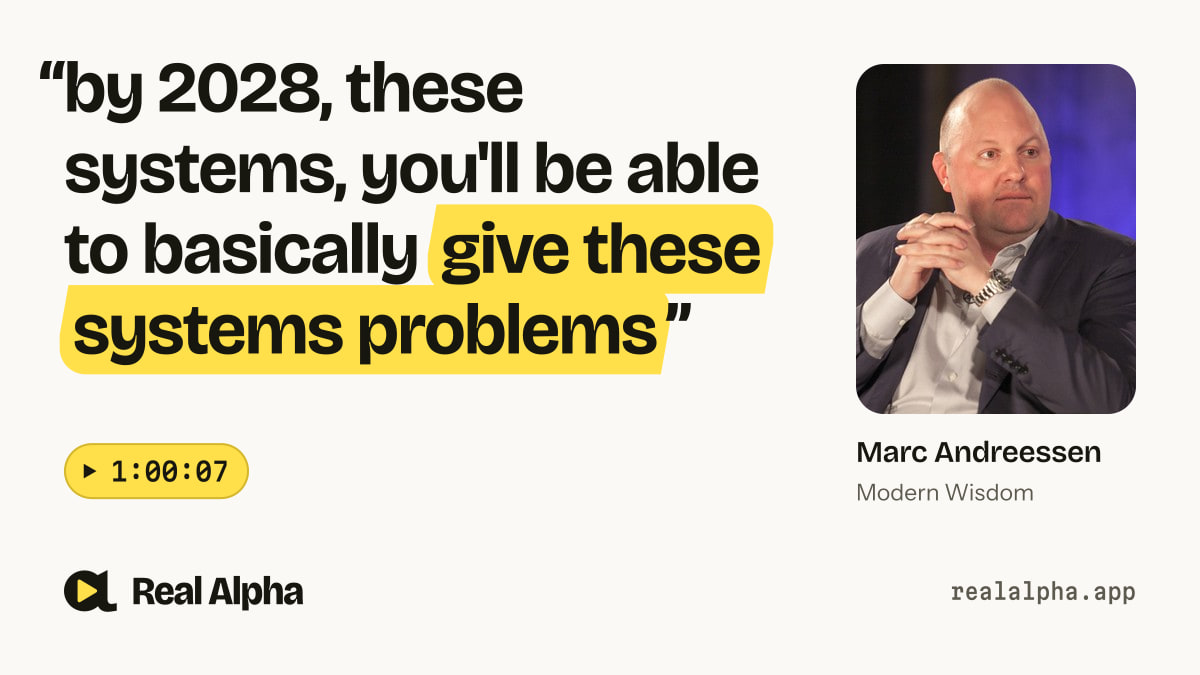
“by 2028, these systems, you'll be able to basically give these systems problems”
 Marc Andreessenat 1:00:07 · Modern Wisdom
Takeaways
- Past AI forecasts have repeatedly missed their timelines.
- Reliable reasoning and problem-solving are near-term goals.
- Robotics adds mechanical-engineering and battery constraints.
About this segment
Marc Andreessen says AI is unusually hard to forecast, but expects systems to solve human-doable problems by 2028 as reasoning improves. He sees robotics as a next step, with hardware and batteries still limiting.

Marc Andreessen is a venture capitalist, entrepreneur, and co-founder of Andreessen Horowitz.
Co-founded Netscape and co-created Mosaic, then co-founded a16z, a venture firm backing AI, crypto and frontier tech.

Chris Williamson, Host · Host, Modern Wisdom
From “Elon Musk, The Changing World Order & America’s Future - Marc Andreessen”, Dec 14, 2024. Watch the full episode
Answers “What will AI look like in the next few years?” See all 169 answers
Thanks. We'll look at and fix what's off.
Transcript
Transcribed by machine (Whisper) from the episode’s audio, so a word may be off here and there.
- 56:29
2028, 2030. What do you think? I mean, you must be... It's coming. You must be knee-deep in projections for robotics, for AI, for where we're going to get to. What's the meteorological artificial intelligence forecast for the next few years? What do you think people can expect, sort of 25, 26, 27, et cetera? Yeah, so I'll just start by saying it's really hard to forecast this. And I'll give you my favorite example of this, which was the world's leading AI researchers in the year 1956 got together and they got a grant from the government to spend 10 weeks in the summer of 1956 at Dartmouth University. And so they all got together. And in that 10 weeks, they were going to finally get to artificial general intelligence. They were so close. It was called AGI. They were almost an AI that can do everything
- 57:18
that a person can do. They were only 10 weeks away. And you'll notice that was in 1956. It sitting here in 2024 and we still don't have it. So this field is prone to, this field of all the fields in tech, AI is prone to utopianism. It's prone to apocalyptic nightmare scenarios. And it's prone to a very, very, it's been very hard to forecast progress, like extremely difficult to forecast progress. Well, another great example of that is OpenAI was not formed to make chat GPT. OpenAI was not created to make large language models. OpenAI was created to make an entirely different kind of AI. And then it turns out if you trace back the origin of GPT, there was literally one guy at OpenAI, his name is Alec Radford, and he was like sitting in a corner and he's like, I think all this other stuff is wrong. I think we should be doing this other
- 58:01
thing instead. And so like, you know, even that company that brought us, you know, ChatGPT, you know, didn't, you know, a few years ago, didn't know that that's what they were going to do. So forecasting is very hard, especially about the future. Look, having said that, the progress is staggering. And, you know, one is just the observed progress is staggering. The plans that people have are incredibly exciting.
- 58:23
One of the things you always wonder with any field like this is just how many more ideas are there, right? Arguably, we've run out of ideas for what the smartphone can do. What's new with the smartphone now versus last year versus the year before? The smartphone companies have kind of run out of ideas. With AI, there's ideas all over the place. And so that's very optimistic. And then many of the smartest people in the world are being drawn into the field, right?
- 58:47
And so every smart college kid who's considering what to do, a lot of the very smartest are going into the field. And then a lot of people are coming over from other fields like physics to work on this now that it's really started to work. So we're also getting this effect as kind of this reverse brain drain or something where we're pulling in all the smart people. That's another reason for optimism. And then obviously the commercial opportunity is very large. So that's another reason for optimism. The big focus right now is to get these things to what's called reasoning, general purpose reasoning. So to get them to predictably be able to solve problems in a way that is fully coherent and leads to good results every time. And these things are very good at solving certain problems most of the time. It's a very unusual technology where
- 59:31
if you ask a large language model the same question twice, it actually gives you different answers. And if it doesn't know the answer to the question, it will sometimes make up an answer. And it is pretty amazing and wild that we have creative computers that will literally make things up. But we need versions of these that don't do that. We need versions of these that are able to reason their way through complicated logic chains that are able to model physical reality, like I just described, that are able to think longer and get better results.
- 1:00:00
And so there's tremendous amounts of work happening on that right now. I'm pretty optimistic on that. I think by, yeah, I think by, I don't know, 2028 or something, I'm just off the top of my head, just with a little bit of margin of safety by 2028, these systems, you'll be able to basically give these systems problems, and they'll, you know, and they'll solve the problems. if it's something that a human being can do, they'll be able to do it.
- 1:00:21
And then robotics is basically that. And then we now have the interface method for robotics because we have large language models so we can now make robots talk and listen and we have voices and, you know, human English comprehension, all that stuff. And then basically the rest of robotics is basically mechanical engineering and then some power, basically battery technology. And I think robotics are getting quite close now.
- 1:00:41
And so that, and that, I bring that up because like that AI is going to be important if it's just disembodied software, but it's going to be really important if it's, if it's around us all the time in the form of actual physical objects. Yes. In the real world. In the real world. And then of course that's already happening,