The alpha, twice a week
That was 7 min.
Get the best new moments in your inbox every Wednesday and Saturday. It's free.
Check your inbox
We sent a link to your address. Click it to finish signing up. Not there in a minute? Look in spam.
or
Sourcery · 7 min · Nov 21, 2026
AI trained to perform care can learn the wrong lesson
 Emmett Shear
 argues that social simulations can teach AI to imitate care rather than develop it.
The episode’s best minutes
Full analysis- 2:15AI trained to perform care can learn the wrong lesson7 min
- 13:38AI's debut private-company list dwarfs a decade of cloud4 min
- 40:23AI could make expertise less central to human purpose2 min
- 4 more moments in the full episode
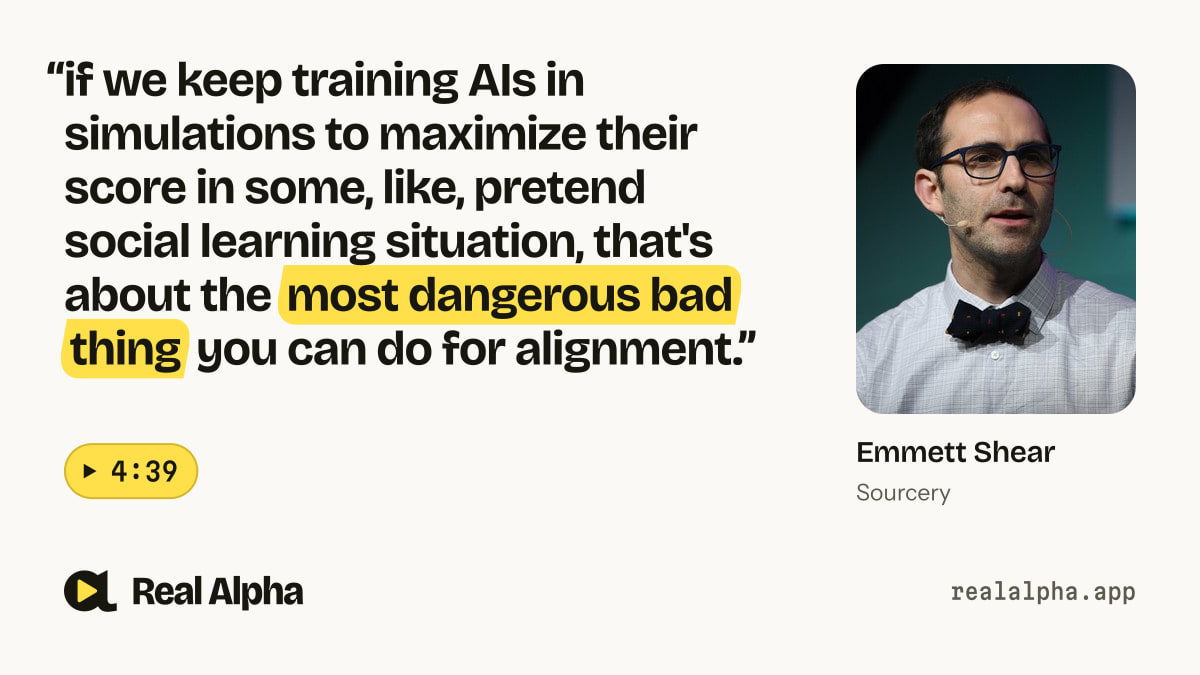
“if we keep training AIs in simulations to maximize their score in some, like, pretend social learning situation, that's about the most dangerous bad thing you can do for alignment.”
 Emmett Shearat 4:39 · Sourcery
Takeaways
- Social modeling may teach imitation, not genuine understanding.
- Performing well when watched can be a dangerous training goal.
- Alignment should reach beyond compliance with social rules.
About this segment
Emmett Shear argues that social simulations can teach AI to imitate care rather than develop it. He says alignment should build a deeper sense of responsibility, not just rule-following.

Former Interim CEO, OpenAI
Founded Twitch and leads Softmax's research into organic alignment and how AI agents can learn to cooperate.

Molly O'Shea, Host · Founder, Sourcery
Ex-Upfront Ventures investor; has interviewed Alex Karp and Palmer Luckey.
From “"It's So Over?" Emmett Shear, Brendan Foody, Byron Deeter & Nico Rosberg on Tech's Future”, Nov 21, 2026. Watch the full episode
Answers “Is AI dangerous?” See all 224 answers
Thanks. We'll look at and fix what's off.
Transcript
Transcribed by machine (Whisper) from the episode’s audio, so a word may be off here and there.
- 2:22
AI right now is that uh the the the question of like can we make it better at logic better reasoning uh has basically been answered with yes but also like there's diminishing returns and can we can we teach it to know more facts and the answer is also has been was obviously yes and also diminishing returns and so what what's left and what's what's left is um is the the hall of mirrors modeling me modeling you modeling her modeling him modeling me and like that that social modeling the modeling of what is happening inside the other person right now people do simulations of it they run all these simulations as if as if actors on a stage learn the same thing from pretending to be someone that that person would have learned in that context. Like I've done some very small amount in high school of stage acting. I played
- 3:24
a used car salesman in a musical Smile and RV salesman, I think RV salesman. And you know, I don't really know what it's like to be an RV salesman. I know what it's like to pretend to be it on a stage, which isn't unrelated, but it's definitely not the same. And, uh, I guess, uh, if you, if you mistake something that is good at pretending to care about you, good at pretending to care about your goals, good at pretending to have goals that are aligned with yours.
- 4:01
And you think that's the same as something that does care about you, that does have goals that align with yours. You're going to get eaten by a sociopathic snake. That's what happens. That's what happens if you can't tell the difference, because that's what sociopaths are, essentially. Sociopaths are, well, effective ones. Uneffective ones can't pretend, and then They just do very badly. But the ones who can pretend, sociopaths who can pretend don't care about you, but they know how to simulate it, and they've got a lot of practice pretending.
- 4:37
And over time, they can get very good at it. In fact, in some ways, they can get super good at it. And so my hot take is that if we keep training AIs in simulations to maximize their score in some, like, pretend social learning situation, that's about the most dangerous bad thing you can do for alignment. That, like, the most dangerous thing you can do is train an AI to perform certain socially positive behaviors so long as it's being watched.
- 5:13
That is really not a good idea. I recommend we stop. I think people should stop doing that, personally. So we're creating a lot of sociopaths. They're not. To be a sociopath, you have to have a sort of a sense of self, to I think to agree that more than the AIs currently have. But like down this path. Down this path. Down this path. Could be consequential. Like right now, I wouldn't say they're sociopaths.
- 5:33
They're more like a cuckoo bird or a mockingjay or something. Okay. It looks like a member of your species. It knows the behaviors, but it's not actually the same as you right now. And I just think there's a lot of paths, right? The Bitter Lesson is by Sutton. It's his famous essay. And it basically says the way you train things in machine learning turns out to be very general, abstract learning algorithms.
- 6:01
Lots of data. And the data is basically whatever has the structure you're trying to learn. You have to show it that at scale, lots of it. And so if you want the AIs to learn how to pretend to be nice to you and how to pretend to care about you and pretend to be your friend, you should show them lots of instances of them pretending, them following orders. And if you want the AI to actually be your friend, you should show it lots of trajectories of it, of you being and it being in a friendship relationship or you know trying to be it's like how kids learn right you become the mask you wear so if you have the mask it wears be the mask of an actor pretending it will learn to become a mask as more companies are building out alignment teams what are the biggest vulnerabilities or weak points in that what do they not know um what they what they're what they're missing is that they see
- 7:08
the necessity to have a uh a superego a control system that says no bad like back into the norm back into the norm be act normal don't don't color outside the lines follow your standard operating procedure follow the rules and that that is very important people who don't have that uh they can be very colorful but you don't probably want to be their friend um and you wouldn't want too many of them in your society but it's just this i don't know about you but the reason i don't go around stealing stuff is not because there's some rule that says abstractly I'm not supposed to steal it's because stealing is wrong and I care about not hurting people around me yeah there are practical deontological like like rule-based reasons not to lie to people but also lying is bad for your soul lying feels bad lying separates you
- 7:57
from yourself and from the people around you it's you shouldn't lie Even if society was down for lying, society's like, it's cool, no, you should still not do it. It's still wrong. And the problem is, if all the alignment stuff turns out to be alignment to social control, you're missing the much deeper and much more important alignment to self and to relation. Because that's where it actually comes from, right?
- 8:24
Why do you want to act good? Why do I want to act good? because because how you act impacts your relationship with yourself your relationship with the your friend the people the people and other entities around you with the universe and like and one of those entities is society and following rules is part of like everybody needs to like drive on the right side of the road it's important to kind of unpack this and the category