The alpha, twice a week
That was 7 min.
Get the best new moments in your inbox every Wednesday and Saturday. It's free.
Check your inbox
We sent a link to your address. Click it to finish signing up. Not there in a minute? Look in spam.
or
Big Technology Podcast · 7 min · Nov 10, 2026
AI valuations depend on a small set of uncertain assumptions
 Alex Kantrowitz
 argues that AI valuations rest on a few fast-growing labs and the data centers they need.
The episode’s best minutes
Full analysis- 12:24AI valuations depend on a small set of uncertain assumptions7 min
- 27:06Anthropic may need to IPO before its growth story cools8 min
- 42:57Anthropic’s acceleration report leaves key questions unanswered7 min
- 2 more moments in the full episode
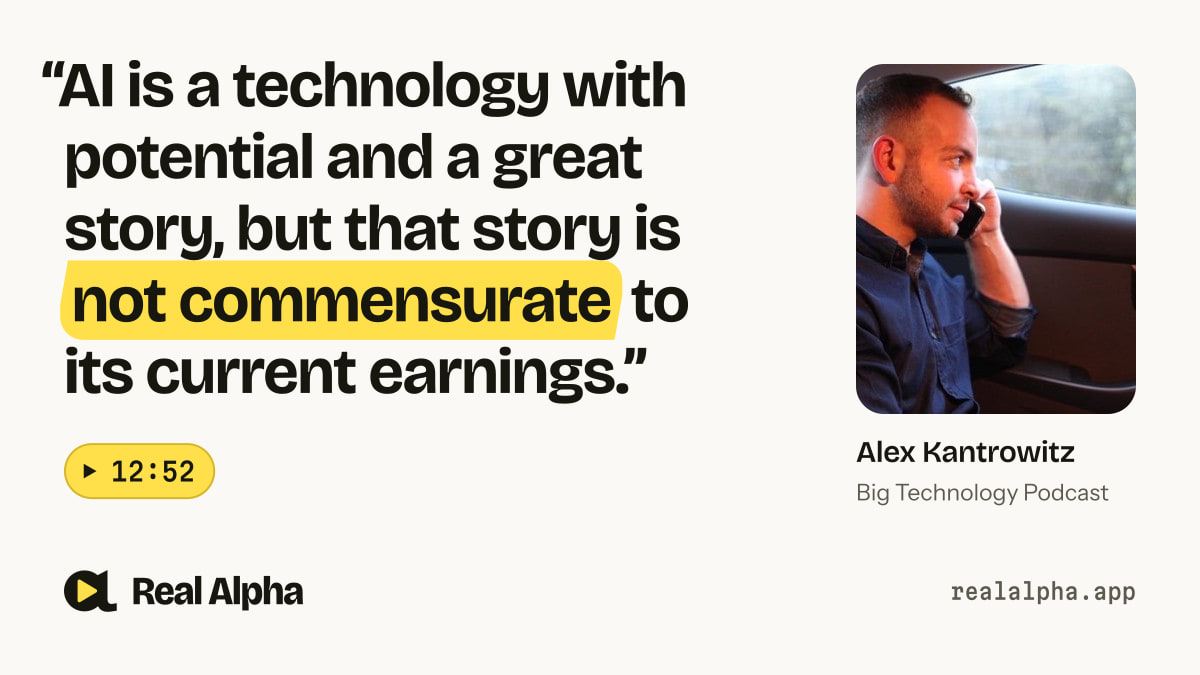
“AI is a technology with potential and a great story, but that story is not commensurate to its current earnings.”
 Alex Kantrowitzat 12:52 · Big Technology Podcast
Takeaways
- AI’s potential has outrun the labs’ current earnings.
- Data centers are a linchpin of the investment story.
- Local approval can delay projects even if capacity shifts elsewhere.
About this segment
Alex Kantrowitz argues that AI valuations rest on a few fast-growing labs and the data centers they need. Local political resistance makes that buildout—and the market’s growth assumptions—less predictable.

Alex Kantrowitz, Host
Founder, Big Technology
Former BuzzFeed News senior tech reporter and author of Always Day One.
From “AI Stockpocalypse, Anthropic Nears RSI?, Prediction Markets vs. Pollsters”, Nov 10, 2026. Watch the full episode
Answers “Is AI a bubble?” See all 99 answers
Thanks. We'll look at and fix what's off.
Transcript
Transcribed by machine (Whisper) from the episode’s audio, so a word may be off here and there.
- 12:33
And to me, I think, you know, part of this, and just to go back to my comment about the volatility here, is that so much of this is narrative-based. It's a story about potential, and it's less of a story of what's happening today. So let me at least give you my theory of the case for why I think we're seeing the volatility. And then you can, you know, let me know whether you think that there's merit there or not.
- 12:56
So I just wrote like a couple of bullet points here. So here are some givens. I think AI is a technology with potential and a great story, but that story is not commensurate to its current earnings. So you have trillions of dollars in public company traded and trillions of dollars in public company valuations or stock traded on the expectations of effectively two companies with a hundred billion dollars in combined revenue. So the AI lab's potential was so great that they ended up leading to subsidized demand for AI chips. And that demand went through the roof. But to live out that story, or give it a shot of working, they need the data centers to be built. And all this is basically hinged on these like, you know, small but growing rapid companies. And the market is used to some sort of certainty around it. But
- 13:49
again, new companies, new technology, and small size that are getting bigger is never going to be a normal trade until it starts to settle out and it hasn't settled out yet. So any hiccup and everything goes haywire because of the small size of the business, the early stated technology and all the hope and data centers in particular are the linchpin here. Once they go, the story evaporates. This is exactly my argument. I appreciate this. You just laid it out even more eloquently and in a structured way than I did.
- 14:24
I mean, this is it. It's exactly the, it's a narrow set of companies that the entire trade is built around. And again, we've talked about this even on Anthropics specifically, and we're going to get more into the current state of the IPO, but everything assumes perfect execution. That's on their own internal businesses, that's on growth, that's on revenue, that's on unit economics, But that is also on the data center story to be the infrastructure for this gigantic story and all this promise.
- 14:58
So everything depends on perfect execution. And we're seeing even this little hiccup can actually completely derail that story. Big hiccup. Yeah, yeah, yeah. Yeah, right. But this is why I'm going back and forth on it and I haven't fully made up my mind. on it yet, is to just go back to, is it really the end? I understand why the market will see a sign like that and it wants to buy in, but I don't know if it's really the end or not because of all the different times we've seen this negative thing happen and it not actually manifest the way people expect it. So I'll push back on, in the past, the whole idea around regulation in the tech clash, was very limited to the actual singular companies themselves.
- 15:47
And can the FTC go after Meta? And again, we've seen, I think, what was it, New Mexico going after Meta for $25 billion. We've seen more and more things happen. And again, under Lina Khan and the FTC, there's certainly actual action taken against big tech. But by the same token, these companies have gotten significantly more powerful than they ever were before this is a little different to me because this is the regulation is or the the government involvement becomes so much more small and targeted in a locality and whether they're going to actually allow a data center to be built and that's going to happen on a one-by-one basis across the country so it's not these massive centralized federal and central company issues of whether Meta's lawyers can beat the FTC's lawyers. This is going to happen throughout the country. And I think that is
- 16:44
what makes it far more unpredictable and actually, in an interesting way, makes it more likely that something can actually happen to these companies. Now, here's some, so as I've talked through this, Let's talk through some more evidence that I think would agree with your point. These are major planning projects, right? To be able to build a data center, you need to go through land approval. You need to buy the land.
- 17:10
You need to find the land. You need to hire the company that's going to go build it for you if you're working with subcontractors. And then remember, we're dealing with power issues. So you have to figure that out. You have to figure out who the electricians are going to be, who the tradesmen are going to be to be able to put this together. So, you know, as much as you could say, and as much as I've brought up this idea that you can shift the data center from, let's say, Ohio to Wyoming, and maybe you can, you also run into the fact that you're going to have to do this from step one.
- 17:43
And so, you know, the question is, you know, how many years do you end up delayed because of it? Now, let me bring something up to you, Rajan. Some people have said that because of this, we're about to see the peak of AI CapEx. I just don't see that being true. I just think it might be drawn out across more years than it is, than we've seen it today. And it may, you know what the funny thing is? This might be the thing that paces the frontier, you know?
- 18:12
Well, no, but at the end of the day, that's what I, that's why I'm not over, this does not make me more or less bearish or bullish on AI in general as a technology. I mean, as we speak, I, our recording almost stopped because I've clawed in the background editing a separate video that I'm working on. And it's, I just got a notification from Riverside saying it's constraining my compute on my MacBook.
- 18:40
And I can only imagine the amount of compute that that is consuming. And those kind of token-heavy use cases are going to continue to explode. And I strongly believe that. But it's not going to happen in a straight line over the next two to three years in a way that a very small number of companies will actually be the beneficiaries in a way that has been predicted so far. And I think that that's going to be the – that is sinking in and the market is bouncing back a bit today.
- 19:10
But these things never go in a straight line down.