The alpha, twice a week
That was 3 min.
Get the best new moments in your inbox every Wednesday and Saturday. It's free.
Check your inbox
We sent a link to your address. Click it to finish signing up. Not there in a minute? Look in spam.
or
Big Technology Podcast · 3 min · Nov 16, 2026
AI will change most jobs more than it eliminates them
 Mike Cannon-Brookes
He expects AI to reshape roles more than erase them, using bank branches as a precedent.
The episode’s best minutes
Full analysis- 2:31AI will change most jobs more than it eliminates them3 min
- 9:26Agents need distinct modes for delegation and collaboration3 min
- 19:05Headless software still needs a strong user interface3 min
- 4 more moments in the full episode
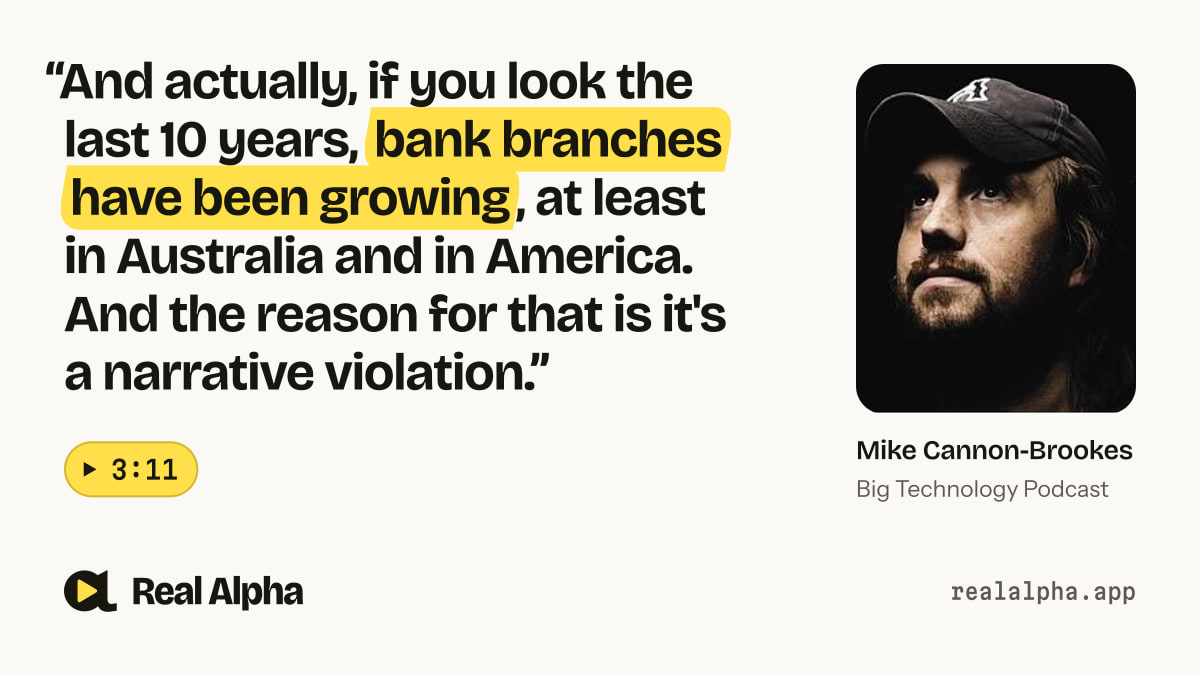
“And actually, if you look the last 10 years, bank branches have been growing, at least in Australia and in America. And the reason for that is it's a narrative violation.”
 Mike Cannon-Brookesat 3:11 · Big Technology Podcast
Takeaways
- Job change is more likely than a simple jobs-lost/jobs-gained split.
- Bank branches grew after digitization by changing their customer role.
- Companies should adapt roles before competitors use AI more effectively.
About this segment
He expects AI to reshape roles more than erase them, using bank branches as a precedent. Digitization changed what branches do rather than making them disappear.

Mike Cannon-Brookes is CEO of Atlassian.
Co-founded Atlassian and built it into a global collaboration software company serving more than 300,000 organizations.

Alex Kantrowitz, Host · Founder, Big Technology
Former BuzzFeed News senior tech reporter and author of Always Day One.
From “Atlassian CEO: How Humans Will Work Alongside AI Agents — With Mike Cannon-Brookes”, Nov 16, 2026. Watch the full episode
Answers “Which jobs will AI replace, and which are safe?” See all 241 answers
Thanks. We'll look at and fix what's off.
Transcript
Transcribed by machine (Whisper) from the episode’s audio, so a word may be off here and there.
- 2:35
I think the restructuring answer is probably far more accurate. I think, look, my view is net-net. Firstly, anyone who tells you they know what's going to happen in the next five years, you probably shouldn't believe them. But my view is net-net, it'll create far more jobs than it changes. There'll certainly be quite a lot of job change. I think we focus on this binary state of lose a job, gain a job, versus the nature of a lot of jobs is changing.
- 3:02
The best parallel for this, I always think, is bank branches. It sounds like a weird proxy, but back in the 2000s, everyone said all these bank branches were going to close, online banking, mobile banking, it was all going to disappear. And actually, if you look the last 10 years, bank branches have been growing, at least in Australia and in America. And the reason for that is it's a narrative violation.
- 3:23
But bank branches don't do, in 2026, what they did in 2000. They do vastly different jobs for the customer. The customer service is way more important. You change massively what that asset is for. I think you're going to see the same thing with AI and jobs. Most people's jobs right now probably have changed a tiny bit in terms of how they get whatever their output was Done, I suspect that continues to change progressively over time. So the question is like will we still have software developers yet?
- 3:53
Yes. Will they work the same way in five years from now as they did five years ago? Absolutely not. Will we still have designers or marketers or finance professionals? The answer to all these questions is yes. Those jobs will be done very differently. Secondly, the ratio between the different job families or crafts may change, right? There's lots of views about how that's going to change. I listened to one podcast where they had a product manager basically saying he thought there'd be many more product managers and many less engineers. And the engineer said, look, I think there'll be many more engineers and many less product managers.
- 4:24
And so the answer is, we'll see. And so I think from your answer, what you're saying is, the question of will AI kill jobs is sort of less interesting. Really, the question should be how it will change jobs. Absolutely, yes. It's how, and I think for companies that are looking to harness AI, the question is, how am I changing the jobs that I have before some other company comes along and does what I do better because they're embracing these technologies, right?
- 4:50
Right. I always love the line that I'm not afraid of losing my job to AI. I'm afraid of losing my job to someone who's really good at using AI to do my job. And I think that's the way most companies should be thinking. And that's hard. Changing the way that people think, their historical priors, is a very difficult challenge for most companies.