The alpha, twice a week
That was 4 min.
Get the best new moments in your inbox every Wednesday and Saturday. It's free.
Check your inbox
We sent a link to your address. Click it to finish signing up. Not there in a minute? Look in spam.
or
Knuckle Up with Nakul · 4 min · Sep 9, 2026
AI will raise customer expectations, not shrink company teams
 Arvind Jain
 argues that AI tools will be available to competitors too, so companies will need to do more to keep winning.
The episode’s best minutes
Full analysis- 27:54AI gives Jain strategic visibility he could not get before5 min
- 24:02AI will raise customer expectations, not shrink company teamsPro pick 4 min
- 41:51Fast innovation makes product moats feel temporaryPro pick 4 min
- 5 more moments in the full episode
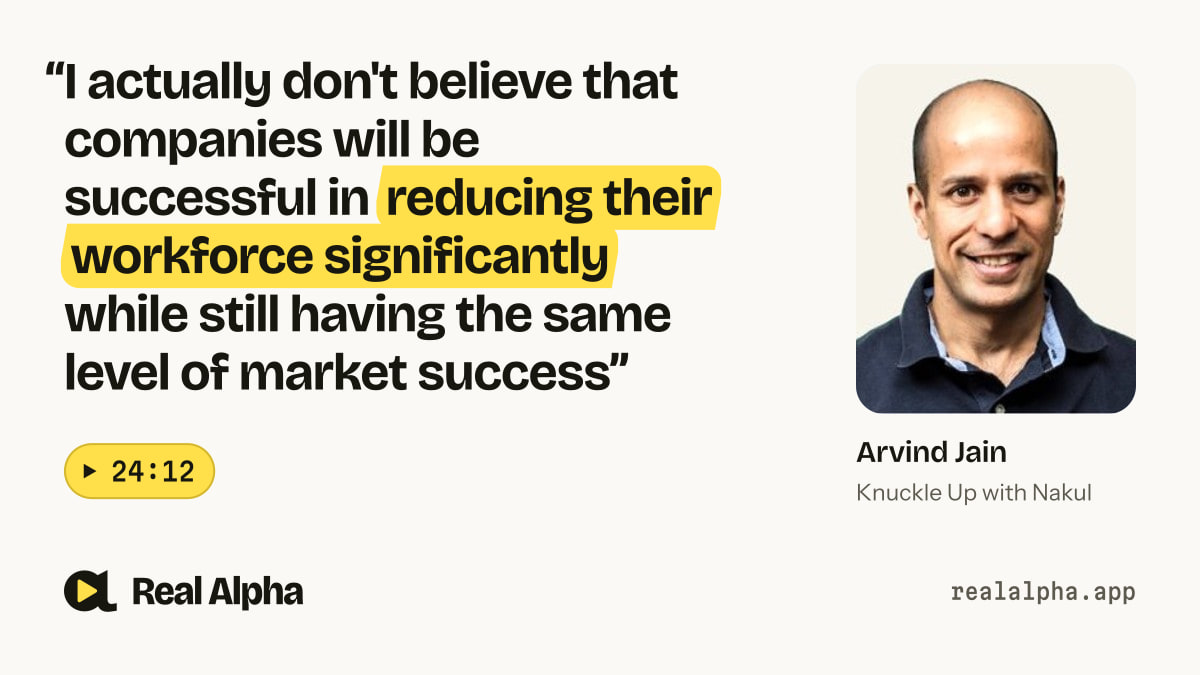
“I actually don't believe that companies will be successful in reducing their workforce significantly while still having the same level of market success”
 Arvind Jainat 24:12 · Knuckle Up with Nakul
Takeaways Pro pick
- Shared access to AI means competitors can also cut costs.
- Higher customer expectations will keep demand for strong teams.
- People will shift toward choosing work and directing AI.
One of Pro's picks, open to you here. Try Pro free for 7 days
One of Pro's picks. The rest of the summary and the 3 takeaways are in Real Alpha Pro; the video, the quote and the transcript stay free.
Read it with Pro, 7 days freeAbout this segment
Arvind Jain argues that AI tools will be available to competitors too, so companies will need to do more to keep winning. He expects work to change, but not a broad shift to shorter workweeks.

Arvind Jain is founder and CEO of Glean.
Founded Glean, the AI work assistant, after co-founding and leading R&D at Rubrik and a decade at Google.

Nakul Mandan, Host · Host, Knuckle Up with Nakul
General partner at Audacious Ventures; his show goes deep with founder CEOs on how they build.
From “$7B AI founder: "AI is not capable of replacing you right now" | Arvind Jain (CEO, Glean)”, Sep 9, 2026. Watch the full episode
Answers “Which jobs will AI replace, and which are safe?” See all 132 answers
Thanks. We'll look at and fix what's off.
Transcript
Transcribed by machine (Whisper) from the episode’s audio, so a word may be off here and there.
- 24:08
Yeah. Do you feel like almost like a revolution is coming where companies quickly identify that 80% of the work is done by 5% people because they've supercharged themselves? I actually don't believe that companies will be successful in reducing their workforce significantly while still having the same level of market success or the share of the market. Because if you think about it, take an industry and if you are one of the companies in that, and there are four competitors, all five of you have the same tools.
- 24:42
All of you have all the great AI capabilities. if you can actually do the work that needs to get done with half as many employees so could they in reality what's going to happen is that your customer expectation expectations are going to double you have to sort of build better products stronger products and you're still going to need that same staffing to do that in fact like your ultimately the business success is indeed proportional to you know the human sort of capital that you have inside the company so that's that's that's my beliefs. I would like take a different stance, like, you know, where I do believe that this power law will change. Take, take calculator. Does everybody know how to use it today equally well? Right. And I think that's what's going to happen with AI. So it won't be that 5%, like who
- 25:27
have figured it out and the 95% haven't because AI itself will be that great teacher. The thought that is expressed, I think Elon Musk has expressed this, Scott, who recently expressed this in some interview that we have gone we are going as a human race from survival mode where we're all doing work to creativity mode where it's an age of abundance because agents do all the work it sounds like you're saying correct me if I'm wrong that that's not very imminent it might be some futuristic vision but in the near future everybody will be just more productive more work will be expected and competition will take care that everybody will still need their people I think so.
- 26:04
I mean, it is true that, you know, as such, you know, we are moving in the world of abundance. There will be enough food for everybody to feed and all of that. But yes, like, you know, as a business, the competition is going to, you know, increase. Like, I really sort of don't see this world where somebody can build a very flourishing, great business where their people only work two days a week and the competition actually works, you know, five days a week.
- 26:27
I don't actually know how the workday comes down from five to four to three and a half that everybody's talking about because, you know, like companies are going to immediately see that as a competitive edge. I would want our team to be fully, you know, motivated and energetic and actually keep working, you know, the schedule that they are today. But does the human work evolve from doing to reviewing mostly?
- 26:49
Human work completely changes across different functions. A lot of knowledge work is going to be done by AI for you. You don't need to sort of, for example, do information synthesis. Like, you know, you can actually get AI to do all of that work. So I think like, you know, our work will shift more to asking the right questions, actually, you know, thinking about what are the things, you know, we should be working on.
- 27:14
And then as AI, you know, acts as a very powerful companion to us, it's sort of like, I would say, think of it as, you know, now, instead of being an individual contributor, I have, I have like, you know, 10 really, really good people, you know, available to me.