The alpha, twice a week
That was 3 min.
Get the best new moments in your inbox every Wednesday and Saturday. It's free.
Check your inbox
We sent a link to your address. Click it to finish signing up. Not there in a minute? Look in spam.
or
Newcomer Pod · 3 min · Nov 17, 2026
AI's market could dwarf the cloud cycle
 Byron Deeter
 compares the AI 100 with Bessemer's Cloud 100 and explains why AI's market can dwarf the cloud cycle.
The episode’s best minutes
Full analysis- 7:13A small share of labor could justify AI's buildout2 min
- 4:32AI value may shift from models to applicationsPro pick 3 min
- 14:48AI's market could dwarf the cloud cycle3 min
- 2 more moments in the full episode
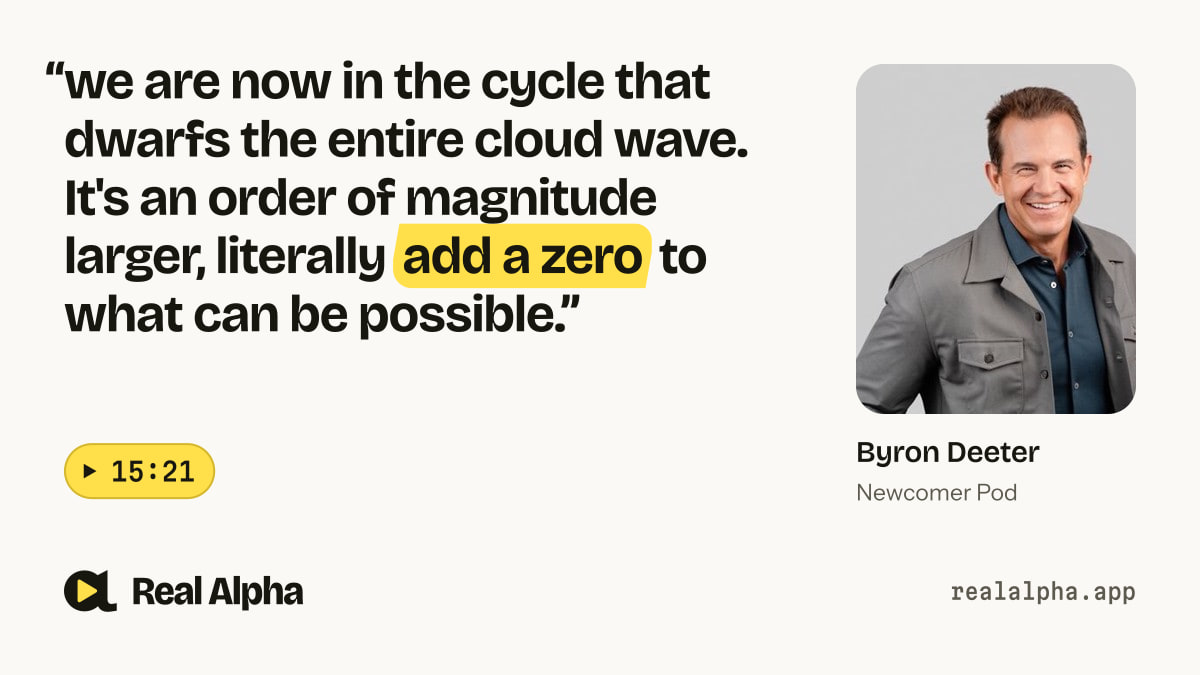
“we are now in the cycle that dwarfs the entire cloud wave. It's an order of magnitude larger, literally add a zero to what can be possible.”
 Byron Deeterat 15:21 · Newcomer Pod
Takeaways
- The first Cloud 100 was worth about $99 billion in total.
- The AI 100 now totals $3.6 trillion in value.
- Some AI leaders have high revenue; others have none yet.
About this segment
Byron Deeter compares the AI 100 with Bessemer's Cloud 100 and explains why AI's market can dwarf the cloud cycle. He also describes the valuation tension between revenue-rich infrastructure and pre-revenue frontier bets.

Partner, Bessemer Venture Partners
Co-authored Bessemer’s AI 100 and Cloud 100; backed 26 companies now valued above $1 billion.
- EN
Eric Newcomer, Host · Newcomer
From “Bessemer on the $3.6 Trillion AI Startup Race”, Nov 17, 2026. Watch the full episode
Thanks. We'll look at and fix what's off.
Transcript
Transcribed by machine (Whisper) from the episode’s audio, so a word may be off here and there.
- 14:54
Yeah, what made you decide to say, okay, have the companies changed or the brand changed? And how did you think about making that shift? Yeah, I've been part of the software industry for decades now. Cloud was the macro cycle of the last decade. And in 2016, we published the first cloud 100. Last year was the 10th anniversary of that list. And the inaugural value of that list was $100 billion, $99 billion.
- 15:24
As you think about the list and the evolution of the cycles, we are now in the cycle that dwarfs the entire cloud wave. It's an order of magnitude larger, literally add a zero to what can be possible. Already, the value of these companies are 36x. The sum total of this list is $3.6 trillion. The mean value, therefore, is $36 billion. of a company on this list. And that just shows that when you went from democratizing compute in the cloud wave to now democratizing intelligence in the AI wave, the markets are entirely different.
- 15:56
And this is that next super cycle that we're going to experience. It's in tech, in software, and in business. There was something that felt, perhaps incorrectly, solid about a cloud list, where it's like recurring revenue. People knew how to value them. You look at the AI 100, they're much more valuable collectively. But, you know, companies we're interested in, like Mercore, where it's like helping AI training runs get smarter and smarter.
- 16:21
It's like, will that be a strong business forever? And then, obviously, there are labs where some of them are almost pre-revenue. I mean, Prometheus. I'm afraid to even say it, but you're like, Eric, they are free revenue. Literally infinite multiples of revenue. But I think you actually, you highlight the extremes very well, which is the neoclouds, the, you know, the training data sets, which have extremely high revenue numbers, but perhaps the market is questioning durability.
- 16:48
And then you have these really bold physical AI, foundation models, et cetera, you know, bio labs that are doing things that are valued in the billions that have fantastic founding teams, but have zero revenue. and in some cases won't have revenue for a while, but deserve to be on the list, you know, an isomorphic as an example. And so you get in these, which does have revenue, but, you know, it's a high multiple on revenue or, you know, Mind Robotics or Pi, Physical Intelligence, those sorts of companies. And so that's where market leadership, that's where some of those variables weigh in to how the market values them and how the list ranks them.