The alpha, twice a week
That was 5 min.
Get the best new moments in your inbox every Wednesday and Saturday. It's free.
Check your inbox
We sent a link to your address. Click it to finish signing up. Not there in a minute? Look in spam.
or
My First Million · 5 min · Oct 28, 2026
Amazon Prime began as a 100-day response to a weak quarter
 Ethan Evans
 traces Prime from a looming weak quarter to Project 100, then explains how free-shipping experiments shaped its economics.
The episode’s best minutes
Full analysis- 35:52Bezos passed on crowded, regulated markets6 min
- 45:28Amazon Prime began as a 100-day response to a weak quarter5 min
- 18:49Bezos used customer complaints to drive fast accountability3 min
- 5 more moments in the full episode
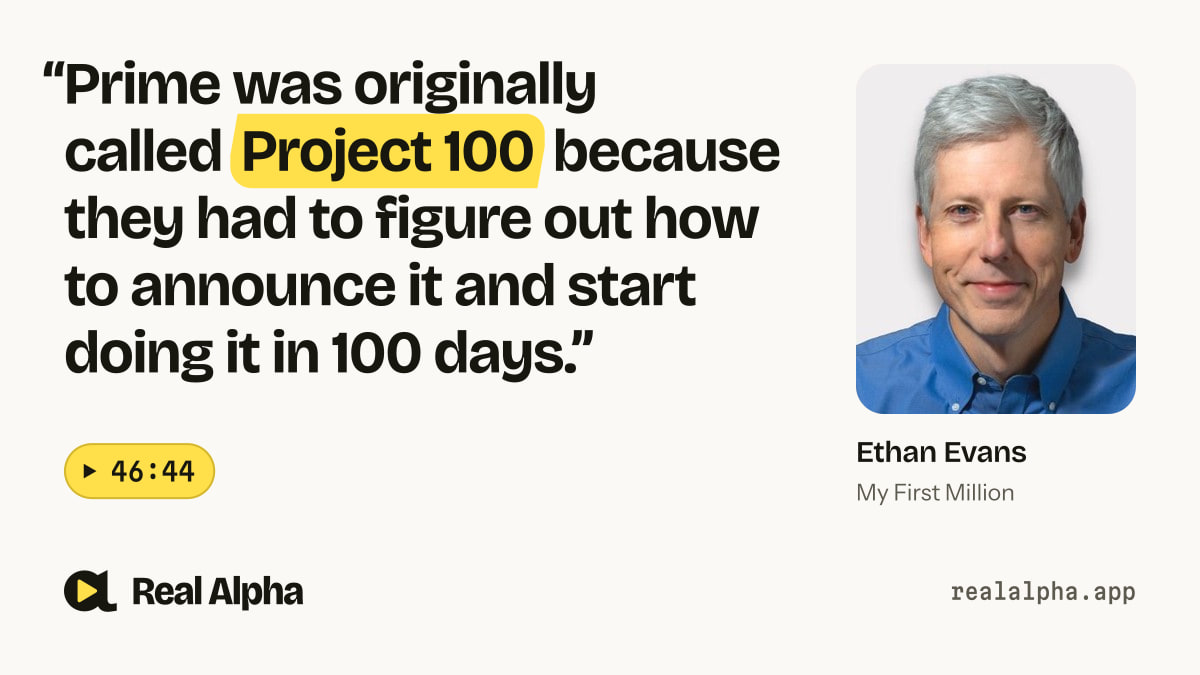
“Prime was originally called Project 100 because they had to figure out how to announce it and start doing it in 100 days.”
 Ethan Evansat 46:44 · My First Million
Takeaways
- Prime was built on a 100-day launch timeline.
- The first version focused on fast delivery, not perks.
- Free shipping thresholds helped make the economics work.
About this segment
Ethan Evans traces Prime from a looming weak quarter to Project 100, then explains how free-shipping experiments shaped its economics. The story shows how customer value and unit economics evolved together.

Ethan Evans is a former Amazon VP and executive coach.
Invented Prime Video, Amazon Appstore and Prime Gaming, and led global teams of 800+ during 15 years at Amazon.

Shaan Puri, Host · Co-host, My First Million
Sold Bebo to Twitch in 2019; co-founded the crypto newsletter Milk Road.

Sam Parr, Host · Co-founder, Hampton
Founded the business newsletter The Hustle and sold it to HubSpot.
From “Ex-Amazon VP: What it's really like working with Jeff Bezos”, Oct 28, 2026. Watch the full episode
Thanks. We'll look at and fix what's off.
Transcript
Transcribed by machine (Whisper) from the episode’s audio, so a word may be off here and there.
- 45:39
That starts somewhere. It does. It starts with an idea. So were you there? What was it? Uh, I joined Amazon right after Prime. I've met the engineer who may still be at Amazon. You can, one of you can Google in the background. His name is Charlie Ward. Charlie Ward, who became a VP at Amazon claims that as a principal engineer, he invented the idea of Amazon Prime. I believe Jeff Bezos also claims that Jeff himself invented it. So I don't know if they had the same idea at the same time, or, you know, if there's a little appropriation going on there. Well, it wasn't that unique, right?
- 46:14
Like Costco, like. Well, there's multiple things, right? Was the initial thing just, hey, there's a membership with perks or was it two day? Hey, what if we could do two day shipping? That'll change everything. So originally there was supposed to be no perks. It wasn't a perk based program. It was purely a fast shipping program. That was the initial idea. And I think the biggest thing that would be interesting is Jeff was about to have a shitty quarter and he could see things lining up.
- 46:44
It was right after the internet crash kind of instilled a bubble. He could see the quarter wasn't going to be what Wall Street wanted. And so he said, we need something. And so Prime was originally called Project 100 because they had to figure out how to announce it and start doing it in 100 days. It's not a two-day shipping program. It's a two-day delivery program. And you might be like, what's the difference?
- 47:10
That's a distinction without a difference. Jeff figured out, we're going to call it two-day delivery. It began with a lot of FedEx two-day shipping, but he knew over time he'd get down to where two days he could do often one day through the post office or one day on his own trucks. And it never told you the shipping method. So the origin anyway was Jeff trying to have good news to tell investors in a rough time.
- 47:37
because back then he wasn't Jeff Bezos, the inevitable tycoon. He was still Jeff Bezos, the dot-com, maybe dot-bomb guy. In any case, whether it was from him or from Charlie, there was this thing at Amazon, you'll love this, it was called the Idea Tool. And anybody could put any idea into the Idea Tool and Jeff would sometimes look at them and maybe others and some of them would get done. Charlie put a description of a rapid shipping program into the Idea Tool.
- 48:07
And then presto, 100 days later, you have the launch of Amazon Prime. The idea of adding ancillary benefits to it, perks, came later. Well, even the fast shipping thing, okay, that sounds not controversial, but nobody was doing it. And I think nobody was doing it because it was going to be expensive. You'd lose money. and so there had to be some strategic rationale or some big picture vision or some clever hack to make that pencil out when it wasn't clear that it would pencil out, right?
- 48:39
Yeah, well, Jeff was willing to lose money for a long time, but the big joke at Amazon for a long time was, oh yeah, we lose money on every unit, but we'll make it up in volume, which of course, on straight math, you're just gonna lose more money. But of course, with economy of scale and potentially the evolution of time, things like Moore's Law or whatever, you can shift the unit economics so that you can do that.
- 49:06
Prime had a trial run that you're not thinking of or recalling. And that trial run was simply free shipping. Before there was Prime, Jeff had a big argument again with this other guy, Jeff Wilkie, who was the Walmart guy, where he said, look, we have to figure out a way to do free shipping. And Wilkie said, yeah, but Jeff, shipping costs money. Like, it's a thing. We actually pay for that. So Jeff said, but my customers hate paying for shipping.
- 49:33
So we got to figure out how to do it. Well, probably from Freakonomics, you know a lot of the story because it's been documented. But the key thing is what they did is when that very first came out to get free shipping, you had to pay $100. And they realized like, oh, okay, at $100, we can put enough stuff in a box to get enough profit to give the shipping away. And then they started carving away.
- 49:57
So if you actually look at the history, it went 100, 75, 50, then 25. And it sat at 25 for many, many years. And the secret they figured out by experimentation was at that point in time, the big things we shipped, I mentioned, were books, music, DVDs. $25 was this magic number that meant you had to buy two. You had to put two things in the box. And what they figured out was there wasn't enough profit in a single DVD to cover the shipping and still be in business. But if you could put two or more in the box, DVDs, CDs, some mix, there was enough profit to ship it for free. So Prime was an outgrowth already of having figured all that out and seeing like, oh, we can figure out how to ship for free.