The alpha, twice a week
That was 3 min.
Get the best new moments in your inbox every Wednesday and Saturday. It's free.
Check your inbox
We sent a link to your address. Click it to finish signing up. Not there in a minute? Look in spam.
or
Big Technology Podcast · 3 min · Nov 2, 2026
Amazon's 39% AWS growth still did not calm investors
 Alex Kantrowitz
AWS grew 39% year over year, yet investors remained uneasy about AI spending.
In this episode
Full analysis- 34:03Anthropic's margins need compute-discount disclosurePro pick 8 min
- 7:31AI answers weaken Google's old traffic bargain5 min
- 47:02More efficient models could weaken data-center economicsPro pick 4 min
- 42:16Anthropic's earliest hires could receive nine-figure IPO payouts4 min
- 18:06Amazon's 39% AWS growth still did not calm investors3 min
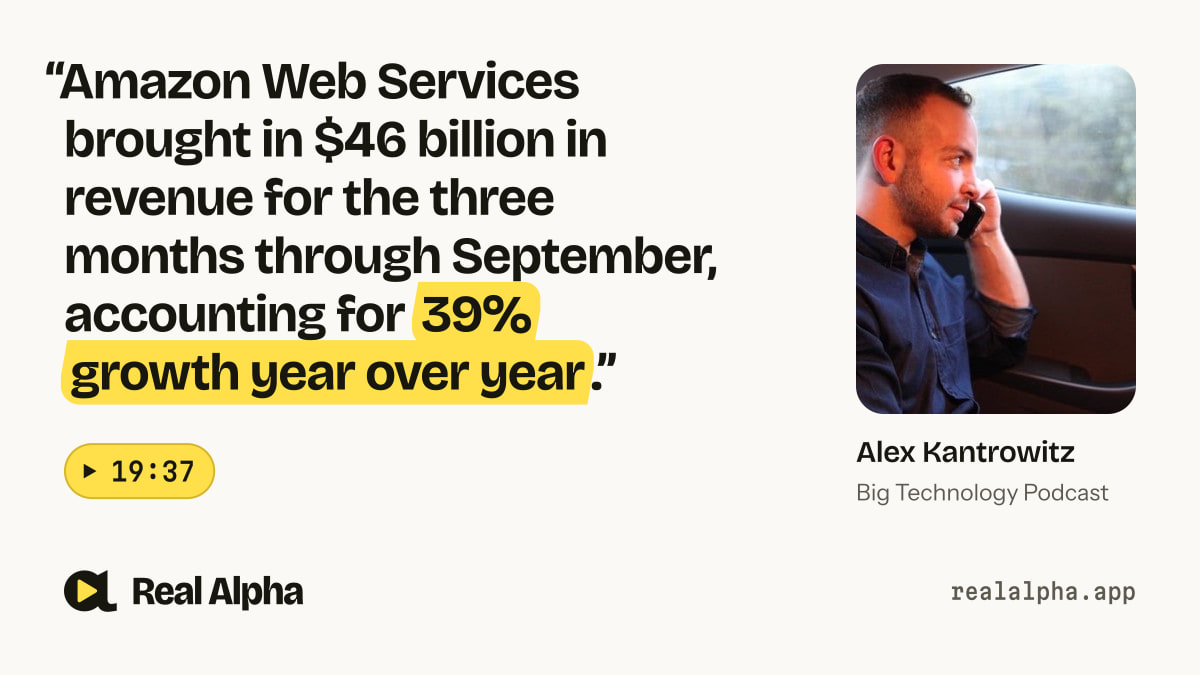
“Amazon Web Services brought in $46 billion in revenue for the three months through September, accounting for 39% growth year over year.”
 Alex Kantrowitzat 19:37 · Big Technology Podcast
Takeaways
- AWS generated $46B in quarterly revenue, up 39% year over year.
- That growth did not erase concern about Amazon's AI investment.
- Groceries and everyday essentials made up half of retail units sold.
About this segment
AWS grew 39% year over year, yet investors remained uneasy about AI spending. Roy also notes that groceries and everyday essentials made up half of Amazon retail units.

Alex Kantrowitz, Host
Founder, Big Technology
Former BuzzFeed News senior tech reporter and author of Always Day One.
From “Big Tech's Ugly Week, Getting Rich At Anthropic, AI Costs Plunge”, Nov 2, 2026. Watch the full episode
Thanks. We'll look at and fix what's off.
Transcript
Transcribed by machine (Whisper) from the episode’s audio, so a word may be off here and there.
- 18:13
The most interesting part of it, I think this week was the moment that investors are recognizing these companies are betting on being a different business. We said they're disrupting themselves, but do you think that's what's happening? They are betting on being a data center, compute provider business, which have unproven economics, which maybe they will win. They're very well positioned to win, but no one knows what they look like.
- 18:41
Almost, I have to imagine definitively, there's no way a compute provider business model has the same attractive economics as search advertising. Do you think that's what's happening? Well, again, you take certainty. versus uncertainty. Uncertainty is, you know, this search advertising business is working well and uncertainty is your cloud business is going to power an uncertain AI, you know, takeoff.
- 19:09
So that's the sort of, you factor in the risk and you make your decision. And then the other companies, like Amazon was very interesting, by the way. So this is from the Wall Street Journal, Amazon stock drops on Wall Street miss despite biggest cloud growth in years, right? So you would think that if the investors, well, you know, you're right. Investors are seeing these companies go in this different direction, and they're not buying in 100%, which is very interesting.
- 19:36
Amazon.com reported its highest revenue growth for Amazon Web Services in years. That wasn't enough to quell investors' concerns about artificial intelligence. Amazon Web Services brought in $46 billion in revenue for the three months through September, accounting for 39% growth year over year. Think about the retail business. The retail business is, and by the way, overall revenue increased 12% to $201.9 billion.
- 20:02
The retail business is, it's amazing because Amazon.com was seen as like this, and it really was a revolutionary invention for better or worse, right? It is sort of a cornerstone of the early internet and today, but it is changing in nature. Listen to this. Groceries and Amazon's everyday essentials accounted for half of units sold on its retail website in the quarter. Again, it's everyday essentials from Amazon, which are effectively white-labeled products of like all these other products that you use in the house.
- 20:37
And groceries, half of the units sold on the retail site in the quarter. So Amazon as the everything store is really, it's a little bit different now. What didn't you say? Well, overall unit, half of units, I feel is a bit misleading because if these are cheaper products that are- So each cucumber counts as like a- Yeah. Yeah. When you do a Whole Foods order, they're going to count it. But they want to show growth there because that's like a habitual purchase.
- 21:05
So I think that's what they're trying to show with that. That's like kind of a, feels like a bit of a massage number to investors. But I have to say, do you know what the crazy thing?