The alpha, twice a week
That was 4 min.
Get the best new moments in your inbox every Wednesday and Saturday. It's free.
Check your inbox
We sent a link to your address. Click it to finish signing up. Not there in a minute? Look in spam.
or
a16z Podcast · 4 min · Dec 8, 2025
Analog computers use physics to compute more efficiently
 Naveen Rao
 explains why digital computing scaled and how analog systems compute by using a physical medium.
The episode’s best minutes
Full analysis- 4:51Analog computers use physics to compute more efficientlyPro pick 4 min
- 9:13AI’s energy demand makes computing efficiency urgent3 min
- 15:57Rao thinks time and causality could bring AI closer to AGIPro pick 3 min
- 2 more moments in the full episode
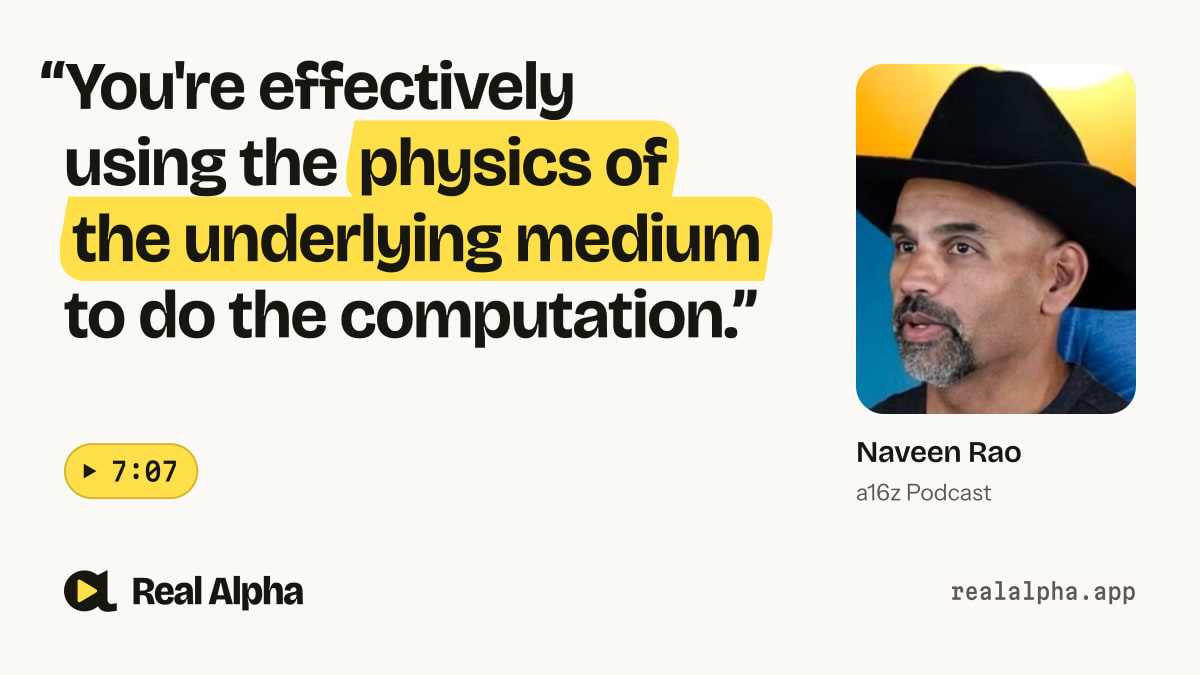
“You're effectively using the physics of the underlying medium to do the computation.”
 Naveen Raoat 7:07 · a16z Podcast
Takeaways Pro pick
- Digital computing scaled because high-or-low states were reliable to manufacture.
- Analog systems compute through the physics of their medium.
- Rao sees intelligence as stochastic and distributed, not purely deterministic.
One of Pro's picks, open to you here. Try Pro free for 7 days
One of Pro's picks. The rest of the summary and the 3 takeaways are in Real Alpha Pro; the video, the quote and the transcript stay free.
Read it with Pro, 7 days freeAbout this segment
Naveen Rao explains why digital computing scaled and how analog systems compute by using a physical medium. Intelligence may fit a less precise, more distributed substrate better than traditional calculations do.

Naveen Rao is cofounder and CEO of Unconventional AI.
Co-founder and CEO of Unconventional AI; founded and sold Nervana Systems to Intel and MosaicML to Databricks.
- MB
Matt Bornstein, Host · a16z
From “The Chip That Could Unlock AGI.”, Dec 8, 2025. Watch the full episode
Thanks. We'll look at and fix what's off.
Transcript
Transcribed by machine (Whisper) from the episode’s audio, so a word may be off here and there.
- 5:03
true in all of humanity. And so for those of us who aren't experts, can you describe the difference between digital and analog computing systems? And like, why do you think the architecture has evolved the way it has sort of more digital focus over decades, as you said? Yeah, I mean, very simply, digital computers implement numerics and numerics with some sort of estimation, right? I I mean, in a digital computer, a number is represented by a fixed number of bits.
- 5:39
And that has some precision error and things like this. It's just a way we implement the system. If you make it enough bits, like 64 bits, you can largely say that maybe the error is small. You don't have to think about it. And so the digital computer is capable of simulating anything that you can express as numbers and arithmetic. So it became a very general machine. I can literally simulate any physical process.
- 6:01
All of physics, we try to do computational physics, right? I have an equation. I can then write numeric solvers that sort of deal with those imprecisions in the number of bits. And so this became obviously computer science, the entire field now. And we went that direction actually very early on because we couldn't scale up computation. It's actually kind of an interesting conversation if you look from back then, not that I was there, of course, but if you look at the papers and things, they actually look very similar to today in terms of scaling up GPUs.
- 6:29
Analog computers were actually some of the first computers, and they worked really well. they're very efficient, but they couldn't be scaled up because of manufacturing variability. So someone said, oh, okay, you know what? I can actually say I can make a vacuum tube behave as a higher low, very reliably. I can't characterize the in-between very well, but I can say it's higher low. And so that was kind of where we went to digital abstraction. And then we could scale up.
- 6:52
ENIAC, which was built in 1945, had 18,000 vacuum tubes. So 18,000 is kind of similar to how many GPUs people use now, right, for large-scale training. So scaling things up is always a hard problem. And once you figure out how to do it, it makes a paradigm happen. And I think that's why we went to digital. But analog still is inherently more efficient because it's actually analogous computing is the way to think about it. Like, can I build a physical system that is similar to a quantity I'm trying to express or compute over? You're effectively using the physics of the underlying medium to do the computation.
- 7:25
And so in digital computers, we have transistors. Just to make it sort of concrete, what kind of substrates are you talking about for analog computers? Yeah, I mean, analog computers can do lots of different things. There's wind tunnels are a great example of an analog computer in a sense where I have a race car, a track, or an airplane, and I want to understand how the wind moves around it. And you can, in theory, solve those things computationally. The problem is you're always going to be off. It's very hard to know what the real system is going to look like. And And doing things with computational fluid dynamics accurately is pretty hard.
- 7:56
So people still build wind tiles. That's actually modeling that. That's an analog computer. I think we still have lots of reasons to build these analogous type computers. Now, in the situation we're talking about, we can actually build circuits in silicon. to recapitulate behaviors of neural networks. So what we're doing today is more specified than what we were doing 80 years ago, in a sense, is that then we were trying to automate generic calculation, which was used to calculate artillery trajectories.
- 8:23
It was used to calculate finances, maybe some physics problems like going into space, things like that. Those require determinism and specificity around these numbers and these computations. Intelligence is a different beast. You can build it out of numbers, but is it naturally built out of numbers? I don't know. A neural network is actually a stochastic machine. And so why are we using the substrate that is highly precise and deterministic for something that's actually stochastic and distributed in nature?
- 8:54
So we believe we can find the right isomorphism in electrical circuits that can subserve intelligence.