The alpha, twice a week
That was 4 min.
Get the best new moments in your inbox every Wednesday and Saturday. It's free.
Check your inbox
We sent a link to your address. Click it to finish signing up. Not there in a minute? Look in spam.
or
Minus One · 4 min · Nov 5, 2026
Anduril grew out of a search for software-led hardware
 Trae Stephens
After hundreds of meetings, Trae Stephens concluded defense needed hardware powered by software, then Peter Thiel urged him to build it.
The episode’s best minutes
Full analysis- 23:45High valuations can make even successful startups poor investments6 min
- 30:28Anduril grew out of a search for software-led hardware4 min
- 34:20Anduril started with a deployable product, not its ultimate ambitions5 min
- 4 more moments in the full episode
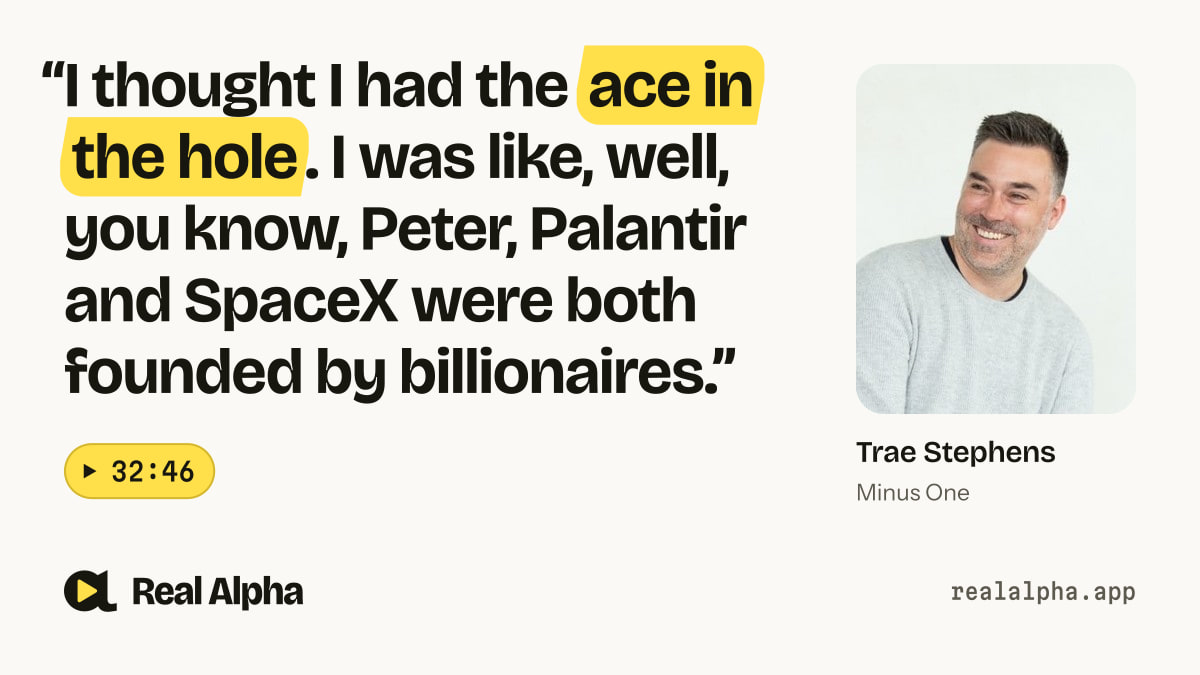
“I thought I had the ace in the hole. I was like, well, you know, Peter, Palantir and SpaceX were both founded by billionaires.”
 Trae Stephensat 32:46 · Minus One
Takeaways
- Trae searched for a company combining hardware and software.
- Government contracts made hardware easier to value than software.
- Peter Thiel pushed Trae to build; Palmer joined later.
About this segment
After hundreds of meetings, Trae Stephens concluded defense needed hardware powered by software, then Peter Thiel urged him to build it. Palmer Luckey joined after leaving Meta.

Trae Stephens is cofounder of Anduril Industries and Partner at Founders Fund.
Co-founded Anduril, building autonomous defense systems on a shared software platform, and invests in government-focused startups.

Aditya Agarwal, Host · Partner, South Park Commons
One of Facebook's first engineers, he helped build its first search engine; later CTO of Dropbox.
From “What Nobody Tells You About Building Defense Tech Companies | Trae Stephens”, Nov 5, 2026. Watch the full episode
Thanks. We'll look at and fix what's off.
Transcript
Transcribed by machine (Whisper) from the episode’s audio, so a word may be off here and there.
- 30:33
No, actually not at all. So because I didn't know anything about venture, but I understood government tech pretty well. When I was just running through that like first 500 pitch meetings, I decided that I wanted to try to see if I could find the next Palantir Space X. So incidentally, government acquisitions is all public. And so you can find out everyone that bid on contract or bid on RFPs. And so I just went and started scraping down all the data I could about companies that had raised venture capital that had also bid on federal contracts.
- 31:04
And then I outbounded to get meetings with these companies. And I met with a couple hundred companies in the first two years that were doing that. Ended up making one investment into a company called Expanse. It started out being named KDM. This started by Tim Junio and Sean McGuire, who's now one of the partners at Sequoia. So we led their seed round in their Series A. Ended up being a good acquisition by Palo Alto Networks.
- 31:29
Again, it doesn't really move the needle for a fund of our size, but it was a great company. I'm glad we invested. But that was it. I didn't find anything else. And over the course of these 200 plus pitch meetings, the realization that I had come to is that we needed a hardware, like a hardware defined company that was driven by software to pair along with Palantir, which was just doing software. And one of the things that I had learned doing software sales at Palantir is that the government has no idea.
- 32:00
value it. Like they think of it as just hours. It's like hours and lines of code. And so you could deliver like the most perfect software ever as a product and they're always going to think it was too expensive. But hardware, there's a bill of materials. And so it's actually much easier to sell hardware. And so I came back to the team and I said, well, you know, I've taken all these meetings. Unfortunately, I don't think there's a next Palantir. But the thing that I'm looking for is a software-defined but hardware-enabled company that works on low-cost autonomous systems.
- 32:30
That would be like the thing that I would be excited about investing in. And everyone just sat there silently. And Peter was like, great. It sounds like there's nobody better to build that company than you. And I'm like, oh, no, no, you did this to me once. I'm working at Founders Fund. I'm not saying that I want to build this company. And he was like, no, you should build the company. And I thought I had the ace in the hole.
- 32:51
I was like, well, you know, Peter, Palantir and SpaceX were both founded by billionaires. And I think that's pretty important to building a government company because it takes a long time and you need like a lot of hype. You need, you know, a face to the company. And I'm like, I got him on this one because I'm not a billionaire. And he said, well, you know, a lot of billionaires. I was already friends with Palmer.
- 33:14
We did the first institutional round in Oculus. So I reached out to him and I pitched this idea and he was like, that's dope. I definitely think you should do that. You should come to my house in Woodside. I'm building a, I drained my swimming pool and I'm building a ramjet in my swimming pool. Of course. Of course, yeah. And so I went to his house and checked out his ramjet and I'm like, so seriously, you should, you know, you're working for the corporate overlords now at Meta.
- 33:39
And he's like, Zuck is VR boy number one. Like I'm VR boy number two. Like we're gonna do this VR thing forever. I'm like, oh, well, I guess that's one billionaire down. I need to go figure out how I'm going to do this. And then a couple of months later, he called me out of the blue and he was like, you still want to do that company? And I'm like, yeah, man, what changed? She's like, I totally got fired.
- 34:05
So that's how we started Anduril. Oh, man, it's amazing. It's actually based on what I know of Palmer and kind of that situation. And it's all tracks.