The alpha, twice a week
That was 4 min.
Get the best new moments in your inbox every Wednesday and Saturday. It's free.
Check your inbox
We sent a link to your address. Click it to finish signing up. Not there in a minute? Look in spam.
or
Bloomberg Law · 4 min · Oct 27, 2026
Anthropic gives investors equity but little control
 Dorothy S. Lund
 describes a board structure that divides control between founders and an independent trust, while public investors get little say.
The episode’s best minutes
Full analysis- 7:29Comey’s filing tests an unusual way to toll a deadlinePro pick 3 min
- 18:19Anthropic gives investors equity but little control4 min
- 28:11Safety failures may expose Anthropic’s board to shareholder suits3 min
- 4 more moments in the full episode
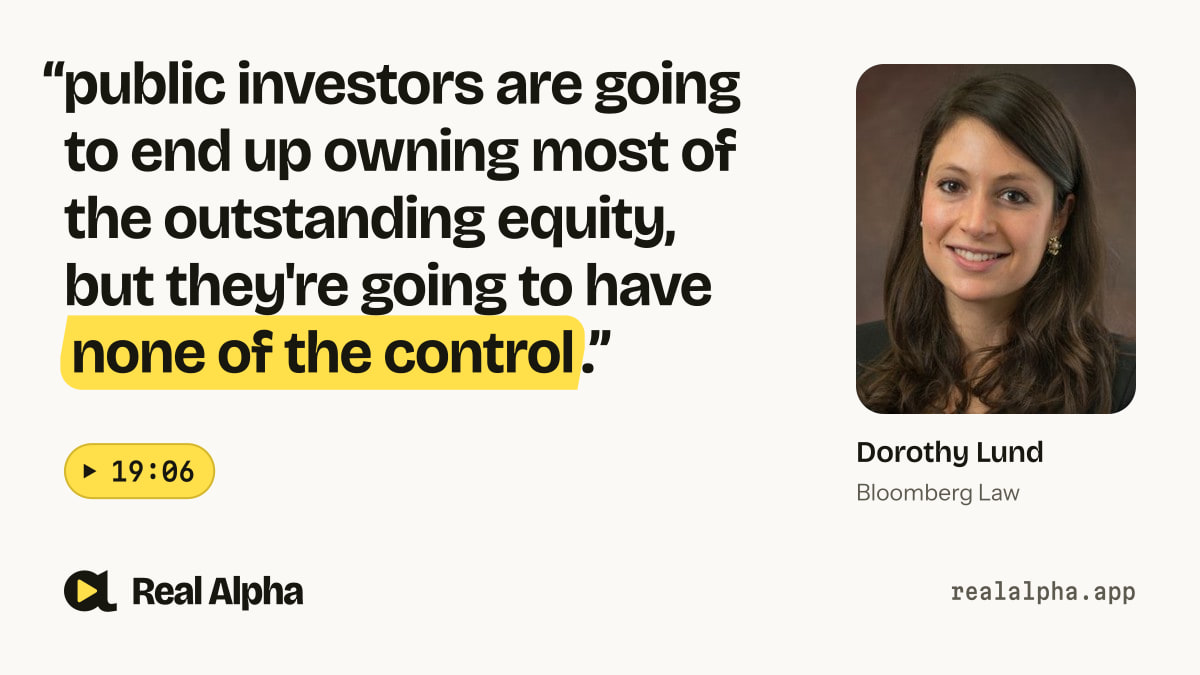
“public investors are going to end up owning most of the outstanding equity, but they're going to have none of the control.”
 Dorothy Lundat 19:06 · Bloomberg Law
Takeaways
- Public investors will own most of the equity but have no control.
- The founders and a trust will divide board control.
- The two groups could clash over the company’s direction.
About this segment
Dorothy S. Lund describes a board structure that divides control between founders and an independent trust, while public investors get little say. That setup could preserve the company’s mission but create conflicts between its power brokers.

Professor, Columbia Law School
Studies corporate governance and securities regulation, co-directs Columbia’s Millstein Center, and co-hosts Beyond Unprecedented.
- JG
June Grasso, Host
From “Comey Charged for Third Time & Anthropic IPO | Bloomberg Law”, Oct 27, 2026. Watch the full episode
Thanks. We'll look at and fix what's off.
Transcript
From the transcript Bloomberg Law publishes with the episode.
- 18:22
Is there anything unusual about Anthropic's IPO? I think there's a few things that make this really unusual. And I. You know, typically with a public company, the default rule is that every shareholder gets a vote. And sometimes companies will depart from that default by giving, you know, certain shareholders more say. So, you know, think about like Meta, right? So in Meta, you have Mark Zuckerberg, who holds a small fraction of the equity, but has voting control as a result of having these special Class B shares with 10 votes per share. So this is a way of saying, well, we've got some visionary person but we think should have say over what's going on with this company over the long term. And so here with Anthropix IPO, public investors are going to end up owning most of the outstanding equity,
- 19:14
but they're going to have none of the control. And the thing that makes this unique is that they're not doing this in the typical sort of Mark Zuckerberg meta way. They are splitting the control of the board between two groups of shareholders that basically have no economic stake. So one is this long-term benefit trust that's going to be composed of outside experts. And by design, these experts are given zero equity stake in the company. And then you also have this LLC that's controlled by these seven founders, and each of them get some board seats that they get to elect. You know, again, this is very different than having control with a single individual who has a big equity stake, but not enough to get you over that 50% hurdle. And so we're kind of building a coalition of people who don't really have a very large
- 20:06
equity stake at all in the company. Are there any disadvantages to that structure? Any dangers?
- 20:13
Well, so one danger is you might worry. One of the things that's nice about not having a controlling shareholder in a company is that over time, if things change, outside investors can use their governance rights and kind of sword rattle. They can wage proxy fights. They can do all sorts of things that make the company redirect. So here... Basically, Anthropic is saying trust that these seven people and the founder LLC checked by this long-term benefits trust, they're going to make the right decisions into the future. And that there's not going to be any need for some outsider to come in and check what they're doing. In fact, having an outsider come in and weigh in or try to redirect their vision is actually going to be harmful for our goals. And so, you know, a risk you might have is like, well, what if they don't have
- 21:04
the right ideas, right? What if this coalition, you know, doesn't actually make the right choices? You know, there won't be a lot of ways for investors to redirect the ship. There's also, I think, sort of, it's an interesting governance structure that is sort of a version of this was used in the private company and also in OpenAI where But I worry a little bit about, you know, you have this long-term benefit trust that controls a majority of the board seats. You've got the founder LLC that controls the other three seats. What happens if they start to disagree with each other about what the right path forward is, right?
- 21:42
And we saw something like this happen with OpenAI, right? We had the trust that basically the directors who populated the foundation decided to fire Sam Altman, right? They didn't think it was a good idea. to have Sam Altman at the helm, the people on the ground really disagreed with that, right? And so you had this clash between the trust and the founders. And, you know, could there be similar power struggles going forward? I mean, there's room for dealing with disagreement here. But, you know, again, these are the two power brokers in this governance structure and conflict can emerge.