The alpha, twice a week
That was 4 min.
Get the best new moments in your inbox every Wednesday and Saturday. It's free.
Check your inbox
We sent a link to your address. Click it to finish signing up. Not there in a minute? Look in spam.
or
Bloomberg Tech · 4 min · Nov 3, 2026
Apple’s low capex offers a safer AI investment profile
 Anurag Rana
 says memory costs, not extra Siri spending, are the main source of margin pressure.
The episode’s best minutes
Full analysis- 23:15Apple’s low capex offers a safer AI investment profile4 min
- 15:41Grab cuts AI costs while increasing usage3 min
- 38:45Election waves have barely changed market returns3 min
- 4 more moments in the full episode
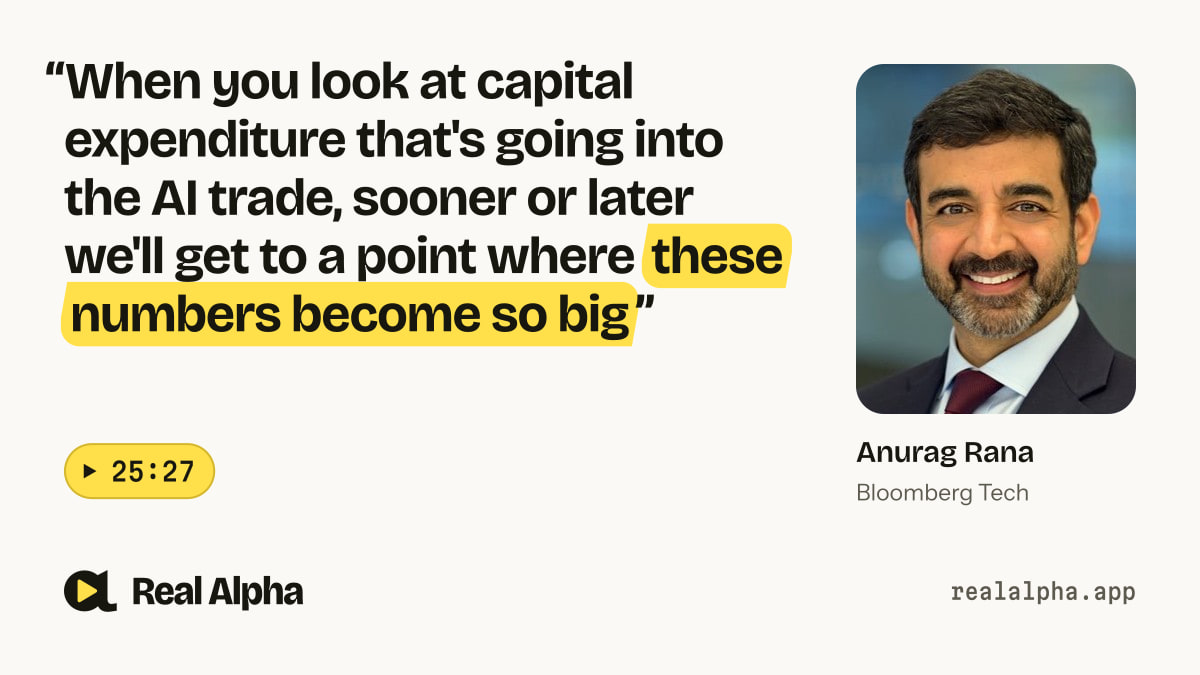
“When you look at capital expenditure that's going into the AI trade, sooner or later we'll get to a point where these numbers become so big”
 Anurag Ranaat 25:27 · Bloomberg Tech
Takeaways
- Memory costs are the main driver of Apple’s margin pressure.
- Apple is expected to generate over $125 billion.
- Low capex may look safer as AI investment costs grow.
About this segment
Anurag Rana says memory costs, not extra Siri spending, are the main source of margin pressure. He argues Apple’s cash generation and low capex look safer as AI infrastructure bills rise.

Sector head & senior equity analyst for software and IT services, Bloomberg
Leads Bloomberg Intelligence’s software and IT services coverage, analyzing large-cap technology companies.

Ed Ludlow, Host · Host & correspondent, Bloomberg
Hosts Bloomberg Tech and reports on technology, supply chains, deals and finance for Bloomberg News.
From “Apple's Happy Holiday Forecast Overshadowed by Shrinking Margin | Bloomberg Tech”, Nov 3, 2026. Watch the full episode
Thanks. We'll look at and fix what's off.
Transcript
From the transcript Bloomberg Tech publishes with the episode.
- 23:17
And the reasons why memory, but the bit I'm trying to understand is like Apple actually spending some money on developing Siri AI here. Is that a factor at all? I think so.
- 23:30
I mean, to be honest, that doesn't move the needle as much because, you know, even if I spend a billion or two billion extra, that really doesn't move the profitability figure. But when you look at the size of the revenue that they have, the overall money that goes into making these products, the cost of memory is probably the most important thing right now that's causing that product margin to decline. And that's really where I think you could say is the only negative. And frankly speaking, they've managed it so well in the last several quarters. I was expecting this margin hit to come in like two quarters ago, frankly, but it hasn't happened.
- 24:07
So it's product margin pressure. I mean, what the analysts on the call tried to do was get John Ternus to explain when this imbalance changes. In other words, there's great demand, particularly for the iPhone Duo, and they are supply constrained. And in truth, John Ternus didn't really answer the question, at least for me. Did he for you?
- 24:29
No, but because he can't do it at this point. I mean, frankly speaking, think about it this way. When so much memory is going in the AI trade with everybody fighting for it, it is very difficult to figure out capacity. I mean, look at the hyperscalers. They can't figure out how much of capacity will come online over the next two years. You can perhaps guess for the next six months, but that's where your estimates are going to be as good as. In the case of Duo, you mean this demand has been far better than what people were expecting, especially with such a high cost of the product and being the first generation product, which usually doesn't happen. So, I mean, there are so many elements of it. The question is, can they go out and fulfill that demand?
- 25:09
So I want to go to part two of your React, part two of your thesis, which is Apple's low capex stands out from rivals who are spending big. Go into that. I mean, Apple's never spent big, so it does stand out.
- 25:24
So, So we had put that thesis out last November saying one simple thing. When you look at capital expenditure that's going into the AI trade, sooner or later we'll get to a point where these numbers become so big and people won't know how funding will happen. That happened actually just in the last several months. And then what happens is Then you look at somebody like an Apple that's continuing to generate, what, $ 125 billion plus or something like that. And you're going to save a similar number next year when your CapEx is just so low, even if after I account for new data center spending and stuff.
- 26:01
So that's the kind of the safety trade people are looking for. If you look at valuation disparity right now, Look at where Apple is trading versus NVIDIA, Google, Microsoft, Amazon. You could see that showing up in valuations with investors saying, you know, we know what we're getting here. We may not have an idea when the payoff is coming back for some of the others.
- 26:22
Could you just explain the last line of that react to me? Apple's limited Middle East exposure, about 5% of new phone sales, underscores China as the primary risk given its central role in manufacturing and growth. What are we getting at there?
- 26:35
It's a supply chain risk. It's always the case when it comes to Apple, because majority of their products are assembled and not just assembled, but the parts that they guessed are from China. Now, we are not in that tariff war right now. We are not in a situation where things are getting murky with China and Taiwan. But maybe down the road, if that happens, how is Apple going to go out and fulfill its promises of selling 250 million phones a year, at least on an annual basis?
- 27:05
Anurag Rana of Bloomberg Intelligence bringing us the double react.