The alpha, twice a week
That was 6 min.
Get the best new moments in your inbox every Wednesday and Saturday. It's free.
Check your inbox
We sent a link to your address. Click it to finish signing up. Not there in a minute? Look in spam.
or
Bloomberg Surveillance · 6 min · Nov 6, 2026
Asian investors are buying the dip as funds face losses
Anthony Stephens describes local retail buyers supporting Asian chip markets while stressed hedge funds sell.
The episode’s best minutes
Full analysis- 34:11AI fundamentals and market narratives are moving apartPro pick 7 min
- 42:21Asian investors are buying the dip as funds face lossesPro pick 6 min
- 49:59Short-dated corporate debt can beat money-market yields5 min
- 4 more moments in the full episode
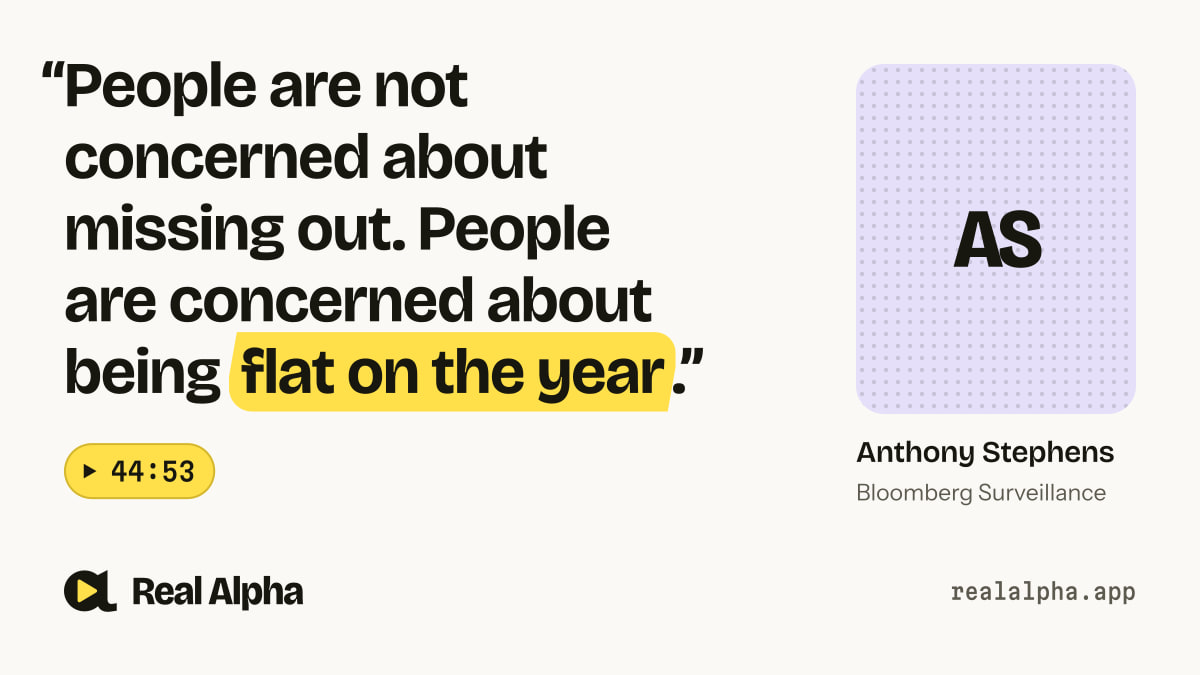
“People are not concerned about missing out. People are concerned about being flat on the year.”
Takeaways Pro pick
- Retail investors bought heavily as Taiwan and Korea fell.
- Hedge-fund losses intensified selling and market volatility.
- Chipmakers’ full order books offer little visibility beyond 2027.
One of Pro's picks, open to you here. Try Pro free for 7 days
One of Pro's picks. The rest of the summary and the 3 takeaways are in Real Alpha Pro; the video, the quote and the transcript stay free.
Read it with Pro, 7 days freeAbout this segment
Anthony Stephens describes local retail buyers supporting Asian chip markets while stressed hedge funds sell. He says the mood has shifted from FOMO to fear of ending the year flat, as investors question chipmakers’ visibility beyond 2027.
Markets Reporter, Bloomberg News
- TK
Tom Keene, Host
- PS
Paul Sweeney, Host
From “October Jobs and Tech Selloff | Bloomberg Surveillance”, Nov 6, 2026. Watch the full episode
Thanks. We'll look at and fix what's off.
Transcript
From the transcript Bloomberg Surveillance publishes with the episode.
- 42:23
and it's beyond elegantly down to a three standard deviation move yesterday. Did you see any sign of a bid in Asia on the Asia semi stocks?
- 42:37
Well, the bid in Asia is coming from local retail. So that's good and bad news. They've been buying all the way down. They have unlimited pockets from the money Asia is making today. You know, there's these huge exports out of Taiwan and Korea, and that's ending up in people's pockets. And they are true believers in the AI story out in Korea and Taiwan. They will buy all the way down. And they bought $ 5 billion between the two countries just today from foreigners. They've bought $ 250 billion year to date from foreigners. So they have invested in the AI trade. That's the good news. The bad news is they've been wrong all the way down. Professionals have been right. And the hedge funds right now are under so much stress that they blew out of their positions right on the open in AI. So we saw Taiwan
- 43:23
opened down 9%, which I've been trading Asian markets for around 18 years across a bunch of shops. I've never seen that. Korea opened down 9%, was halted for 20 minutes. And then the local retail bought it back. And just to conclude, the local governments are helping. So Korea has loosened margin rules. Taiwan is trying to limit short selling. But these are technical measures to slow the slide. The slide is coming from the US and no one has any control over it. US policy, nor any visibility on US policy.
- 43:55
From your window in Hong Kong, looking up that famous mountain, explain this to me. What does fear of missing out mean on the streets of Seoul, the streets of Tokyo?
- 44:07
Well, now we have fear of being down on the year. That is much more important than fear of missing out. In June, July, we got a lot of greed in the system. You know, volatility was spiking. People were launching triple levered ETFs, et cetera, right? Now the narrative has become, oh my God, we've had such a good year. How am I close to flat on the year? If you look on the terminal, you run a huge list of absolutely blue chip hedge funds that are close to down on the year. The likes of Aspex, Lone Pine, D1, Walleye.
- 44:38
I covered these clients directly myself. These people are not stupid people. They're the best of the best. They work, you know, 16, 17 hours a day on the tech trends. And for them to lose 11% in October and then close on double digits again in November, two weeks in, that is coming as a shock to the system. People are not concerned about missing out. People are concerned about being flat on the year.
- 45:00
We welcome all of you to an interesting Friday. Jobs Day coming up at 8.30. Of course, the politics of the moment as well within the United States. Protests in France. I think that's way below the radar this morning. Anthony Stephens from Hong Kong with Bloomberg News with his pro perspective on tech with Paul Sweeney.
- 45:20
Anthony, I'm reading a lot of research coming off of Wall Street here this morning, and a lot of folks are saying a lot of the trading over the past two days has been technical in nature. What did you see from your perch in Asia?
- 45:34
That's absolutely on point. When you see a coordinated bounce in volumes this late in the year, alongside a big pop in volatility, a big pop in implied correlation, we see a big tick up in kind of capital markets activity in terms of unwinding people looking for block risk. You know, we had Goldman on a Bloomberg article saying the phones were ringing off the hook, right? And you call up a sales trading desk. You don't call them for news. You can read the news yourself on the terminal.
- 46:02
You call them for liquidity. That's why people are calling banks like GS or MS or JP. They want to get out using liquidity that's not in the market. And we saw that in the volumes in the US. We saw it in Korea. So that's one thing we're seeing from the technical side. Fundamentally, it's a very different picture. And we've seen the street defend the fundamental picture. But that time horizon difference can be 20, 30 percent.
- 46:25
On a standard deviation move, Taiwan's semiconductor is sort of a mirror image, sort of kind of like here of April of 2025. Anthony, it popped 259 percent off that trade war, tariff war low. Right now, it's up 162% from there, even with a pullback yesterday. Is anybody talking about a return to the linear extrapolation of what we've enjoyed the last year and a half?
- 46:55
There's some discussion of the repricing of the profitability, right? There was this profit bubble. People like TSMC are booked out to 2027, 2028, right? Once you come off that cliff, though, if the democratic kind of vision of data centers changes, pricing of that visibility disappears, right? So we have order books that are full up to 2027, and does it fall off a cliff right after that? So then the linear model of price mean reversion, you know, comes back into play because we were pricing until now a structural change in how these names are valued. These names used to be valued as cyclical plays, right? Some technology will blow up, you get a bunch of demand, you produce for that demand, and then the structure, and then it cycles back to being less demanded. People were pricing in Samsung, Hynix, TSMC.
- 47:44
These things have fundamentally, structurally changed to producing these mountains of cash. Now that has changed because 2028, 2029, you have no visibility.