The alpha, twice a week
That was 8 min.
Get the best new moments in your inbox every Wednesday and Saturday. It's free.
Check your inbox
We sent a link to your address. Click it to finish signing up. Not there in a minute? Look in spam.
or
All-In · 8 min · Nov 24, 2026
Attackers can log in with stolen sessions or fake identities
 George Kurtz
 explains how phishing can steal session tokens that bypass repeated logins, then recounts detecting North Korean operatives posing as employees.
The episode’s best minutes
Full analysis- 21:54AI has turned patching into a break-or-breach decisionPro pick 7 min
- 30:41AI attack frameworks can compromise companies in hours3 min
- 42:18Attackers can log in with stolen sessions or fake identities8 min
- 4 more moments in the full episode
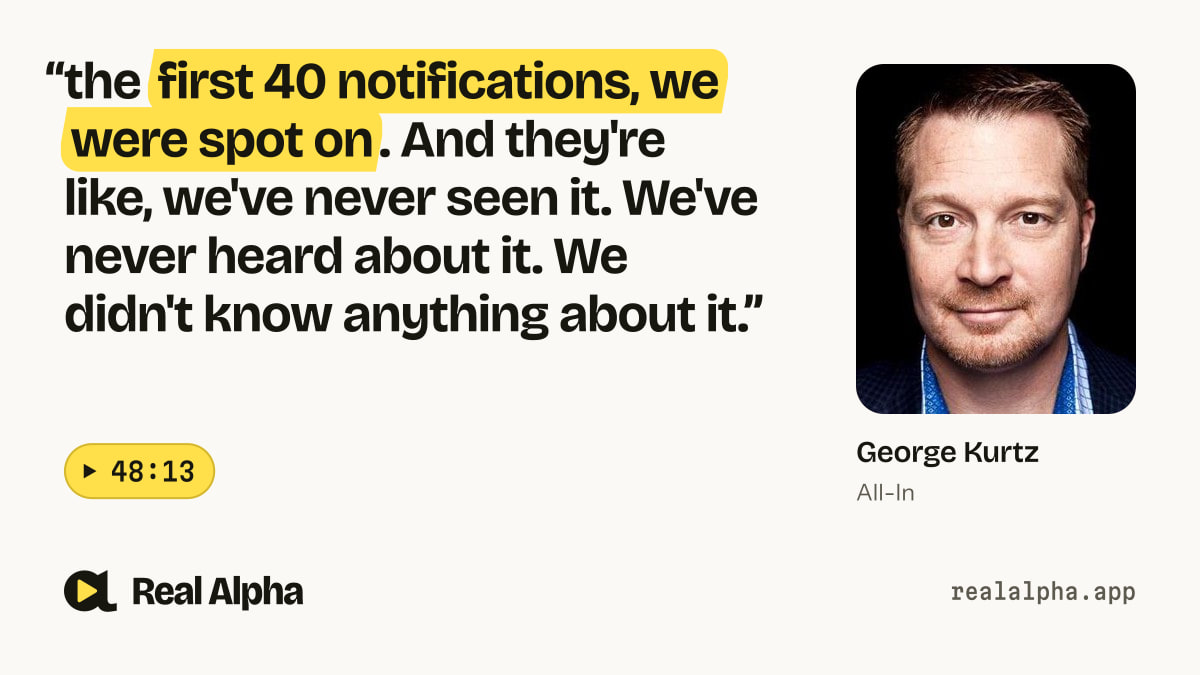
“the first 40 notifications, we were spot on. And they're like, we've never seen it. We've never heard about it. We didn't know anything about it.”
 George Kurtzat 48:13 · All-In
Takeaways
- MFA does not prevent attackers from stealing an authenticated session token.
- Compromised email rules can hide wire-related messages from victims.
- Remote keyboard and mouse devices helped flag suspected fake employees.
About this segment
George Kurtz explains how phishing can steal session tokens that bypass repeated logins, then recounts detecting North Korean operatives posing as employees. The examples show why identity and hiring controls matter alongside technical defenses.

George Kurtz is CEO of CrowdStrike.
Co-founded CrowdStrike in 2011 and leads it as president and CEO, after founding Foundstone.

Chamath Palihapitiya, Host · Founder & CEO, Social Capital
Led Facebook's growth team; his firm backed Slack and AI chipmaker Groq.

Jason Calacanis, Host · Founder & CEO, LAUNCH
Early Uber angel; sold Weblogs Inc. to AOL; hosts This Week in Startups.

David Sacks, Host · Co-founder & partner, Craft Ventures
PayPal's first COO, founded Yammer; White House AI & crypto czar 2025–26.

David Friedberg, Host · CEO, Ohalo
Founded The Climate Corporation, sold to Monsanto for about $1.1B in 2013.
From “Crowdstrike CEO: AI Cyberattack Wave, Hyperspeed Hacks, & The Patching Problem”, Nov 24, 2026. Watch the full episode
Thanks. We'll look at and fix what's off.
Transcript
Transcribed by machine (Whisper) from the episode’s audio, so a word may be off here and there.
- 42:26
all four core four and so we're gonna have a great time there but when we talked you said something that stuck with me and i think the exact way you said it was why break in when you can log in? Why break in when you can log in? And now you think about phishing. You think about spear phishing. Phishing, they send you like, hey, log in here. Everybody's getting a bonus. So literally James Dolman did a phishing test for the Madison Square Garden employees about, hey, we all won the championship. We're having a party or something. You're going to get your commemorative ring or jacket. Click here. Of course, 30% of the organization after going through phishing training was like, oh, I get my ring. They're so excited. They click on it.
- 43:08
And now they're all dragged into a seminar to once again, learn that don't click on links in your email box, et cetera. Spear phishing is when you go after an individual, hey, George, here's your ticket for the specific thing. And then you got swishing and this ishing and going into your SMS. How does AI impact that? Because I've had to now with, I'm an LP in a bunch of venture firms. I have LPs in our firms.
- 43:35
people are starting to send messages to me by the way we will never call you as an lp in our fund and ask you for this type of information on the phone and when we do it we have a new protocol we're going to email you you're going to call us on this phone number we're going to hang up we're going to call you back and you know just multi-layer human factor defense so let's talk about human factors with this.
- 44:00
technology. And I understand somebody did this with some crypto stuff where they made a version of George or Jake Al on Zoom to talk to somebody and get them to give it up with avatars. And these are starting to cross the uncanny valley, I believe. So we talk about that attack vector, and are you working on it? And what's the defense there? Or is this more just science fiction than reality? I'll bifurcate this. I mean, there's a lot to talk about. But when we think about sort the login piece versus maybe the deepfake.
- 44:28
So let me start with, to your point, it's easier to log in than to actually break in. There's a couple of pieces there. One, it's still easy to phish credentials. So, and with AI, you can create an incredible campaign. It's all automated now. Now, the thing to keep in mind is someone will say, well, I have multi-factor authentication. I have not only my password, but I have something else that I have to authenticate with.
- 44:54
That's great. The challenge you have right now is that these attackers will actually intercept your credentials. But more importantly, they'll steal the session token. So if you think about like if you use Outlook or Gmail, it doesn't really matter, pick a site, you authenticate and then it doesn't ask you every time you read an email to re-authenticate. And you click that 30-day button or like trust this computer and like now we don't have to log in and then two-factor and the exhaustion people experience from two-factor fatigue, which is a thing.
- 45:29
Right. So essentially there's a token, which basically behind the scenes is like your passkey that says, hey, I'm JCal, like just let me read my email. Yeah. The adversary will steal that session token. So it's already authenticated for the next 30 days and then they're good to go. Yeah. And that's how it all works. Typically with these sort of business email compromises, they will then go into your Outlook mailbox. They will then create automatic rules that will, like if you have wires and those sort of things, then they'll, they'll actually put them into folders that you never see. And then, and then they begin communicating with, with the, with the target.
- 46:11
Wow. So, and it's all. So sophisticated. Yeah. And you, and you never see it. Right. So that's, that's what we're seeing. Now, the next iteration of that is what the North Korean are doing. And again, it's like, well, why break in when I can just get somebody hired and get their laptop? So this is. Wait, you have to explain what we're talking about here, because you and I know this, but the public does not understand the concept of North Korean applying for jobs, getting jobs, and having a laptop shipped to a fake address and then VPNing into it from North Korea to some woman who has got busted with like 80 laptops in her house.
- 46:54
Yeah, in Texas, by the way. It was in Texas. Okay, great state of Texas. Here we go. Explain the background here. Let's talk about this. So we were actually, I think one of the first to really talk about this publicly a couple of years ago. And we were actually working on some new algorithms. Internally, it was called Signal, where we were looking to essentially separate the signal from the noise. So there's a lot of things that happen at scale, as you might imagine, with CrowdStrike. And there's always these small signals that you'd never want to miss.
- 47:26
So we built this. And part of it, when we were testing it all out, we're like, this is really weird. Like, why are these like remote keyboard mouse Pi devices being connected all over the place? This is really odd. And when we dug into it, we're like, okay, we actually think we have an Intel team. And they went through it. And they're like, we think this is North Korea. And we think that they are, you know, employees.
- 47:51
So we unfolded all this. And then our guys came to me and said, OK, George, we'd like to contact. this particular customer, but we have to tell them that their employee may not be their employee. This is not an easy thing to do, as you might imagine, right? This isn't like, hey, this might be malware, it may not be malware. You're basically saying like, you know, Bob is not Bob. So I said, look, let's just go to what we found to those customers and tell them what we think.
- 48:20
We could be wrong, but tell them. And the first 40 notifications, we were spot on. And they're like, we've never seen it. We've never heard about it. We didn't know anything about it. And now it's a whole in you know now it's a whole industry of where north korea is getting the job and i have a great story on it is getting the job as you said they're having mules send a laptop to a farm and then they connect in and then they as a team they behind the scenes they work but they also have access to uh the system now my last story on this is we work with a company we notified them there was a problem and we went to the hiring boss and we said did you ever see this person they said no They interviewed without their camera on.
- 49:01
We never met them in person. I said, okay, well, like you have a problem. It's North Korea. And the HR people said, hey, we're going to get rid of them. And they said, do we really have to get rid of them? They do the best work of anyone on the team. I mean, people are desperate for talent. We have the lowest unemployment of our lifetimes. Just such a self-owner. The best one was they had this IT worker, North Korean, et cetera.
- 49:25
And the way they busted them at one of these companies was they said like, I don't know exactly what they said, but can you just say Kim Jong-un is a fat pig or something? We did that. That was you? Yeah, that was actually, it was our intel guy. His name is Adam. He runs our counter-adversary organization. And he basically told the customer that we were working on to say that. Yes. And of course, if you're in North Korea, these are probably words you don't want captured on camera.
- 49:53
Kim Jong-un is a little sensitive about the... Yeah, I don't think Osanpik has made his way to the North Korean president. You know, my prediction on all this, sorry to restart the interview again, it was just one question I wanted to ask you. If all this code gets rewritten by machines, it's going to be a lot less brittle. Is there a concept of perfect working code or like extremely secure code?