The alpha, twice a week
That was 3 min.
Get the best new moments in your inbox every Wednesday and Saturday. It's free.
Check your inbox
We sent a link to your address. Click it to finish signing up. Not there in a minute? Look in spam.
or
Odd Lots · 3 min · Nov 21, 2026
Beijing puts high-tech self-reliance ahead of consumer demand
 Kyle Chan
 argues that Beijing sees high-tech capacity, not GDP growth or household consumption, as the priority.
The episode’s best minutes
Full analysis- 31:41Beijing puts high-tech self-reliance ahead of consumer demand3 min
- 38:31China’s chip frontier keeps moving as it tries to catch up4 min
- One more moment in the full episode
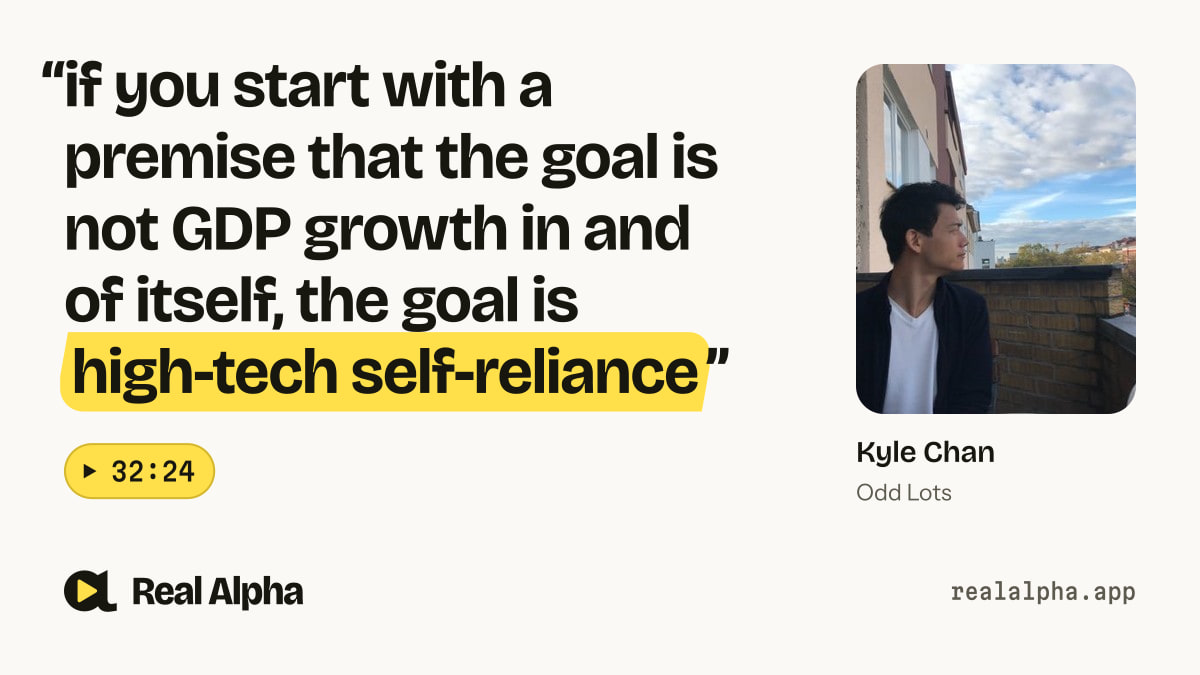
“if you start with a premise that the goal is not GDP growth in and of itself, the goal is high-tech self-reliance”
 Kyle Chanat 32:24 · Odd Lots
Takeaways
- The policy goal is winning future industries.
- Consumer stimulus is treated as secondary.
- Beijing expects jobs and growth to follow industrial capacity.
About this segment
Kyle Chan argues that Beijing sees high-tech capacity, not GDP growth or household consumption, as the priority. That helps explain why stimulus and consumer welfare can take a back seat.

Kyle Chan is a fellow at Brookings’ John L. Thornton China Center and author of High Capacity.
Researches China's push to lead in AI, robotics, semiconductors, electric vehicles, and other critical technologies.
From “How AI Is Reshaping China's Industrial Policy | Odd Lots”, Nov 21, 2026. Watch the full episode
Thanks. We'll look at and fix what's off.
Transcript
From the transcript Odd Lots publishes with the episode.
- 31:53
Yeah, I mean, I'll throw out a controversial take, which is Xi Jinping's does not really care that much about the economy or about consumers or about households in the sense that, you know, in the traditional sense that we might think about in the U.S. or in the West. I think up until now, you have all these calls for an adjustment of, you know, imbalances, you know, why isn't China boosting consumption? Why aren't they offering, if not handouts to consumers, some kind of stimulus measures to stimulate demand, right?
- 32:25
There's a big demand slump, especially after the real estate collapse, which was a deliberate sort of popping of a bubble and a pivot towards something else. And the answer to all that is, if you start with a premise that the goal is not GDP growth in and of itself, the goal is high-tech self-reliance of sort of like winning the industries of the future. If you start with that premise, everything starts to make a lot more sense. So those who have been wondering like, well, is the stimulus coming?
- 32:56
Are they going to Finally bail out, you know, whoever it is that needs to be bailed out in order to get demand going. That I think is ultimately seen as secondary. downstream to this high-tech push. And the idea is there's this very clunky term that has become sort of like the buzzword, which is the new quality productive forces. If you have these particular high-tech industries, growth sectors, industries of the future, If you can start to win in those areas and also have the supply chains, sort of the complete industrial system, which is like a term in Chinese that's very common, to back all that up, then everything else will kind of follow. You will end up having the kind of robust economic growth. You will have jobs.
- 33:38
You will have high-tech jobs, right? In this shift away from sort of blue-collar factory jobs, you might have purple-collar jobs, jobs that require more advanced degree and have more technical know-how, maybe maintaining and repairing robots, for example, rather than actually sort of making widgets on the factory floor. So to take a step back, basically, I see that there is this sort of all-in push to try to become, if not the dominant, a dominant global player in a number of these key industries. And everything else is sort of like know if if that works that's great but that's not really the the main goal right now.