The alpha, twice a week
That was 7 min.
Get the best new moments in your inbox every Wednesday and Saturday. It's free.
Check your inbox
We sent a link to your address. Click it to finish signing up. Not there in a minute? Look in spam.
or
80,000 Hours Podcast · 7 min · Nov 19, 2026
Beijing sees AI loss of control as a threat to political security
 Julian Gewirtz
 explains why Beijing’s first concern is political control, not abstract AI safety.
The episode’s best minutes
Full analysis- 12:24Beijing sees AI loss of control as a threat to political security7 min
- 38:27China’s compute purchases may reveal whether leaders fear falling behindPro pick 4 min
- 1:07:01China may reverse its open-weight stance if risks threaten stabilityPro pick 6 min
- 5 more moments in the full episode
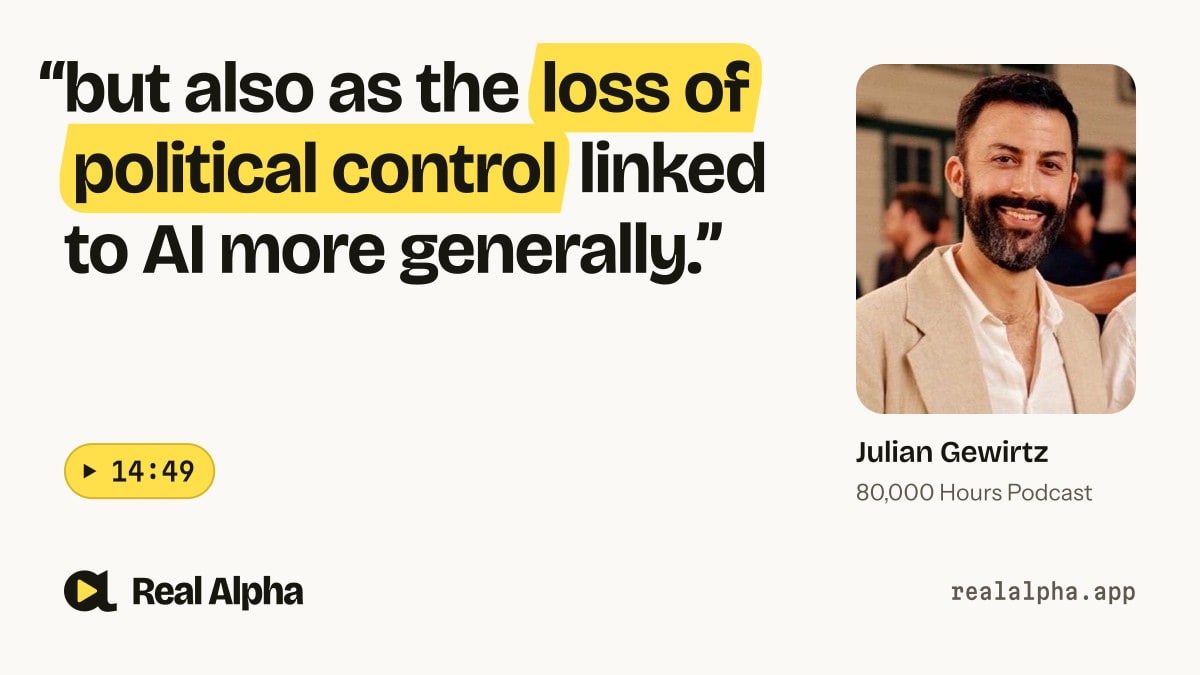
“but also as the loss of political control linked to AI more generally.”
 Julian Gewirtzat 14:49 · 80,000 Hours Podcast
Takeaways
- Regime security is Beijing’s primary concern about AI risks.
- Political control includes control over information and the cyber ecosystem.
- Mythos has heightened Beijing’s concern about US cyber capabilities.
About this segment
Julian Gewirtz explains why Beijing’s first concern is political control, not abstract AI safety. US cyber capabilities are another major risk shaping its response.

Julian Gewirtz is a historian and former senior director for China and Taiwan affairs at the NSC under Biden.
Authored histories of modern China and advised Biden administration leaders on U.S.–China policy.
- TR
Tom Reed, Host
From “Beijing’s Unprecedented Campaign Against Anthropic”, Nov 19, 2026. Watch the full episode
Thanks. We'll look at and fix what's off.
Transcript
Transcribed by machine (Whisper) from the episode’s audio, so a word may be off here and there.
- 12:30
that you think would be more likely to cause something like a broader rectification campaign? Like, is there, what I'm trying to think of is, is there some kinds of ways that AI could go rogue that would be more worrying to the CCP than others, or that might encourage them to view things as not just any other, you know, familiar cyber incident? We have to start with the reality of what China is and what the Chinese Communist Party cares about, as opposed to kind of working backwards from the place we think they need to get in order to accomplish our broader goals.
- 13:03
And I say that because the number one concern is regime security, regime stability, what they call political security, and social stability. So the kinds of risks that I think are most likely to cause them to recalibrate some of their current approach to the AI sector are really in that domain. They do want to avoid risks to regime security, also sort of major economic disruptions. So, you know, from that perspective, I think as we consider the kinds of scenarios that might unfold, it's really the ones that are in that core political and regime security space.
- 13:52
And as your listeners well know, there are those risks. And that, in fact, control over information, particularly information about the government, about the Communist Party, access to, you know, a very, very carefully controlled cyber and information ecosystem, that is the kind of thing that we can imagine, you know, these new tools, new technologies disrupting, either inadvertently via loss of control by a company or deliberately. And I think the deliberate piece of this is a big element to just bring in because candidly, as I've seen the Chinese AI discourse evolve, there is increasing attention to what they call extreme loss of control risks. But we have to remember that when they use that phrase, loss of control, they don't simply mean it in the way that a lot of AI safety folks here mean it,
- 14:52
you know, loss of human control over AI systems, but also as the loss of political control linked to AI more generally. And so when we think of, you know, deliberate hacking, you know, deliberate dissemination of information that the government doesn't want spread, those are all the kind of risks I think that are likely in the first instance to make them really start to reconsider. And sorry, maybe just one last thing. But, you know, there was recently this vulnerability exposed. Oh, this is the hack of WeChat? Yeah, exactly. The vulnerability in WeChat, which is the sort of one app to rule them all in China. So just to clarify for our audience, This was a hack of WeChat that was disclosed by a group that had used AI to find the vulnerability.
- 15:43
They'd found a vulnerability, but they disclosed it responsibly. But we have no idea exactly how the government sort of processed this information. We just know that it happened and they would be aware of it. Right. And sort of in line with what we were just saying a second ago, the response of Tencent, the company that. that, you know, created WeChat was to say, you know, we patched the vulnerability.
- 16:05
But the shoe that never dropped publicly was how the government saw that and what kind of conversations about the vulnerability there were. But there was just one other thing which I should have said in the prior kind of set of comments, which is the U.S. factor here is major. And I think, in a way, the most significant event in shaping the evolution of Beijing's thinking about AI risks, you know, over the course of the past year or so is mythos. And the kind of sense that the United States is gaining extraordinary capabilities in cyber, and that that is motivating a set of counter responses that we have very little visibility into, but that they see as part of the AI risk conversation centrally.
- 16:59
And it's whenever they talk about AI risk at the government level or the party level, they talk about the United States as one of the threats. So the main risk for them is US primacy through AI advantages or something like that? I still think loss of political control, political security is number one, but a very close second is the U.S. dimension, exactly as you say. And crucially, they're connected.
- 17:26
And how do we know that Mythos was like this sort of wake-up call for them? I've heard this before, but yeah, how is it that we know this is the case? They've not said, oh, this was a wake-up call for us. Are there signs that Mythos shifted things for the CCP? Yeah, no, I don't think any government would say, you know, call a press conference and say, were really freaked out about this. But no, there are a few things. First, there are indications in official statements where they have quite directly invoked it. So they have spoken about it a little bit. They don't say, you know, we've turned up the alarm to the highest level, but they acknowledge the reality of it and they acknowledge it as something that could pose a kind of security set of challenges for China. And then second, you know, in kind of track two
- 18:18
dialogues and other settings where, you know, there's communication, it's been quite clear that this is something that has reverberated profoundly in their system. And in general, right, to go back to that kind of initial point of starting from what China is and what the party cares about, You know, their concern about American cyber capabilities and all the rest has been a huge issue for well over a decade.
- 18:46
Xi Jinping has spoken about this frequently over the years. So they are primed to see that as a threat vector of the greatest significance. Can I force you to make a guess about something? Sure.