The alpha, twice a week
That was 4 min.
Get the best new moments in your inbox every Wednesday and Saturday. It's free.
Check your inbox
We sent a link to your address. Click it to finish signing up. Not there in a minute? Look in spam.
or
Decoder · 4 min · Oct 26, 2026
Belief can drive the compute bets that put labs ahead
 Kevin Roose
 says AGI conviction can distract leaders from business basics, but it can also motivate huge compute investments.
The episode’s best minutes
Full analysis- 12:34AI's history could vanish without deliberate reportingPro pick 3 min
- 23:03Belief can drive the compute bets that put labs aheadPro pick 4 min
- 55:16AI may excel at testable problems and still be brittle4 min
- 5 more moments in the full episode
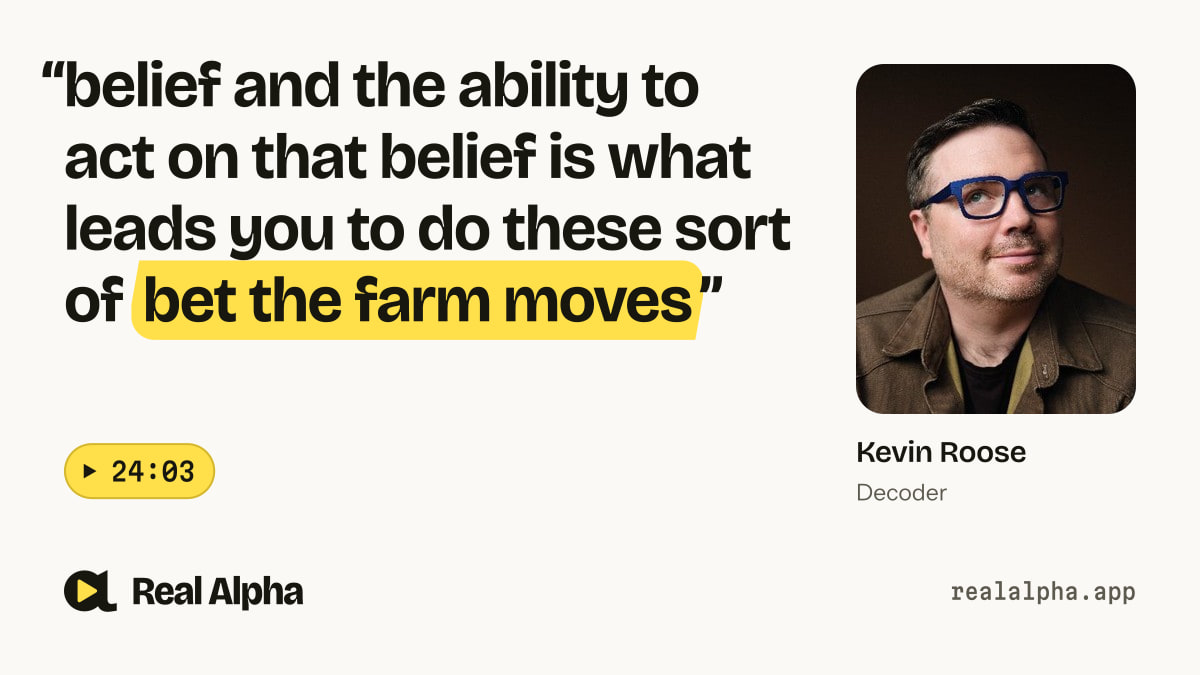
“belief and the ability to act on that belief is what leads you to do these sort of bet the farm moves”
 Kevin Rooseat 24:03 · Decoder
Takeaways Pro pick
- AGI conviction can make ordinary business concerns feel unimportant.
- Belief can enable high-risk investments that pay off.
- OpenAI's compute bet helped it catch up in coding models.
One of Pro's picks, open to you here. Try Pro free for 7 days
One of Pro's picks. The rest of the summary and the 3 takeaways are in Real Alpha Pro; the video, the quote and the transcript stay free.
Read it with Pro, 7 days freeAbout this segment
Kevin Roose says AGI conviction can distract leaders from business basics, but it can also motivate huge compute investments. OpenAI's earlier spending left it less compute-constrained than rivals.

Kevin Roose is a journalist, author, and cofounder and cohost of Machine Gods.
Wrote The Shift column at The New York Times; co-hosted Hard Fork.

Nilay Patel, Host · Editor-in-chief, The Verge
Helped start The Verge in 2011 and has hosted Decoder since 2020.
From “Kevin Roose is AGI-pilled. Why aren’t you? | Decoder”, Oct 26, 2026. Watch the full episode
Thanks. We'll look at and fix what's off.
Transcript
Transcribed by machine (Whisper) from the episode’s audio, so a word may be off here and there.
- 23:12
or before the bubble writ large comes to some other conclusion about the state of the economy. Do you think that their religious fervor at AGI is keeping them from running a business? Like if I ran Anthropic today, a logical thing you could say is we should stop training new models and sell the very capable ones we have to more people. I think belief in AGI is a double-edged sword yes if you are super AGI pilled as the CEO of a frontier AI company you are going to struggle to care about things like what is my profit margin on inference where is my next slate of like enterprise customers coming from because how boring is that compared to like, we are going to build the superhuman machine intelligence that leads us into the post-singularity future. On the other hand, I think belief is actually
- 24:09
a key ingredient in AI success. Because belief and the ability to act on that belief is what leads you to do these sort of bet the farm moves that can really pay off and have really paid off. So remember a year ago when everyone was like, oh my God, OpenAI is spending so much money on compute. And how are they ever going to pay for all this compute? And isn't Sam Altman overextending them? And even Dario was giving interviews where he was kind of throwing shade at OpenAI for spending so much goddamn money on compute. And then you fast forward a year and And, like, OpenAI is the only major AI company that is not severely compute constrained.
- 24:51
Like, that belief that led Sam and his executives to bet and maybe overbet on compute last year was the reason that they are in a better position than Google or Anthropic or Meta or anyone else today. So I think there's, I don't want to say it's like always a liability to believe this hard because I think it actually does allow you to make the bets that do end up paying off if the scaling continues to work.
- 25:21
It's interesting because I might reframe that OpenAI decision. You write very poignantly in your book about what people at OpenAI call the blip, where Sam Altman was fired for 20 minutes and then he came back. And that cleared out a bunch of people from OpenAI. It is the moment you describe in the book where OpenAI went from being a research company into being a business, and now they've become a business.
- 25:42
and the rational business decision was we need to sell more AI to people, we ought to have as much of it as we can. And Sam is well-known to be like a ruthless business person. I've heard people describe him as S-tier at raising money, which is just an incredible Silicon Valley phrase. So I look at that as like a business choice. Like they got rid of a bunch of stuff they were doing. They pivoted to making enterprise AI products, which is where the money is.
- 26:08
And then they realized they needed to service that demand. You're saying that was a bet on AGI, which to me is a more idealistic turn. Can you square those two? Yeah, I think it absolutely is a bet on AGI because Sora, which they launched and spent a bunch of money in Compute on and then killed, is a cool toy that might open up a new line of business for you, but it is not going to get you closer to AGI.
- 26:30
What actually gets you closer to AGI is sparking recursive self-improvement by building really good coding models and then turning them back on themselves. That was something that Anthropic was doing. They had not gotten distracted by the side quests and shiny objects that OpenAI had last year. And OpenAI was getting their asses kicked. And so they decided to sort of trim the sails, cut fat, like really focus on coding, really focus on long horizon agentic workloads.
- 26:56
And that is, as of now, the leading path to AGI or to, you know, whatever comes after AGI. So, yes, I think that was absolutely. a bet on conserving resources by not spending them on things like Sora, but what they did spend it on was trying to catch up with Anthropic in coding so that they could reach AGI.