The alpha, twice a week
That was 2 min.
Get the best new moments in your inbox every Wednesday and Saturday. It's free.
Check your inbox
We sent a link to your address. Click it to finish signing up. Not there in a minute? Look in spam.
or
No Priors · 2 min · Nov 12, 2026
Better-designed drugs could make combination treatments safer
 Max Jaderberg
 says drug interactions and toxicity make it hard to combine medicines safely.
The episode’s best minutes
Full analysis- 6:24AI can make drug discovery learn from every programPro pick 5 min
- 20:30Human-relevant models could improve on animal toxicity tests2 min
- 29:02Better-designed drugs could make combination treatments saferPro pick 2 min
- 4 more moments in the full episode
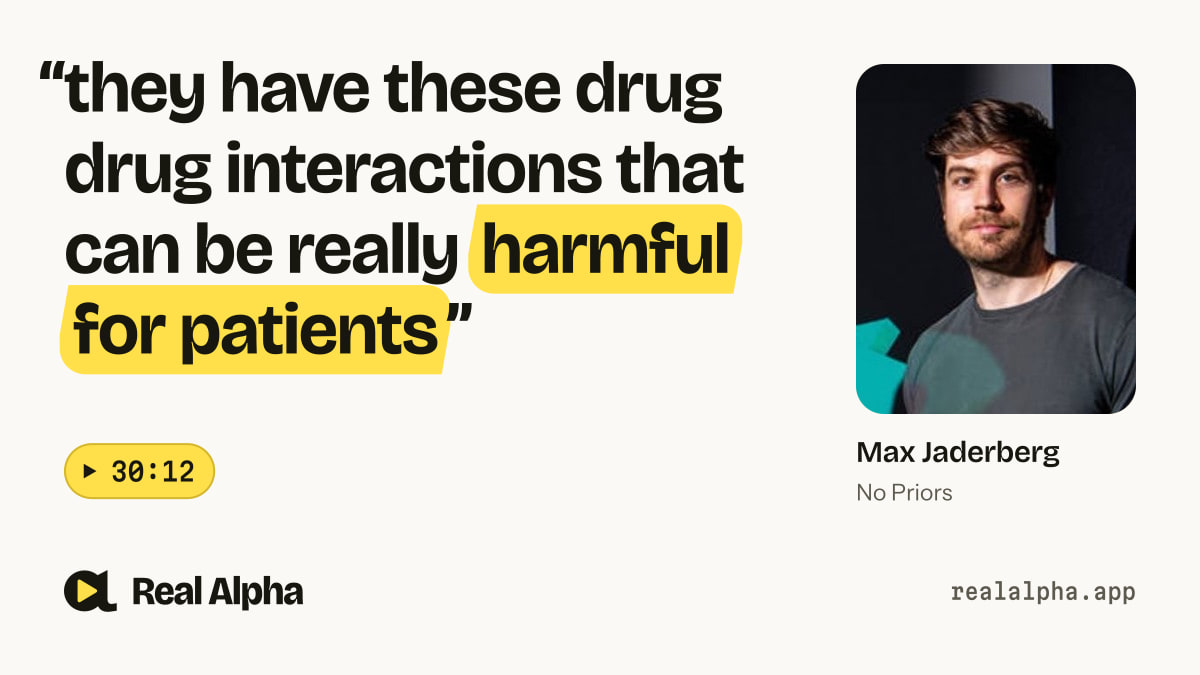
“they have these drug drug interactions that can be really harmful for patients”
 Max Jaderbergat 30:12 · No Priors
Takeaways Pro pick
- Toxicity and drug interactions limit combination treatments.
- More precise engineering could reduce those risks.
- Multi-target combinations may better address complex disease pathways.
One of Pro's picks, open to you here. Try Pro free for 7 days
One of Pro's picks. The rest of the summary and the 3 takeaways are in Real Alpha Pro; the video, the quote and the transcript stay free.
Read it with Pro, 7 days freeAbout this segment
Max Jaderberg says drug interactions and toxicity make it hard to combine medicines safely. More precise molecule design could enable treatments that act on several targets across a biological pathway.

Max Jaderberg is president of Isomorphic Labs.
Led development of AlphaFold 3 and Isomorphic Labs’ drug-design AI after pioneering deep-learning systems at DeepMind.

Elad Gil, Host · CEO, Gil & Co
Investor in Airbnb, Stripe, Coinbase and Anthropic; co-founded Color.
From “Powering AI-Driven Drug Discovery with President of Isomorphic Labs Max Jaderberg”, Nov 12, 2026. Watch the full episode
Thanks. We'll look at and fix what's off.
Transcript
Transcribed by machine (Whisper) from the episode’s audio, so a word may be off here and there.
- 29:05
of view like just and also has a natural function so being able to module well yeah exactly so you And of course, in cancer, things mutate very quickly. So you think you've got a solution, but actually, clinically, it doesn't work out because it just mutates around the solution. It's actually an interesting point because for a lot of different drugs, for a lot of different areas of health, this also was HIV, right?
- 29:28
You end up with a cocktail of drugs that you give eventually, and that's actually what allows you to suppress AIDS or HIV. In cancer, similarly, a lot of drugs were developed as individual drugs versus cocktails. And to your point, often within a tumor, you have a spectrum of mutations that you need to suppress simultaneously if you really want to cure the thing, because otherwise it'll sort of evolve out under, given the sort of substrat of mutations that exist in a distribution across the cells.
- 29:53
Are you thinking about those more complex approaches of cocktails or multi-drug approaches? Yeah. So why aren't we giving more cocktails drugs well the problem is like often these molecules they are they work but they have some toxicity or they exhibit some effect on the liver such that if you're taking multiple of these molecules these medicines at the same time they have these drug drug interactions that can be really harmful for patients and so it's actually because we're not great at engineering exquisite molecules and medicines that means that we can't combine them together in a safe way for patients and so we're maybe limiting like the the surface of applicability. Yeah I guess you only have so many patients too and so many people you can enroll a clinical trial and so the combinatorics of it my
- 30:41
sense is also kind of adds up in terms of the clinical trial side. Especially when there's a lot of like risk and uncertainty about how these things will combine and so that's where we see an opportunity. If you can actually much more accurately engineer these molecules to be safe, to not have these effects on the liver to not interact with each other in bad ways, then you can feasibly come up with actually, I would really hope, some quite complex combinations that can modulate not just a single target at a time, but a whole vector of targets that span these very complex biological pathways at the same time and to have a better effect on disease. There's a very good YouTube