The alpha, twice a week
That was 3 min.
Get the best new moments in your inbox every Wednesday and Saturday. It's free.
Check your inbox
We sent a link to your address. Click it to finish signing up. Not there in a minute? Look in spam.
or
MTS · 3 min · Oct 24, 2026
Big tech is well funded, but social engineering still targets people
 Joel de la Garza
De la Joel de la Garza estimates security takes 10% of a typical tech budget and perhaps 20% at Google, while underfunded regional systems face more risk.
In this episode
Full analysis- 0:43AI makes old vulnerabilities cheap to exploit4 min
- 12:21Doom scenarios can make security harder to improve3 min
- 21:25Critical systems may be shut down proactively for patching2 min
- 4:22Companies need months of patching capacity, not a one-week sprint5 min
- 9:36Nation-state attackers shifted from malware to hardware security3 min
- 16:53Big tech is well funded, but social engineering still targets people3 min
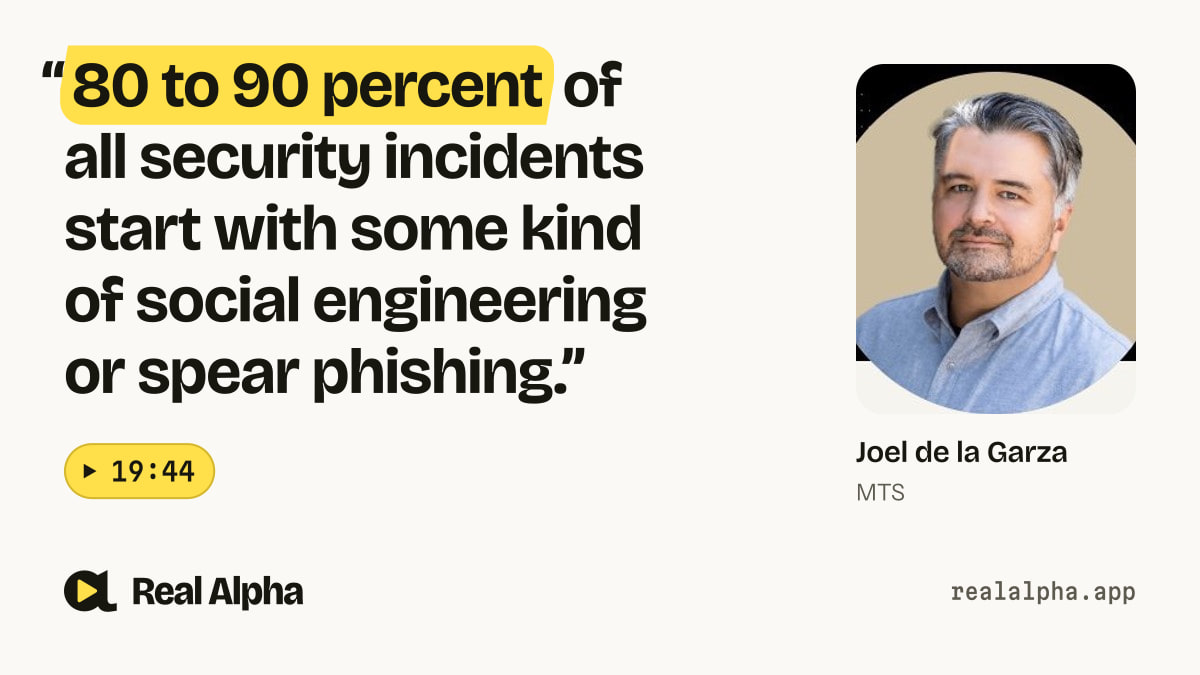
“80 to 90 percent of all security incidents start with some kind of social engineering or spear phishing.”
 Joel de la Garzaat 19:44 · MTS
Takeaways
- A typical security budget is about 10% of technology spending.
- Google may allocate closer to 20%, in De la Garza's estimate.
- 80–90% of incidents begin with social engineering or spear phishing.
About this segment
De la Joel de la Garza estimates security takes 10% of a typical tech budget and perhaps 20% at Google, while underfunded regional systems face more risk. He says social engineering starts most incidents.

Joel de la Garza is a partner at Andreessen Horowitz focused on cybersecurity.
Led security at Box and Citi before investing in information-security companies at Andreessen Horowitz.

Theo Jaffee, Host · Co-founder & host, MTS
One of the first members of a16z's new media team; earlier hosted the Emergent Ventures-backed Theo Jaffee Podcast.

Sophia Dew, Host · Host, MTS
From “System Shutdowns Are Coming in the Next Year | Joel de la Garza”, Oct 24, 2026. Watch the full episode
Thanks. We'll look at and fix what's off.
Transcript
Transcribed by machine (Whisper) from the episode’s audio, so a word may be off here and there.
- 16:57
that big tech companies will be able to handle cybersecurity much more easily. And so to the average person who only really uses a handful of websites, Facebook and Google and Reddit and Gmail, that they will be fine, basically. I mean, the big tech companies are phenomenal. I mean, Google is probably, you know, Google plays at the level of a nation state when it comes to information security. Microsoft does as well, right?
- 17:22
Like, these are folks that have done a tremendous amount of investment. And largely, it's, I mean, you know, Google had this golden goose that pumped out golden eggs, and they used those golden eggs to build really cool infrastructure. And so, like, I think that for the most part, those things are going to be just fine. I think those things are properly resourced. I don't know what the Google spend.
- 17:46
Like in general, across the industries, 10% of your technology budget is typically allocated to information security. I'd imagine at a place like Google, it's probably more like 20. I think the rest of the industries have to get to that level and spend a little bit more on information security. Potentially, this is a temporary situation, but over time, who knows? It could go down. It could go up. TBD.
- 18:09
But yeah, I think, like I said, I think there are outliers where we could see some potentially negative things. And these would be, you know, regional systems, like systems that don't have a lot of funding, things that are particularly low margin, where they just haven't made those investments. And that's where the risk is ultimately going to be. But, I mean, you know, there's a lot of these parts of our infrastructure are already struggling, right?
- 18:33
Like, you know, there's a broader problem about maintaining our infrastructure properly that isn't just a result of kind of the AI longpocalypse stuff. Right. So is there anything really that the ordinary person can do other than like turn on two-factor authentication with an authenticator app instead of a phone number? Don't have the same password across all of your apps. Use a password manager. Is that it?
- 19:03
Those are all great things. I mean, I think really, honestly, like the vulnerability stuff that's happening right now is really for professionals like myself, people that are doing this day-to-day to really focus on and spread the word. Like the most important thing to do is to let business leaders know that this is important and they need to invest in it and they need to do this. And that's outside the realm of the normal person.
- 19:25
I think the scarier stuff or the stuff that's probably more concerning for the normal person are the social engineering attacks, to your point, strong authenticators. You know, I think we're seeing a lot of the deep fake stuff. We're seeing a lot of attempts to deceive people. I think those are more targeted at the normal person. And actually, if you look at the data, if you look at the Verizon data breach data from every year for the past 10 years, 80 to 90 percent of all security incidents start with some kind of social engineering or spear phishing.
- 19:53
Like it is just overwhelmingly the case that our people will always be weaker than our infrastructure. And that's where. We have to focus on keeping people educated and informed.