The alpha, twice a week
That was 4 min.
Get the best new moments in your inbox every Wednesday and Saturday. It's free.
Check your inbox
We sent a link to your address. Click it to finish signing up. Not there in a minute? Look in spam.
or
Prof G Markets · 4 min · Nov 2, 2026
Big Tech now depends on capital markets to fund its AI buildout
 Ed Elson
 argues that hyperscalers’ negative free cash flow is forcing them to raise money externally for AI infrastructure.
The episode’s best minutes
Full analysis- 32:58Big Tech now depends on capital markets to fund its AI buildout4 min
- 41:50Apple's restraint has outperformed the AI arms race3 min
- 52:52Circular AI financing could amplify market risk4 min
- 2 more moments in the full episode
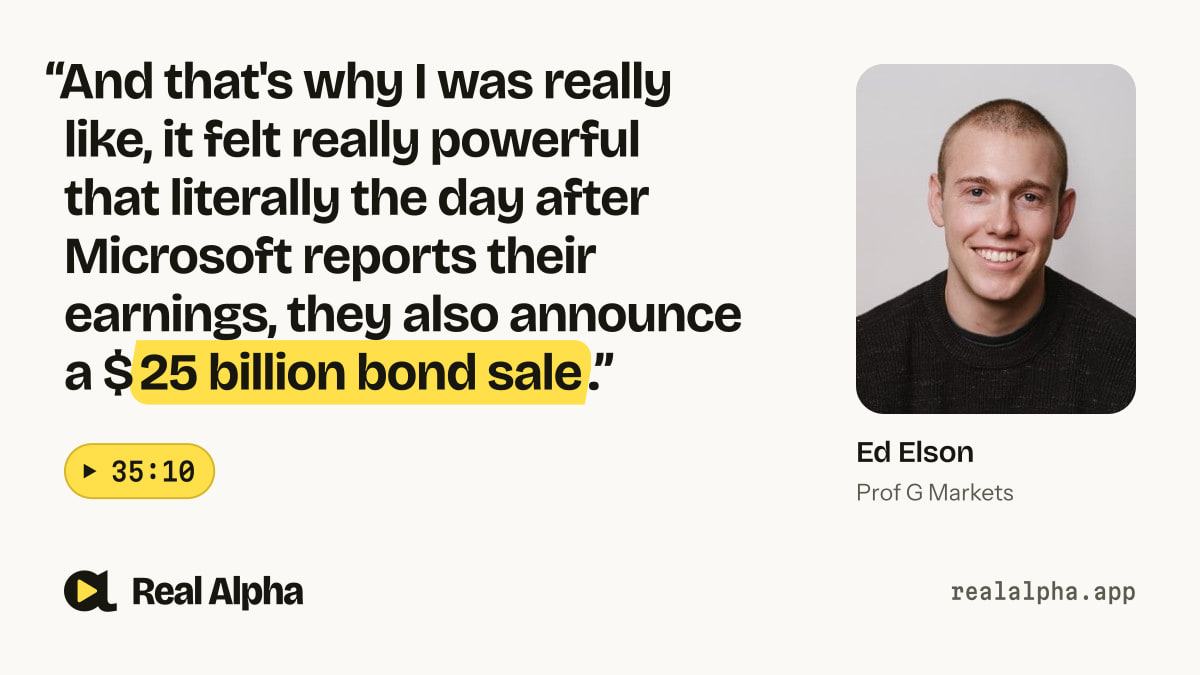
“And that's why I was really like, it felt really powerful that literally the day after Microsoft reports their earnings, they also announce a $25 billion bond sale.”
 Ed Elsonat 35:10 · Prof G Markets
Takeaways
- Hyperscaler capex is outpacing cash generated by their businesses.
- The coming buildout may require more than $2 trillion over two years.
- Bond and equity markets now have greater leverage over Big Tech.
About this segment
Ed Elson argues that hyperscalers’ negative free cash flow is forcing them to raise money externally for AI infrastructure. That dependence leaves them more exposed to investor sentiment and financing conditions.

Ed Elson, Host

Scott Galloway, Host
From “The Stock Market Is Already Pricing In A Democratic Sweep”, Nov 2, 2026. Watch the full episode
Thanks. We'll look at and fix what's off.
Transcript
Transcribed by machine (Whisper) from the episode’s audio, so a word may be off here and there.
- 33:11
is that negative free cash flow. And to be clear, Google is not alone there, because we also know that Oracle's free cash flow is negative, Meta's free cash flow is negative now, Now, Amazon's free cash flow is negative now. All of the hyperscalers have now entered into negative free cash flow because of how much money they're spending on the data centers. It's nearly $700 billion on CapEx in the past 12 months.
- 33:36
That's up nearly 90% from a year ago. The only hyperscaler with positive free cash flow is Microsoft, which is great, but it still came down 27%. So the thing that worries me is the fact that these businesses can no longer use their profits to finance their goals, which is in this case to build data centers and build the AI revolution. And so you think about, okay, well, what can they do then if the most profitable companies in the world can't even use their profits to do whatever it is that they want to do?
- 34:12
Well, then you'd say, okay, they can go to the cash on their balance sheet. And that's what a lot of people have pointed out. And to be fair, these guys have a lot of cash on hand. If you look at their cash and cash equivalents and their short-term investments, you've got Amazon with more than $120 billion. You've got Google with more than $250 billion. If you add all the hyperscalers together, it's nearly $600 billion, which is great.
- 34:37
But then you look at how much CapEx is going to rise next year and the year after that. And if you add it all up among the hyperscalers, the five of them, Oracle, Microsoft, Meta, Amazon, Google, over the next two years, it's estimated to be more than $2 trillion. So basically what you have is like a $1.5 trillion gap between how much money they're going to spend and how much money they actually have.
- 35:06
Because remember, they can't use the profits anymore or the cash flows because those cash flows are negative. So they have to get the money from somewhere else. And so then you think, OK, where is that money going to come from? And the answer is they have to go to the capital markets and raise money. And that's why I was really like, it felt really powerful that literally the day after Microsoft reports their earnings, they also announce a $25 billion bond sale.
- 35:36
And that's just a week after Meta said, we're going to go raise $95 billion in the equity markets. So what it was so great about these companies is how independent they were for so long. They were so strong, so profitable. They could do whatever they want. who gives a shit about the market conditions they don't need our money but that has now completely changed they need money from the capital markets they need money from us the investors and if we decide that we don't want to give them that money then they're screwed they're just in a systemically more vulnerable position and that to me is the real shift in what's happened here for big tech they used to be these dependent or excuse me independent companies, do whatever they want. But now they have to go out there and they have to please investors and they have to convince them, don't worry, give us the money, we'll pay it back.
- 36:30
We can raise it through the bonds, we can raise it through the equity, but just play the game with us. They're dependent on the capital markets now.