The alpha, twice a week
That was 6 min.
Get the best new moments in your inbox every Wednesday and Saturday. It's free.
Check your inbox
We sent a link to your address. Click it to finish signing up. Not there in a minute? Look in spam.
or
Sourcery · 6 min · Nov 23, 2026
Bubbles burst when wealthy owners need cash
 Ray Dalio
 explains why a technology can be transformative yet still become a bad investment, and how debt or other cash needs can force owners to sell.
The episode’s best minutes
Full analysis- 20:13Bubbles burst when wealthy owners need cash6 min
- 13:28The wealth gap grows when productivity is not broad-basedPro pick 5 min
- 25:55Investment decisions can be built from explicit criteria4 min
- 4 more moments in the full episode
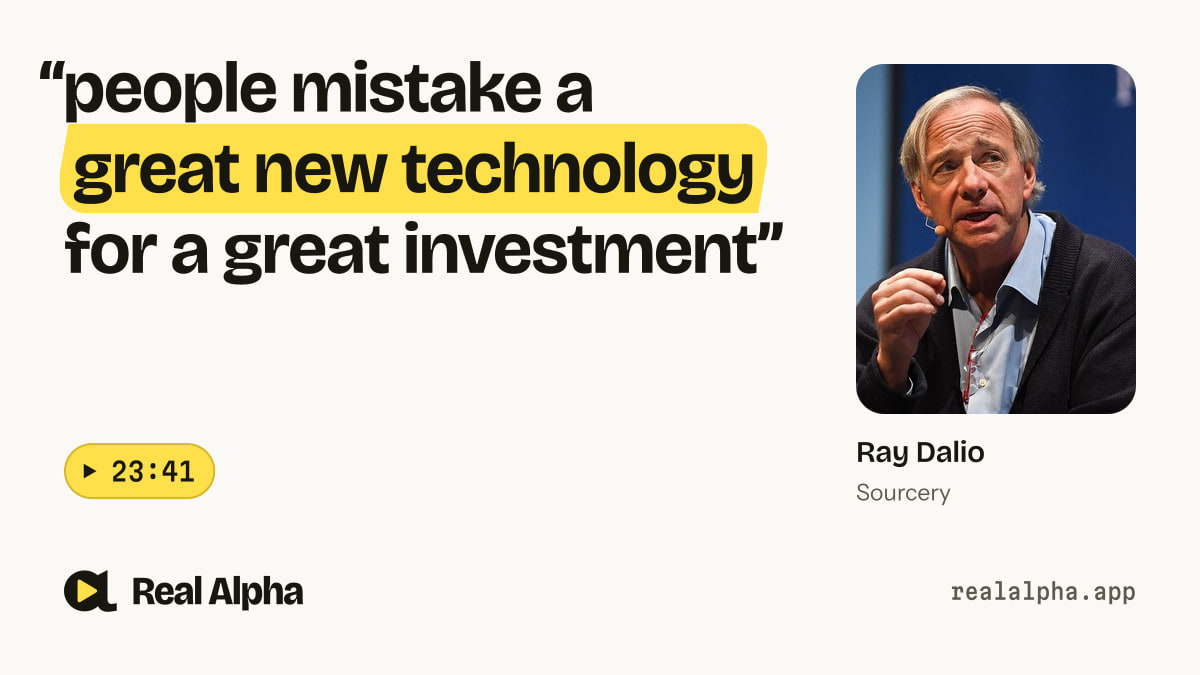
“people mistake a great new technology for a great investment”
 Ray Dalioat 23:41 · Sourcery
Takeaways
- Great technology does not guarantee a great investment.
- Wealth must be sold to become spendable money.
- Cash needs can force selling and turn a bubble downward.
About this segment
Ray Dalio explains why a technology can be transformative yet still become a bad investment, and how debt or other cash needs can force owners to sell. The distinction helps explain how bubbles reverse.

Ray Dalio is founder of Bridgewater Associates and global macro investor.
Founded Bridgewater and developed investment approaches like risk parity and All Weather for global institutions.

Molly O'Shea, Host · Founder, Sourcery
Ex-Upfront Ventures investor; has interviewed Alex Karp and Palmer Luckey.
From “I Finally Interview Ray Dalio”, Nov 23, 2026. Watch the full episode
Thanks. We'll look at and fix what's off.
Transcript
Transcribed by machine (Whisper) from the episode’s audio, so a word may be off here and there.
- 20:19
It's interesting because as we talk about this, I don't know when this IPO will happen, if it'll happen, if the markets have changed it, but the Anthropic IPO is coming up. If not, it'll be out by the time this is released. But we've had a string of very large IPOs this year that are creating really large wealth generation events, increasing the divide and the gap. And so we had SpaceX earlier this year that reached up to $2 trillion. We're having Anthropic. They're saying it'll be between $1 to $2 trillion, $1.5 or wherever it lands. It's beside the point.
- 20:53
But more so, what was interesting with this one was that they're creating a public benefit corporation for that. Do you think that's like a remedial type of like they're trying to push back on any or like save themselves from any sort of pushback? Like, do you think that they're trying to show, no, we actually do care about people. Don't hate us. We're not the bad guy. Like, we're going to help you.
- 21:20
And then like, what is the point of that? It's important to distinguish wealth from money, okay? You can't spend wealth. You have to sell wealth and convert it into money in order to spend it. So there's a dynamic, for example, that's relatively easy to create wealth. What you do is you, let's say, have a $50 million raise at a billion valuation. And all of a sudden, you've created a billion dollars of wealth, and you have and you become a billionaire because you've done that but that's you can't do anything with that until you sell the wealth in order to get it to have the money and so that dynamic happens where when those who want to sell wealth um or need to sell wealth typically bubbles burst when uh those who have wealth need to sell it to get money now quite often that happens because
- 22:17
they borrowed to make the wealth or something. Anyway, so when we take that dynamic and look at it, they will have some wealth, okay, but will that convert into money because you have to spend it? So I think it's a good thing. I've contributed to what are called trumpet counts in terms of giving others and so on. And I think these are good things. However, they don't turn into money. Okay. And, and so we're still facing that particular issue. Okay. Where, where does the money come from? Interesting. So we are in a bit of an AI bubble. I'd love for you to explain what a bubble is and maybe where we are in this process okay a lot of people think a bubble is whether the price gets beyond that which can come from the present value of future cash flows and that's not it because um what happens is you don't know the future cash flows for decades so
- 23:27
if you take the present value and in any case even those with had good financial cash flows have had bubbles so you could see like the 1920s bubbles and then you have the collapses and even if they work out in the long run you have the bubble bursting right the bubble the mechanics of it is that people mistake a great new technology for a great investment and in other words let's say in the 20s imagine what that was like that was the first time you had a electricity in houses so you had lighting and you had refrigeration you had movies you had radio you had cars you had airplanes all of this new technology coming on i mean it would be more apparent than anything we've seen even with ai it's more apparent and so on so everybody believes in that technology and then what they do is they borrow money quite often to have it and you have
- 24:28
a lot of selling of that new technology and that demand. And great wealth is created, but you still need money. And what happens when you need the money is, let's say, money to pay off the debt because you bought the stock or whatever. Interest rates rise and all of a sudden you need more money or you could have wealth taxes and you need, well, where is the money going to come from to pay the wealth taxes, you got to sell. And so when that happens, that's a classic problem. And then the ownership becomes in weak hands, right? Because everybody wants the thing. Everybody wants that new technology and so on. And so you get the sort of concentration that you have now. Like everything depends on AI, right? The markets, the economy, everything depends on AI. And so that technology is volatile and very risky. And then when you get that dynamic, you pop that and then the thing
- 25:26
starts to work in reverse. Okay. People rather than become confident, they become scared or they need the cash flow they need in order to deal with it. So things get worse and then people back off. They're backing off means that there's less of that and so on. So you have that dynamic that happens that then works in reverse because you, you know, you need the money and then you're