The alpha, twice a week
That was 5 min.
Get the best new moments in your inbox every Wednesday and Saturday. It's free.
Check your inbox
We sent a link to your address. Click it to finish signing up. Not there in a minute? Look in spam.
or
Newcomer Pod · 5 min · Aug 3, 2026
Build scientific skills alongside AI literacy
 Pim de Witte
De Witte recommends rigorous sciences and coding to help people validate AI outputs and work with the models.
The episode’s best minutes
Full analysis- 17:04Game data can pretrain robots, but real-world tuning still matters9 min
- 32:42Specialized robots may beat humanoids in homes4 min
- 42:26Build scientific skills alongside AI literacy5 min
- 5 more moments in the full episode
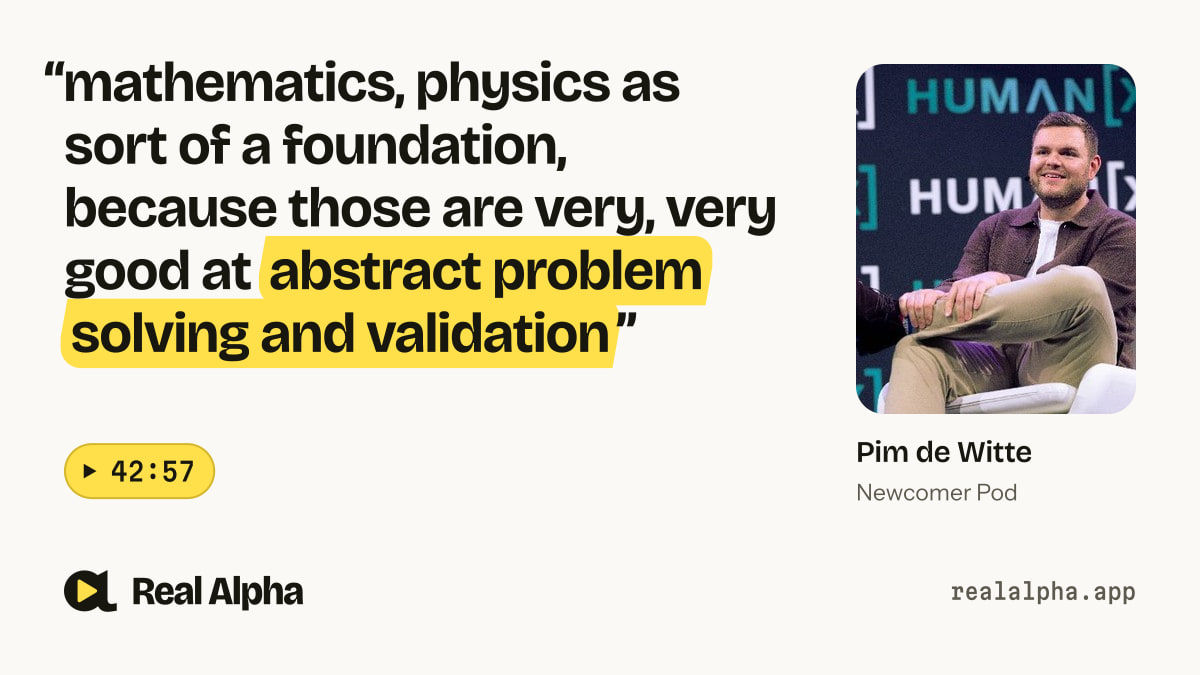
“mathematics, physics as sort of a foundation, because those are very, very good at abstract problem solving and validation”
 Pim de Witteat 42:57 · Newcomer Pod
Takeaways
- Math and physics build abstract problem-solving skills.
- Coding and AI are becoming basic literacy.
- Biology and measurement devices look promising for careers.
About this segment
De Witte recommends rigorous sciences and coding to help people validate AI outputs and work with the models. He sees biology and measurement devices as promising areas for future jobs.

Pim de Witte is CEO of General Intuition.
Co-founded General Intuition, a frontier AI lab for spatial-temporal reasoning, and previously co-founded gaming platform Medal.
- EN
Eric Newcomer, Host
From “The Startup Building World Models From a Billion Video Game Clips”, Aug 3, 2026. Watch the full episode
Thanks. We'll look at and fix what's off.
Transcript
Transcribed by machine (Whisper) from the episode’s audio, so a word may be off here and there.
- 42:34
um if i yeah say i'm this like 18 year old besides like working on your platform and making some money like i don't know i'm smart but somewhat ai skeptical like what do you what do you think they should be doing right now like they should just be sitting there on claude like like what is a practical thing to prepare for the world that's coming as you see it it's actually getting really good at both the fundamental sciences and the capabilities of these models I think that the beauty is that the true skill is found somewhere in the middle.
- 43:04
So, like, yeah, my recommendation would be mathematics, physics as sort of a foundation, because those are very, very good at abstract problem solving and validation in spaces where your job is actually to find out often how to ask the question. And then, which is often harder than sort of finding an actual solution. um and then uh uh so so the fundamental sciences i think become really important because it's a way to check sort of the output of of systems uh and that is sort of the sort of antidote to what you need to the lm hallucinations and that they just tell you what you want to just learn to think in the most rigorous way yeah exactly i think that that's kind of you know that's where i would go then i think coding and systems are still really important i think these are just these are just
- 43:49
going to be like basic literacy because everything you the same way right the same way that um like coding is so important to understand how the world around you works and increasingly so that just having a basic Understanding, I think, is still super important. So I think software engineering and AI, I think, are still going to be really important fields. But I think the fundamental sciences are going to be increasingly important.
- 44:09
In terms of where everything is trending, I think the next frontier is probably biology. In terms of, like, massive value creation. In terms of massive value creation. And that's the most cynical Silicon Valley way to put it. In terms of improving lives of humans and creating a lot of, like, things that are going to translate. You asked me about jobs. Like, I think where is most... I'm not saying you were cynical.
- 44:28
I'm saying Iowa's value creation rather than, oh, we're going to invent all this amazing stuff that could help people live longer, healthier lives, and therefore there will be jobs in it. Yeah, exactly. And I'll give you one example. I think one way to look at it is there's a lot – so there's kind of three stages of AI. There's bits to bits, bits to atoms, and then atoms to atoms. So this is a quote from Andre Kaparthi.
- 44:52
And bits to atoms and atoms to atoms is fundamentally like I think measurement constraint. and biology like i think also this is potentially why mid georgie launched the the the ultrasound based device that they did is because um you just need really good data um for a lot of these problems and data doesn't exist which means ai is not that helpful except if you can sort of constrain a problem down to tech space for a very specific um um a problem set right um so mathematics obviously matters tremendously things like physics and biology but at the at the at the end of the day um i i if you don't have the data uh it's very very hard to push the frontier in in those areas uh um and so i think biology is one of them i also think there's a very good chance that a lot of the things that we will be doing as as our future jobs is just building really really good
- 45:40
measurement devices is is um i think a lot of scientific problems are actually just fundamentally measurement constraint it's very very hard to evaluate you think we'll start to see games build as research vehicles it's like oh it would be really convenient if this happened it was a you know a lab so we could you know somehow subsidize convince people would be fun to spend their time and something useful for us to learn for sure there's um there's a research program called eterna uh out of stanford i don't know if it's still active but they they essentially abstractly represent the rules behind RNA in logic-based puzzles and then they have and also spatial puzzles so they sort of rely on human pattern recognition to correctly predict structures and then there are certain players that don't know anything about RNA that just
- 46:31
based on their learned intuition are able to correctly predict structures that correctly synthesize in the lab. And there's a video about it on YouTube. So this is also the North Star for general intuition, right? If you can solve a general agent that can solve problems in pixel space, all of a sudden it has many scientific applications. But to your point, I think there will be indeed many labs that make it easier to access, because that's another thing that robotics does, right? If you have good models that can take safe actions, you actually open up the operations of something to a lot more people. And so, um, no, so measurements, um, uh, like think about how many things that we haven't measured yet. It's impossible to know. Uh, but that's going to be sort of the limit of science, right? Cause science needs something to value against.
- 47:21
We need to bring more fields into verifiable domain. Um, and so measure like, you know, so on the jobs question, biology and measurement devices, I think are the two where I would feel very confident starting a career in, and in terms of education, fundamental sciences, math, physics, And coding on AI is so important. What do you say to people who think this is just a bubble that's going to blow up?