The alpha, twice a week
That was 3 min.
Get the best new moments in your inbox every Wednesday and Saturday. It's free.
Check your inbox
We sent a link to your address. Click it to finish signing up. Not there in a minute? Look in spam.
or
The Peterman Pod · 3 min · Oct 26, 2026
C succeeded by balancing efficiency and expressiveness
 Brian Kernighan
 explains how C fit the limited memory of early computers while remaining expressive.
The episode’s best minutes
Full analysis- 16:33Bell Labs judged research over years, not weekly output4 min
- 54:06Princeton expects computer science majors to fall sharply4 min
- 39:38C succeeded by balancing efficiency and expressiveness3 min
- 4 more moments in the full episode
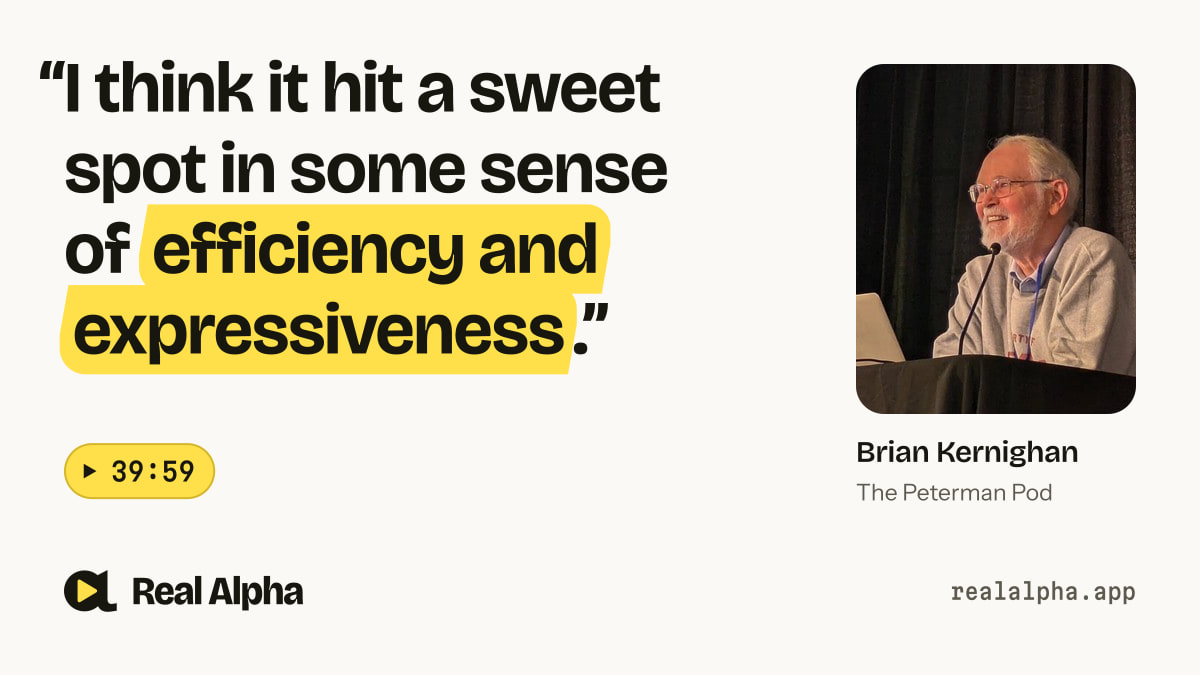
“I think it hit a sweet spot in some sense of efficiency and expressiveness.”
 Brian Kernighanat 39:59 · The Peterman Pod
Takeaways
- C fit the tight memory limits of early computers.
- It was small enough to compile efficiently yet expressive to use.
- Unix and C reinforced each other's adoption.
About this segment
Brian Kernighan explains how C fit the limited memory of early computers while remaining expressive. Its close fit with Unix helped both become widely used.

Brian Kernighan is a former Bell Labs member of technical staff and co-author of the original C book.
Co-authored The C Programming Language and helped develop influential programming tools, including awk.

Ryan Peterman, Host · Host, The Peterman Pod
Went from new grad to staff engineer at Instagram in three years.
From “Brian Kernighan: Inside Bell Labs, The Best Programmer, Why C Won”, Oct 26, 2026. Watch the full episode
Thanks. We'll look at and fix what's off.
Transcript
Transcribed by machine (Whisper) from the episode’s audio, so a word may be off here and there.
- 39:43
The gentleman with the briefcase was not identified. One of the most famous books that you co-authored was the one on the C programming language. And since C kind of came from Bell Labs and you were so close to it, why was C so... So influential, in your opinion, like now looking back. I think it hit a sweet spot in some sense of efficiency and expressiveness. If you go back to when C was first created, let's just call it 1972-ish or something like that.
- 40:18
Machines were pretty wimpy. They didn't have much memory. The first machine that C ran on had, I think, 24K bytes. And that was the whole thing. So you had to write a compiler. Oh, you had an operating system. you needed a bit space for files, what do you do? The disk, I think, was half a megabyte. So it's a little tricky. So C was simple enough that you could see the translation into the underlying actual instructions of the particular machine, the PDP-11 at that point. Language is simple. You could see the compilation. You could imagine building a compiler for it forwardly enough. It wasn't a big language. At the same time, it really was expressive. I mean, you could say what you needed to say very, very effectively in the language. And I think it's hard to find a spot like that. And so one of the reasons I think C has succeeded as long as it
- 41:17
has is that it still has that efficiency and expressiveness is, I think, the right word. Certainly, there are lots of other languages which, for various purposes, are better choice at this point. Well, because there are plenty of things that C doesn't do, couldn't do at the time because you didn't have enough resources, right? You couldn't do a lot with, you know, fancy runtime stuff you didn't want to do checking because checking would take code and you come on you've only got suddenly 4k bytes for your program now what so an awful lot of things were cut that way the other thing is the original target for C was to build the operating system and so there's a class set of things that you just don't need if you're building an operating system so I think it was for its time really really really good match and then of course Unix and
- 42:14
And C was this sort of symbiosis thing went together. And so Unix was just so much better than any of the commercial operating systems at the time. Just so much easier to use, so much more productive and so much more fun that people used it in preference. And then they would write programs in C and they would result in interesting tools.