The alpha, twice a week
That was 7 min.
Get the best new moments in your inbox every Wednesday and Saturday. It's free.
Check your inbox
We sent a link to your address. Click it to finish signing up. Not there in a minute? Look in spam.
or
Machine Gods · 7 min · Oct 28, 2026
Calling AI a marketing term demands more technical precision
Meredith Whittaker traces the label “AI” to its history as a way to attract funding and attention.
The episode’s best minutes
Full analysis- 2:54Anthropic’s growth comes with founder control safeguards7 min
- 43:49Calling AI a marketing term demands more technical precisionPro pick 7 min
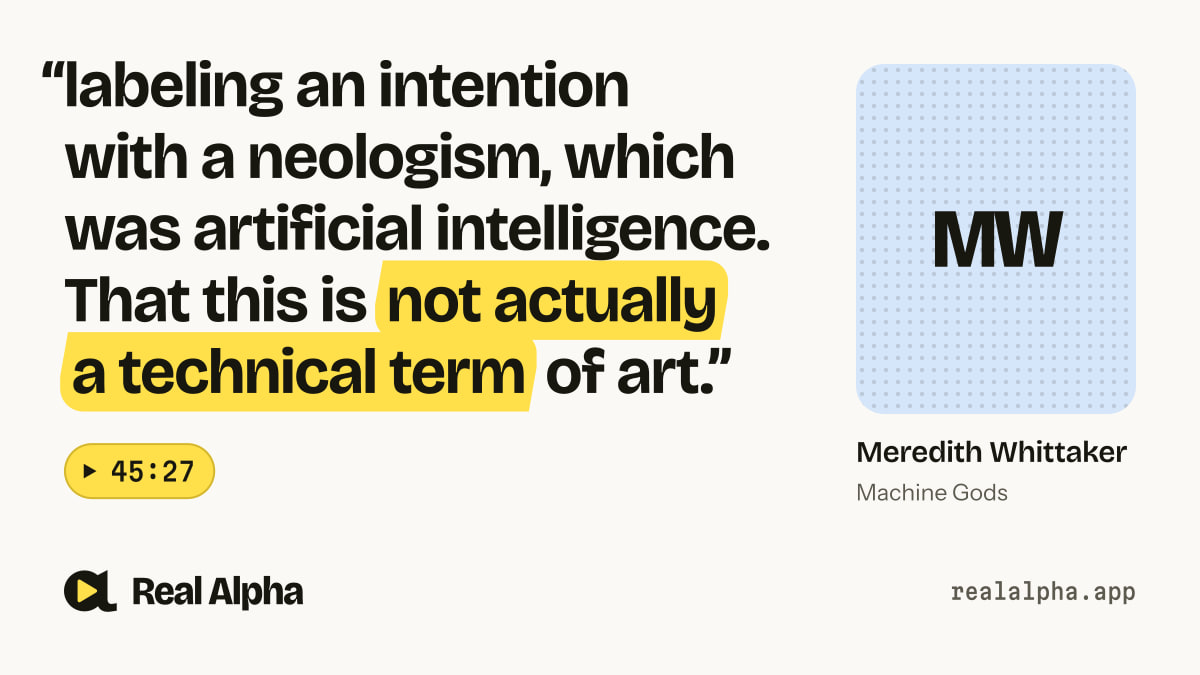
“labeling an intention with a neologism, which was artificial intelligence. That this is not actually a technical term of art.”
Takeaways Pro pick
- The term AI has covered many different technical approaches.
- Whittaker links today’s AI boom to data, compute and commercial incentives.
- Specificity helps people make better decisions about risks and guardrails.
One of Pro's picks, open to you here. Try Pro free for 7 days
One of Pro's picks. The rest of the summary and the 3 takeaways are in Real Alpha Pro; the video, the quote and the transcript stay free.
Read it with Pro, 7 days freeAbout this segment
Meredith Whittaker traces the label “AI” to its history as a way to attract funding and attention. She says technical specificity helps people assess systems, risks and who controls them.
Meredith Whittaker is president of the Signal Foundation.

Kevin Roose, Host · Co-founder, Machine Gods Media
Wrote The Shift column at The New York Times; co-hosted Hard Fork.

Casey Newton, Host · Founder & editor, Platformer
Covered tech at The Verge, CNET and the SF Chronicle; co-hosted Hard Fork.
From “How Anthropic went from “near death” to IPO”, Oct 28, 2026. Watch the full episode
Thanks. We'll look at and fix what's off.
Transcript
Transcribed by machine (Whisper) from the episode’s audio, so a word may be off here and there.
- 44:01
Meredith, you've been very involved in the community that some people would call AI ethics, this group of scholars and activists who I think were early to warning people about risks like bias and surveillance. But maybe we're too dismissive of AI capabilities. You yourself have written that AI is a marketing term. It's not intelligent. As recently as January 2024, you called AGI a marketing term overlaid with quasi-religious symbolism. Do you still feel that way? And do you think there's anything that maybe the AI ethics community has missed or has been too skeptical about as these systems have gotten more capable? We're going to need more than five minutes, Kevin, because you just drew a sword there. One, I would not claim the AI ethics community as a coherent thing. There were just a number of people watching the introduction of
- 44:54
machine learning technologies as they grew in prominence and capabilities, yes, in the tech industry and were concerned about the ways that they could be deployed. Literally, Kevin, the term AI is a marketing term. But I'm not saying that disparagingly. What I'm emphasizing when I emphasize that history, which I can go back to 57 when John McCarthy coined the term in order to market his Dartmouth conference to...
- 45:27
ARPA at the time, in order to get funding, in order to create a term that allowed him to be the father of AI instead of the disciple of Norbert Wiener's cybernetics, is that he was labeling an intention with a neologism, which was artificial intelligence. That this is not actually a technical term of art. And over its now 80 plus year history, it's been applied to a very vast and very heterogeneous array of technical approaches, all of which are kind of trying to get systems made up of code and mechanics and hardware and computation in some form or another to act in ways we would recognize as human-like, as intelligence-like. And that we need to keep that in mind, not because we need to disparage these systems as incapable or as you know, somehow not worthy of our time or, you know, respect when they, you know,
- 46:27
produce code very quickly, but so we can keep in scope what they're actually made of, who actually controls them, how they actually function them. So when we get into Hacktober or whatever we're calling this month, we can actually fix it instead of waving our hands and being like, oh my God, the conscious God machine has come down and decided to smite us by finding vulnerabilities in all our core systems. No, we understand how this works.
- 46:55
We understand the technical fundamentals of how this functions. We understand that it's not magic, even if it produces magical feelings and does things that are virtuosic. And we understand that at this moment in history, the term AI is being applied to a very narrow and very capable in some narrow domains deep learning style approach and this deep learning style approach became popular not because there were advances in deep learning it became popular around the late 2000s early 2010s because the social media companies realized like oh my god we have so much data and we already have compute and distributed systems to process that data let's start applying some back propagation. Let's start applying some old deep learning algorithms from the late 80s and early 90s and see what they do. Oh my God, what do they do? They index the YouTube algorithm
- 47:50
beautifully. We couldn't have done that with human labor. They index Facebook beautifully. We couldn't have done that with human labor. Let's start hiring these guys. Let's start making an industry. Let's change the term from machine learning, which is what we called it at Google as one of the sort of tools and the research statistical toolbox that was trying to optimize ads at the time. Let's change the term to AI, back to AI. Let's reclaim that term because it's fancier, because it has more of a libidinal valence, let's say. So I think I need to sort of push on the characterization there because what I am saying is not, it's just marketing, we can ignore it. I'm saying by understanding that it is in fact a marketing term and demanding more technical specificity, more of a material read on what this actually is and what it's made
- 48:37
of, or we can make much, much better decisions around governments, around what we build, around guardrails, and around, you know, ultimately, how do we reclaim control over these systems and not get bamboozled by a fairy tale? Yeah, I guess my concern is less about us forgetting that this was originally a marketing term, and I believe you that it was. Literally, citations are are ample here but but i think there's this there's this uh there's this move that i have come to associate with people from the the ai ethics community where it's like we can't talk about the sort of long-term or more severe risks of ai because there are so many risks right now in the here and now that we're overlooking when we do that and i think there were people i remember being told you know a year or two ago like stop talking about these uh these
- 49:26
these far off risks like automated cyber attacks, because look at all the things that AI is doing now. And I think in the extreme, and I'm not accusing you of doing this, but I think there are some people who sort of overlooked how real and how fast approaching these concerns were and sort of dismissed them as futuristic science fiction rather than sort of wondering what would happen if they panned out and how we should adapt and respond to that.
- 49:51
I'm marking myself safe from that category because I've been talking about that shit for a while. I don't know. I mean, OK, yeah, there's a lot of people. A lot of people say a lot of stuff. Everyone's trying to get their arms around this thing that's like a little bit scary, a little bit weird and is mystified beyond recognition in a lot of the popular conversations around it. And so what I'm demanding is technical specificity and rigor. And yeah, we need to take the security and privacy concerns deadly seriously because this is, you know, we're watching a kind of eating the seed corn of our core infrastructures right now in a way that I don't think we're actually calculating.
- 50:27
So you want, you know, it's near term, it's far term risk, it's whatever you want to call it to make it sexy for the, you know, the headline. But it's, you know, there are very real risks that also include the consolidation of power in the AI industry, you know, around a handful of companies that are sort of architecting these decisions on behalf of, you know, billions of other people.