The alpha, twice a week
That was 8 min.
Get the best new moments in your inbox every Wednesday and Saturday. It's free.
Check your inbox
We sent a link to your address. Click it to finish signing up. Not there in a minute? Look in spam.
or
The Ezra Klein Show · 8 min · Oct 20, 2026
Canada can target tariffs where they hurt U.S. voters
 Chrystia Freeland
 explains why tariffs on Canadian inputs raise costs for U.S. manufacturers, and how Canada chooses retaliation targets.
The episode’s best minutes
Full analysis- 7:25Canada can target tariffs where they hurt U.S. voters8 min
- 22:00Appeasement taught Trump that coercion was workingPro pick 7 min
- 50:27Russian oligarchs misjudged how much they could control Putin7 min
- 5 more moments in the full episode
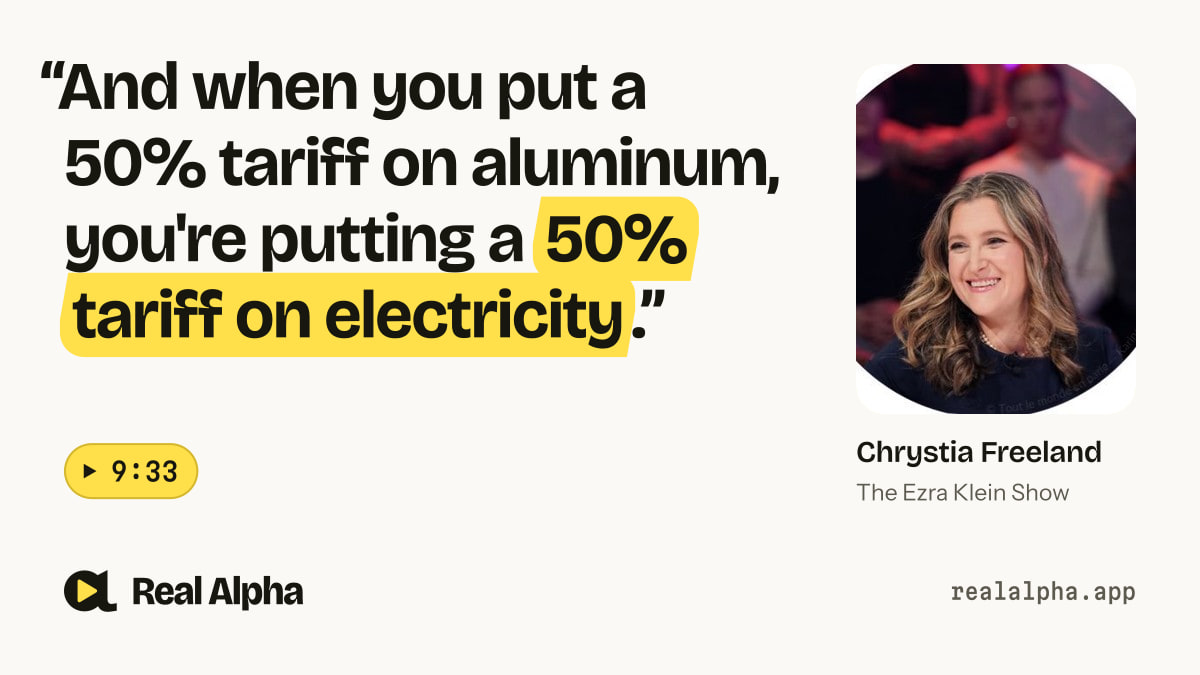
“And when you put a 50% tariff on aluminum, you're putting a 50% tariff on electricity.”
 Chrystia Freelandat 9:33 · The Ezra Klein Show
Takeaways
- Canadian exports often feed directly into U.S. products.
- Retaliation can target goods that are easy to substitute.
- Political pressure works when voters feel the cost of tariffs.
About this segment
Chrystia Freeland explains why tariffs on Canadian inputs raise costs for U.S. manufacturers, and how Canada chooses retaliation targets. The strategy aims to pressure politically sensitive constituencies while limiting harm at home.

Chrystia Freeland is a former Canadian deputy prime minister, finance minister and foreign affairs minister.
Reported in Ukraine, managed Thomson Reuters and served as Canada's deputy prime minister and finance minister.

Ezra Klein, Host · Host, The Ezra Klein Show
From “Trumpism Is Backfiring | The Ezra Klein Show”, Oct 20, 2026. Watch the full episode
Thanks. We'll look at and fix what's off.
Transcript
Transcribed by machine (Whisper) from the episode’s audio, so a word may be off here and there.
- 7:37
What does the world in which this goes to full-on trade war or continues in full-on trade war look like? Can Canada's economy withstand what America is doing? And what is Canada's response to America, given the size differential? The first thing I would say is I think Canadians are very realistic about the fact that this is an asymmetric standoff, shall we say. This is an asymmetric confrontation, and it means it will be more painful for Canada.
- 8:17
Canadians recognize that. But Canadians also really recognize the stakes. It matters more for us. And I am really confident that Canadians will hold the line. So we have been in a version of here before. And the last time the United States imposed tariffs on Canada, we retaliated dollar for dollar. I was the minister responsible for that. And ultimately, America dropped its tariffs. And the reason America dropped its tariffs was twofold. One, imposing tariffs on our exports to you actually hurt you. That's what is perverse about all of this is, you know, the notion that somehow America is better off when it imposes tariffs on Canadian aluminum is just perverse.
- 9:21
We're actually doing you a favor by getting you to drop those tariffs because tariffs on Canadian aluminum are a tax on electricity. You yourselves are choosing to make electricity more expensive. Explain the mechanism there. Well, aluminum is basically electricity in solid form. That's all it is. That's why Quebec produces a lot of aluminum because it has cheap hydroelectricity. And when you put a 50% tariff on aluminum, you're putting a 50% tariff on electricity. The aluminum that Canada normally exports to the United States contains the amount of electricity equivalent to more than 450 data centers, equivalent to the output of half a dozen Hoover dams.
- 10:07
It's a lot of power. And you are choosing voluntarily to say, we're going to make that 50% more expensive. Like, that's the whole absurdity of these tariff wars. When Trump says things we buy from Canada become more expensive, he's taxing things Americans buy. Right. That's the literal. That's like that. Exactly. Like that's like the absurdity here is the initial thing that you want to do and you are seeking to do unopposed is actually bad for you.
- 10:39
But it's also bad for you. Right. For sure. For sure it is. But you are getting that pain. And one reason, and this is kind of a technical reason, Ezra, but I know that you're a wonky person. One reason, one advantage Canada has in a trade fight with the United States and one reason imposing tariffs on Canada is just so dumb is we mostly export intermediate goods to you. So the stuff that we sell you is mostly stuff you use to make stuff yourselves.
- 11:15
And so by imposing tariffs on the stuff we sell you— Give some examples of intermediate goods. So aluminum is an intermediate good. Very few people go to the store and say, I'd like to buy a ton of aluminum. Aluminum is used by companies to build stuff. um another really good example is uh the softwood lumber that we export to you very few people just like buy the wood but people maybe buy a house or buy a table potash another great example um farmers buy potash i grew up on a farm so um but actually farmers don't even buy raw potash but farmers buy potash turned into fertilizer. But everyone uses potash because we like to eat.
- 12:03
So, you know, tariffs on Canadian goods make stuff in the United States more expensive. And then Canada's retaliation actually has an impact. It's true that the Canadian economy is smaller than the American one, obviously. It's true that Canada is more exposed to trade in general than the United States, obviously. But we actually were your biggest market, larger than China, Japan, and the UK combined. So our tariffs can have an impact.
- 12:38
So can you describe, because I think it's more for Americans thinking about what it might mean for our economy, much like China targeted essential parts of the American manufacturing process with, you know, rare earth magnets and things of that nature. There seems to be a view on Canada's part that it can cause outsized pain by focusing on, you know, things like auto manufacturing. Yeah, look, this is trade policy 101. It's not something that Canada invented.
- 13:13
It's what we did in 2018. And by the way, in 2018, we were joined by the EU, which was really important. And I would love if the EU came on board this time. In 2018, we were joined by the EU and by Mexico. The way to retaliate is you try to do two things. Inflict maximum pain on your adversary. And I hate like even using those terms when it comes to the United States because Canadians like really do not wish Americans ill. They just want not to be the target of unjustified and illegal tariffs. But once you're in that situation, you want to inflict, let's say, maximum pressure on the other side and minimum pain on yourself. So the minimum pain on yourself is you try to avoid imposing tariffs on the intermediate goods. You don't want your own economy to suffer. You don't want your own manufacturers to suffer. You try to impose
- 14:18
the counter tariffs on things that are easily substitutable. And then you try to target your retaliation so that it hits politically sensitive constituencies. So you look at who are the influential senators. Who are the influential members of Congress? Which are the swing states that the White House depends on? And you try to be sure that your retaliation is hitting there so that people recognize the tariffs are hurting them. So Smucker's Jam, this was in 2018, turned out to be a really great thing that we targeted, made in Ohio. And I had a conversation with Sherrod Brown, who like you wouldn't have expected to be a defender of Trumpian trade policy. And I want to be clear, he was not. He is a great guy, was a great partner. And ultimately supported our renegotiated deal. But at one point, he said to me,
- 15:14
could you guys ease off on Smucker's jam, please? It's like really hurting my constituents. And I said, Sherrod, with all due respect, that's the point. We want your constituents to be complaining to you. And we want you to go out and say, you guys might lose your job because of Trump's stupid trade war with Canada. And I'll give you one example of how this is starting to