The alpha, twice a week
That was 5 min.
Get the best new moments in your inbox every Wednesday and Saturday. It's free.
Check your inbox
We sent a link to your address. Click it to finish signing up. Not there in a minute? Look in spam.
or
Balance of Power · 5 min · Oct 27, 2026
Candidate quality can matter more than campaign spending
 Alex Conant
Republican strategist Alex Conant compares the race to 2006 and expects a narrower loss than that year.
The episode’s best minutes
Full analysis- 15:55Swipe-fee legislation is a real risk for Visa and Mastercard5 min
- 35:16An election-driven bond rally could fade as risks come into view4 min
- 40:14Candidate quality can matter more than campaign spending5 min
- 2 more moments in the full episode
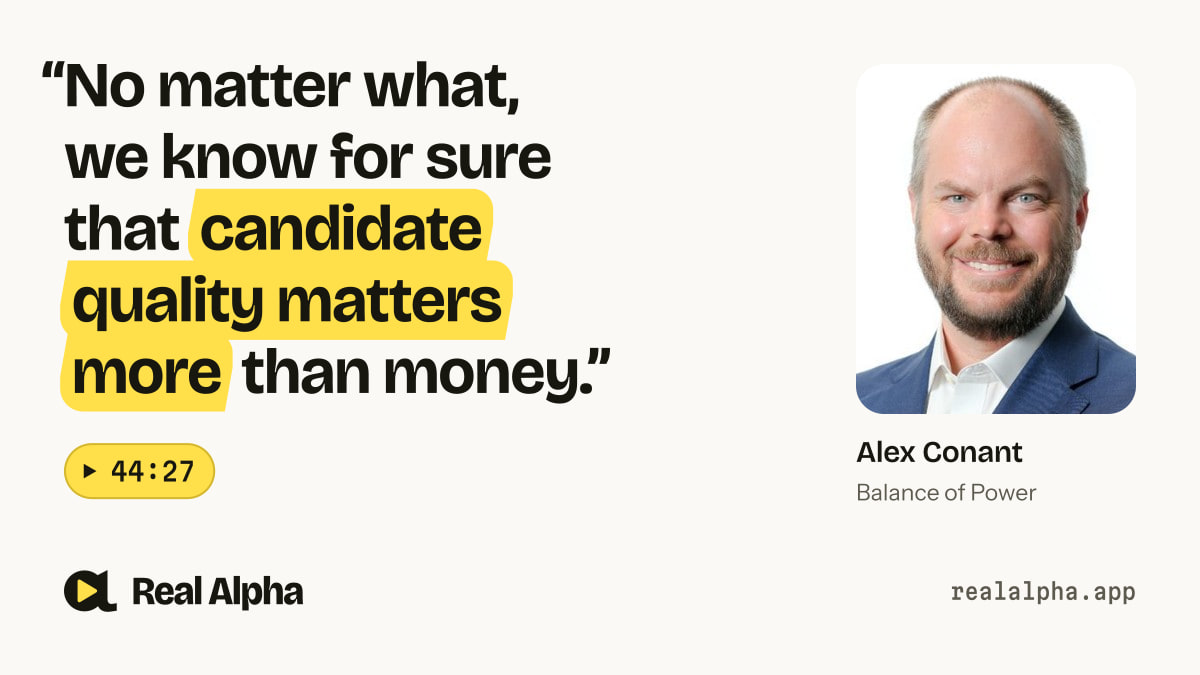
“No matter what, we know for sure that candidate quality matters more than money.”
 Alex Conantat 44:27 · Balance of Power
Takeaways
- Conant expects Republicans to lose the House, but by fewer seats than in 2006.
- He says turning out the Republican base is key in close Senate races.
- He sees candidate quality, not spending, as the reason Texas is close.
About this segment
Republican strategist Alex Conant compares the race to 2006 and expects a narrower loss than that year. He argues that money cannot compensate for weak candidates, even in heavily funded races.

Senior Partner, Precision Strategies
Co-founded Firehouse Strategies and directed communications for Marco Rubio’s 2016 presidential campaign.

Joe Mathieu, Host · Washington Correspondent, Bloomberg
Co-anchors Bloomberg’s Balance of Power and covers Washington; founded and hosted SiriusXM’s POTUS political news channel.

Kailey Leinz, Host · Washington Correspondent, Bloomberg
Co-anchors Bloomberg’s Balance of Power, interviewing presidential candidates, administration officials, lawmakers and regulators on policy.
From “One Week to Election Day”, Oct 27, 2026. Watch the full episode
Thanks. We'll look at and fix what's off.
Transcript
From the transcript Balance of Power publishes with the episode.
- 40:26
When you look at the map, does tidal wave pop into your head? Look, I can't predict the future, but what I can do is make comparisons to past elections. In 2006, 20 years ago, I was a White House spokesman in the Bush White House, and it felt a lot like this, where you had an unpopular president, you had high gas prices, you had an unpopular war in the Mideast. And that year went really bad for Republicans. We lost six Senate seats.
- 40:53
We lost 30 House seats. I don't think it's going to be nearly that bad for Republicans in a week from now. I don't think we're going to lose 30 seats. I don't think we're going to lose six. But the margins are smaller now, right? In fact, I think it's likely. I think most people expect that we will lose the House, but not by 30 seats, right? It's going to be closer than that. And then the Senate, we're a week out.
- 41:14
And what's striking about the Senate map right now is we have so many toss-up races. And all these races really, I think, are 50-50, and nobody knows which way they're going to go. which I think is unusual a week out to have this many undecided races. What gives me some hope is that most of these are in red states or in places where we have really, really good candidates like Maine. Okay.
- 41:33
So of the toss-up races you're referring to here in red states, Kansas, Mississippi, both places where President Trump has had rallies recently. Mississippi was just yesterday. He's in Texas today. All of these states he won by a healthy double-digit margin in 2024. How real is it in your mind that there is a chance they flip blue for the first time in decades or even a century in the case of Kansas?
- 41:56
Well, clearly there's a chance. Otherwise, the president wouldn't be wasting his time going there. Democratic enthusiasm is through the roof. We know independent voters are not happy with the status quo. They haven't been happy with the status quo for about a decade, by the way. And then we know Republicans, they don't like the price of gas. A lot of Republicans don't like the war in the Mideast. If we turn out Republicans, we're going to win all these races. These are red states by a lot. These are states that Trump easily won two years ago. If we turn out the Republicans in Texas and Mississippi and Kansas, heck, in Iowa and Ohio, we're going to be fine. So I think Trump going to these states, it does help because at the end of the day, we don't need to try to discourage them turn out. We don't need to try to win
- 42:36
over independents. We just need to turn out the base. Are you questioning. The samples, the polls, we heard Speaker Johnson say, I simply don't believe them. They are based on flawed data. Is that why you expect something less than Jim Cassidy?
- 42:50
Well, we know why Speaker Johnson's saying that, because it's been true just about every time Trump's been on the ballot. We know that Trump overperforms.
- 42:57
Polls are Republicans under sampled at the same time. I don't think we have a good understanding of why that is. I think part of it is just some Republicans just don't like to talk to the pollsters. I suspect some of our voters are just harder to reach. You know, they're working and they don't what have you. But the we know Republicans typically outperform the polls. The problem is the polls right now are really bad for Republicans.
- 43:18
Right. So sure, we might over over reform the polls by two or three points by, you know, based on what Trump's done in recent elections. I don't know that two or three points is going to be enough to save, say, the House, but certainly could help in some of these Senate races.
- 43:30
Well, we've heard frequently that you don't just need to look at the polls. Just watch where the money is going, and it'll tell you what the reality is on the ground when you see the Senate Leadership Fund investing into places like Kansas, even throwing some money at Mississippi. When we take in aggregate the amount of money that has been spent on behalf of Republicans specifically in PACs that are in support of Republicans, This cycle. What will it say if Republicans aren't able to hold on to a seat like in Texas when so much money was spent there, literally hundreds of millions of dollars?
- 43:59
Yeah. Well, look, we talked about comparing 2026 to 2006 and how the map is better for us this year. Another thing we've got going this year, we have a whole lot more money now than we did in 2006. The amount of resources that Republicans have, we're going to be able to outspend Democrats in all. Of these races. So if we still lose, I think it raises real questions about, like, how much does super PAC money really matter?
- 44:19
And I think at the presidential level, we've known for a while that Canada spends the most isn't. Going to be the one to win. Otherwise, you know, the owner of our network would be president right now. So I think it would just raise further questions about, you know, how much can you buy an election if you can spend all this money and at the end of the day still lose? I think. No matter what, we know for sure that candidate quality matters more than money. And the reason that the Texas race is close is not because of resources. It's because of candidate quality, especially on the Republican side.
- 44:52
You know, some Democrats say that about Michigan. I think that's very accurate, and I think the same is true in Maine. Look, I think both parties, if they could do it again, would do some things differently, right? Like, I think we might want to have our incumbents running in Texas and North Carolina right now.
- 45:07
And I think the Democrats would probably want to. Make some different choices in Michigan and Maine.