The alpha, twice a week
That was 2 min.
Get the best new moments in your inbox every Wednesday and Saturday. It's free.
Check your inbox
We sent a link to your address. Click it to finish signing up. Not there in a minute? Look in spam.
or
Bloomberg Law · 2 min · Nov 3, 2026
Certification is a mandatory step, not a venue for disputes
Jonathan Diaz says certification formally records election results; it is not a chance to relitigate the process.
The episode’s best minutes
Full analysis- 9:17The law protects election officials from federal intimidation3 min
- 15:26Certification is a mandatory step, not a venue for disputes2 min
- 13:00Federal voter purges are barred in the final 90 daysPro pick 2 min
- 5 more moments in the full episode
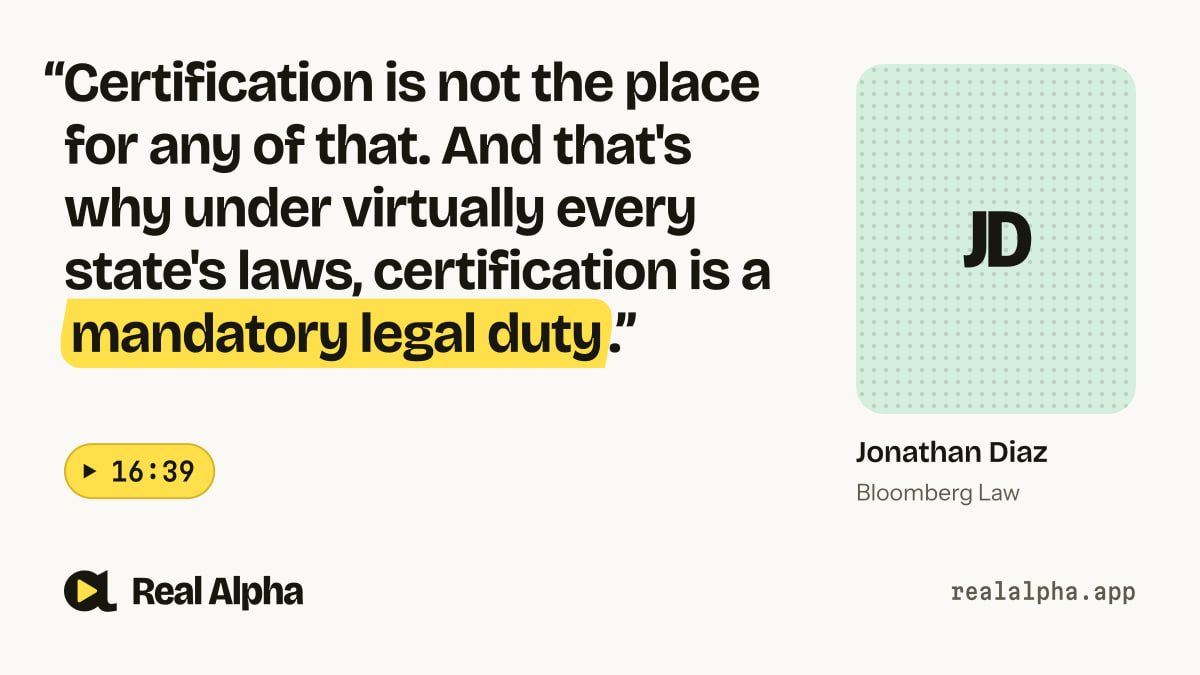
“Certification is not the place for any of that. And that's why under virtually every state's laws, certification is a mandatory legal duty.”
Takeaways
- Recounts and election contests are the routes for challenges.
- Certifying officials generally cannot delay or refuse certification.
- Courts have acted swiftly when officials refused to certify.
About this segment
Jonathan Diaz says certification formally records election results; it is not a chance to relitigate the process. State law generally makes certification a mandatory duty, enforceable by courts.
Director of Voting Advocacy and Partnerships, Campaign Legal Center
Leads CLC’s election-sabotage work, litigates voting-rights cases and coordinates voting-rights partners nationwide.
- JG
June Grasso, Host
From “Trump Loses Election Cases in Alaska & California | Bloomberg Law”, Nov 3, 2026. Watch the full episode
Thanks. We'll look at and fix what's off.
Transcript
From the transcript Bloomberg Law publishes with the episode.
- 15:29
A concern that I hear voiced over and over again is a concern that state election officials won't certify the results of the election.
- 15:39
I mean, unfortunately, it's an issue that we've had to prepare for over the last several election cycles. Look, certification is the final step in the post-election process. It is, I've described it before as like the period on the end of a sentence. It's just the formal conclusion of the process. You know, elections have to end at some point and somebody has to formally declare, you know, the results.
- 16:05
And that's all that certification is. It is not an opportunity to litigate or relitigate the conduct of the election. That's not the time or the place at which to challenge the process or question whether all the laws were followed or whether the ballots should have been counted or not. Every state has really robust post-election procedures for that purpose. That's why we have recounts. That's why we have audits of the machines. That's why there are election contest procedures where a candidate can come in and challenge the results using a legal process. Certification is not the place for any of that. And that's why under virtually every state's laws, certification is a mandatory legal duty. whoever the certifying official is for a given race, they do not have the discretion to decline or delay certification. And in the instances
- 17:01
where officials have tried to do that because of perceived flaws in the electoral process or dissatisfaction with the results, like in, you know, Waynesboro County, Virginia, in 2024 and in Cochise County, Arizona in 2022, legal action was very swift and very decisive. State courts come in and they say, no, this is a mandatory legal duty. You do not have the option to decline. Either you do it or we will find you in contempt because these officials have taken an oath to uphold the law and the law gives them this non-discretionary responsibility.