The alpha, twice a week
That was 3 min.
Get the best new moments in your inbox every Wednesday and Saturday. It's free.
Check your inbox
We sent a link to your address. Click it to finish signing up. Not there in a minute? Look in spam.
or
Bloomberg Surveillance · 3 min · Nov 18, 2026
Cheap Nvidia is not automatically a buy
 John Mowrey
 sees tech multiples compressed amid doubts about earnings durability, but says cheap Nvidia alone isn't a buy signal.
The episode’s best minutes
Full analysis- 12:32Anthropic must win enterprise customers as models commoditizePro pick 3 min
- 25:21Favor shorter-duration AI investments with cash flows soonerPro pick 4 min
- 33:21Cheap Nvidia is not automatically a buy3 min
- 4 more moments in the full episode
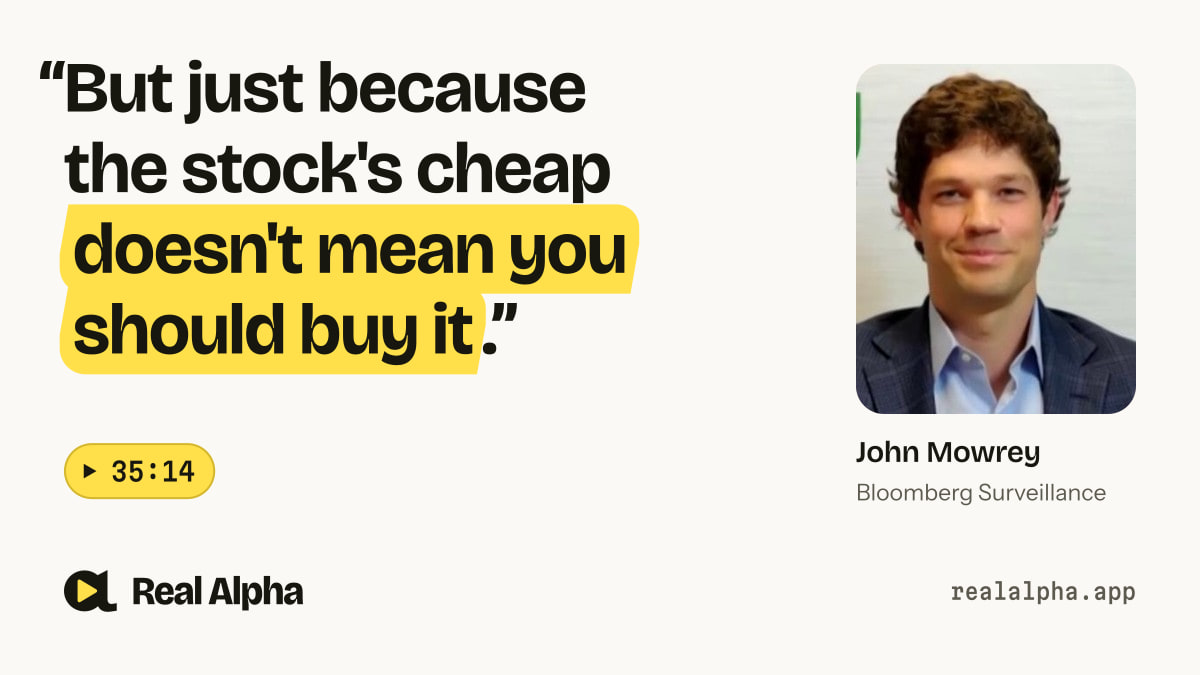
“But just because the stock's cheap doesn't mean you should buy it.”
 John Mowreyat 35:14 · Bloomberg Surveillance
Takeaways
- Tech valuations have compressed amid earnings durability concerns.
- Nvidia's low multiple alone is not a reason to buy.
- Compare relative earnings growth and existing portfolio exposure.
About this segment
John Mowrey sees tech multiples compressed amid doubts about earnings durability, but says cheap Nvidia alone isn't a buy signal. He compares its growth with other chipmakers and explains why his fund stayed out.

CIO, NFJ Investment Group
Leads NFJ’s value-equity strategy and co-manages its dividend, large-cap, mid-cap and emerging-markets portfolios.
- TK
Tom Keene, Host
- PS
Paul Sweeney, Host
From “Nvidia and the AI Trade | Bloomberg Surveillance”, Nov 18, 2026. Watch the full episode
Thanks. We'll look at and fix what's off.
Transcript
From the transcript Bloomberg Surveillance publishes with the episode.
- 33:23
thank you for that question here on Ask Bloomberg Radio. Are we all being fools about AI where we're going to end up doing it on our desktops?
- 33:34
I don't think so. I don't think that's the case at all. And particularly when I look at kind of the AI hardware trade, Tom, you know, you're seeing a substantial dislocation. I mean, I think Dell's trading back at 13, 14 times earnings now. So everyone's kind of worried about this kind of tech bubble in AI. But the reality is you've already had a lot of the multiple compression. In fact, before I came in today, I looked. The NASDAQ is trading at the biggest discount to the S & P on a relative basis in 20 years on the 4P.
- 34:04
So you've got a substantial dislocation that's occurred. It's actually the biggest spread between growth and value since 2000 as we sit here today.
- 34:11
Why is that? Is that the rotation, Trey, we've been hearing about? It's a great question.
- 34:15
I think that there's been a lot of compression because people are really worried about can the earnings hold.
- 34:21
I think it really is about earnings durability. The reality is they have been holding, and I think we could be setting up maybe what occurred kind of in the fourth quarter of 18 into 19. If you think about that, we had a huge sell-off. That was over trade war, right? You had a big sell-off in tech stocks. But then in 19, they all re-rated because the earnings deterioration wasn't as bad as people expected. So all signs right now point to that the market thinks there's going to be some deterioration in earnings.
- 34:50
So you're getting a lot of that compression. And the other, of course, rates. Yep.
- 34:54
NVIDIA, I don't know. The numbers seem NVIDIA-like to me. Beat and raise is what the tech guys tell me I should be looking for. They kind of did that last night. I don't know about the CEO thing, but at least the numbers look good.
- 35:05
What CEO thing? What about the CEO thing? Yeah, we've got two different things going on.
- 35:10
So, I mean, NVIDIA at the close traded at 10.5 times earnings. I mean, that smells like value to me. So that is cheap. But just because the stock's cheap doesn't mean you should buy it. You know, as a portfolio manager, you have to look at kind of the whole semiconductor suite. And actually, the relative earnings growth in NVIDIA is not as fast as companies like Texas Instruments, a Texas stock. Yeah.
- 35:30
It's growing faster on a relative basis year over year than NVIDIA. So I think that's part of the reason you're seeing some of the rotation into some of the other semi stocks. So that's something to consider. But on the CEO piece, I will make one kind of like observation. We've been so worried leading up to this that the AIs were going to make mistakes, right? We're like, well, it's going to kill us to make mistakes. Well, we've been reminded that human judgment is a big part of this and that humans make mistakes too and that we need to be careful about the judgment around how companies structure things, how boards structure themselves. So that's kind of an interesting irony. We've been so worried about AI making mistakes.
- 36:09
Humans can make big mistakes too. Did you buy NVIDIA yesterday? We did not buy NVIDIA. We have not bought NVIDIA yet.
- 36:16
And that's kind of why I went back to the Texas Instruments example, because I don't think it's as simple as one, two, three. NVIDIA is cheap, particularly if you're a fund manager and you already have semiconductor exposure, because you've got to think about how much more semiconductor exposure do I want? And do I want to. Displace one of my stocks in the pageant for another semiconductor stock?