The alpha, twice a week
That was 2 min.
Get the best new moments in your inbox every Wednesday and Saturday. It's free.
Check your inbox
We sent a link to your address. Click it to finish signing up. Not there in a minute? Look in spam.
or
Bloomberg Daybreak: Asia Edition · 2 min · Nov 20, 2026
China wants strategic self-sufficiency in advanced chips
 Nicholas Burns
 says Beijing seeks self-sufficiency in critical technologies but still wants US chips while it trails in AI.
In this episode
Full analysis- 4:18AI agents can find obscure vulnerabilities at scale2 min
- 8:36Nvidia investors should wait for investigations before drawing conclusions3 min
- 19:01Chip restrictions could trigger Chinese retaliationPro pick 3 min
- 1:05Anthropic has strong adoption despite a weak AI market3 min
- 12:00AMD's China restrictions centered on one product3 min
- 16:27The trilateral photo op risked alienating US allies3 min
- 21:52China wants strategic self-sufficiency in advanced chips2 min
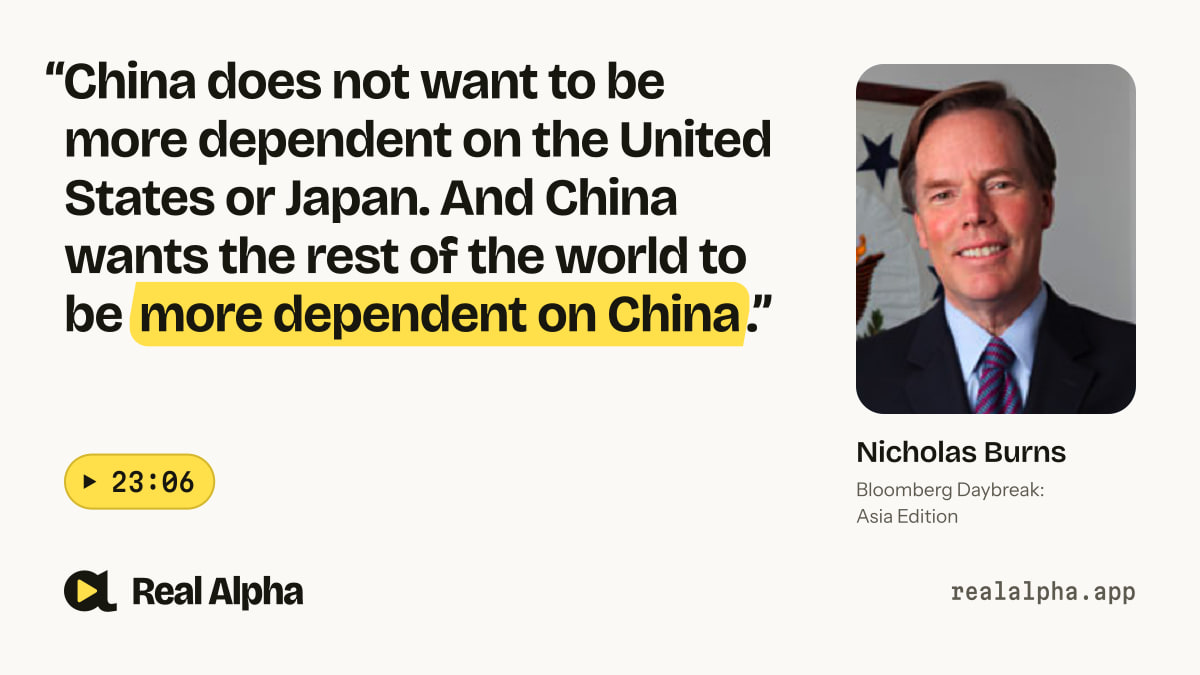
“China does not want to be more dependent on the United States or Japan. And China wants the rest of the world to be more dependent on China.”
 Nicholas Burnsat 23:06 · Bloomberg Daybreak: Asia Edition
Takeaways
- Beijing's long-term goal is self-sufficiency in semiconductors.
- Burns says China remains behind in high-end AI chips.
- He says Chinese firms want US chips in the short term.
About this segment
Nicholas Burns says Beijing seeks self-sufficiency in critical technologies but still wants US chips while it trails in AI. He says efforts to obtain chips help explain the Nvidia investigations.

Roy and Barbara Goodman Family Professor of the Practice of Diplomacy and International Relations, Harvard Kennedy School
Negotiated the U.S.–India Civil Nuclear Agreement and served as ambassador to China and NATO.

Kailey Leinz, Host · Co-anchor of Balance of Power, Bloomberg
Co-anchors Bloomberg’s Balance of Power, interviewing presidential candidates, administration officials, lawmakers and regulators on policy.

Joe Mathieu, Host · Co-anchor & Washington correspondent, Bloomberg
Co-anchors Bloomberg’s Balance of Power and covers Washington; founded and hosted SiriusXM’s POTUS political news channel.
From “Anthropic Record IPO Debuts, Trump-Xi-Putin Trilateral | Bloomberg Daybreak: Asia Edition”, Nov 20, 2026. Watch the full episode
Answers “Is China catching up in AI?” See all 40 answers
Thanks. We'll look at and fix what's off.
Transcript
From the transcript Bloomberg Daybreak: Asia Edition publishes with the episode.
- 21:55
Ambassador, we've got a couple of important headlines that are crossing the Bloomberg terminal right now. Approvals of AI chip sales to China's Tencent, Alibaba and Baidu. Documents released by House panel show these AI chip approvals that cover older generation chips from NVIDIA and AMD. These are not Blackwell's. But with that in mind. I wonder how you see the actual motivations here of the Chinese government versus the actual Chinese companies, the AI companies that were accessing these AI chips.
- 22:30
Palmer Luckey, who. Runs the defense company, Andrew said in his deal book interview that Jensen Wong was on the side of the companies who wanted these chips, that Xi Jinping actually does not want NVIDIA chips, which is why they're stacking up in the port in Hong Kong. He wants to see a homegrown industry coming from the likes of Huawei or some other company. How do you see this? What does Xi Jinping actually want?
- 22:56
I think Xi Jinping's strategy, mid to long term, is to make China self-sufficient in critical materials, critical minerals, and critical technologies like advanced semiconductors. There's no question about it. China does not want to be more dependent on the United States or Japan. And China wants the rest of the world to be more dependent on China. That is a strategic aim. But in the short term... China is behind in the AI race. It's not producing, as you know, the high-end chips that our companies are producing. There has been a massive effort to circumvent the U.S. export controls that President Biden put in place when I was an ambassador there in China four years ago.
- 23:37
And we had Republican as well as Democratic support. So I think in the short term, China does want those chips. The companies have been trying to smuggle those chips into China. That's what the NVIDIA scandal is all about. And that's where the investigations need to lead.