The alpha, twice a week
That was 6 min.
Get the best new moments in your inbox every Wednesday and Saturday. It's free.
Check your inbox
We sent a link to your address. Click it to finish signing up. Not there in a minute? Look in spam.
or
a16z Podcast · 6 min · Sep 29, 2025
China’s demographic window could heighten pressure over Taiwan
 Chris Power
Brian outlines China’s anti-access systems and the difficulty of resupplying Taiwan; Chris Power argues demographic decline may create a 10–15-year pressure window.
In this episode
Full analysis- 0:26Mass production is essential to deterrence3 min
- 6:38Automation can make manufacturing skills easier to rebuild6 min
- 19:34Wartime production cannot be rebuilt overnightPro pick 7 min
- 45:52China’s demographic window could heighten pressure over Taiwan6 min
- 34:39Annual defense contracts make factory capex hard to finance3 min
- 26:02Defense scale requires a handful of large company bets4 min
- 12:46Defense orders cannot quickly fix upstream supply bottlenecks4 min
- 53:25Xi’s security goals can outweigh economic growth2 min
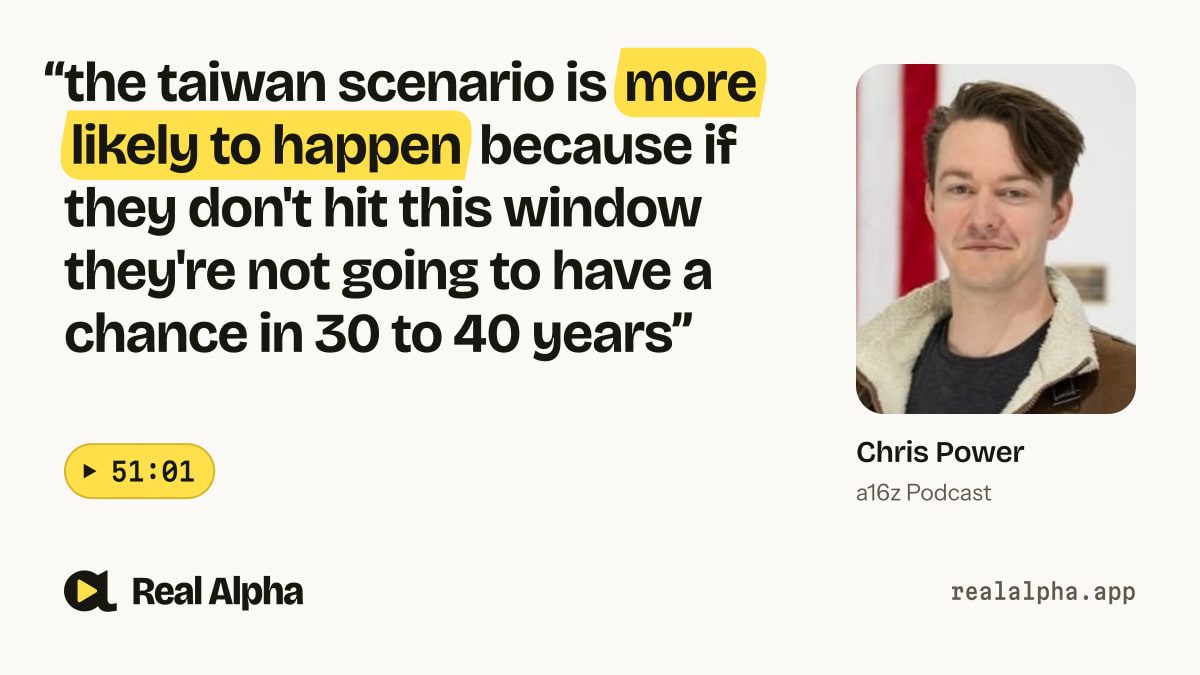
“the taiwan scenario is more likely to happen because if they don't hit this window they're not going to have a chance in 30 to 40 years”
 Chris Powerat 51:01 · a16z Podcast
Takeaways
- China's sensing and missile systems could keep U.S. forces at range.
- Brian says Taiwan's geography makes occupation difficult to sustain.
- Chris sees a 10–15-year pressure window as China's population declines.
About this segment
Brian outlines China’s anti-access systems and the difficulty of resupplying Taiwan; Chris Power argues demographic decline may create a 10–15-year pressure window. Their reasoning connects deterrence to production and geography.

Founder & CEO, Hadrian
Founded Hadrian to build AI-powered factories combining software, robotics and manufacturing to rebuild America’s industrial base.

Erik Torenberg, Host · General partner, Andreessen Horowitz
Helped build Product Hunt; founded On Deck, Village Global and Turpentine.
From “Anduril CEO: China Has Scale. Can America Catch Up?”, Sep 29, 2025. Watch the full episode
Thanks. We'll look at and fix what's off.
Transcript
Transcribed by machine (Whisper) from the episode’s audio, so a word may be off here and there.
- 46:00
but I want to get more into what's misunderstood or not fully appreciated about our competition vis-a-vis China, whether it relates to manufacturing or security, defense, either the state of today, but also where things are going. America has a very hard challenge and has picked a... We always fight in a way game, right? Like, we're always, we're not fighting wars on our homeland, uh, you know, we're always projecting power somewhere around the globe.
- 46:29
That is a very hard challenge. Um, and I think in the recent history, you know, vis-a-vis Ukraine, and I think what would pragmatically happen in a Taiwan scenario, there's American support with, uh, you know, the ally under attack being able to defend themselves. Um, and so I think that's, um, you know, kind of the backdrop of how the U.S. sort of thinks about these things. Well, it presents a very hard problem, right, which is, in a Taiwan scenario, your ability to stage, your ability to resupply, your ability to get things in is the critical question.
- 47:08
But China knew this, and so they have invested systematically in technologies that push back the U.S. and push our whole strategy way, way out, right? So they've invested in space-based sensing. They can find our ships. They can find a lot of aircraft way out, thousands of miles away. They've invested... in this DF-26 missile called the Carrier Killer Missile, commonly, which is able to shoot, I want to say it's something around 1,200 miles out, which makes it so that carriers, warships, all these things we would use for resupply, typically, are massively at risk.
- 47:44
They've got very long-range anti-air missiles, so things that can shoot down aircraft. And so they've created this impenetrable bubble, and that's what they've been investing in, knowing that if they can break the ability of the U.S. to get close, to stage, to resupply, that just cripples the entirety of the U.S. war apparatus from being able to be a real threat. And you combine that with their production capacity, where there's something like 250 times the shipbuilding capacity, you know, massively, massively, probably thousands of times on the weapons side.
- 48:18
You know, it is just on drones, it's massive. Like, you just kind of look category by category, massively outpacing on production. So even if their stuff is half as good, but they've got so much more of it, and they have systematically built up a system that can target us at range, strike us at range, and hold everything at risk, that breaks the entire U.S. war strategy. So it makes it very, very hard.
- 48:42
Now, the counter to this, though, is, you know, in a Taiwan situation, the geography is very hard to sustain the, like, rate you would need to, like, actually occupy, because the goal is to defeat a Chinese occupation, not just an invasion, right? It's not just, you know, people on the sand, on the beach. It's like actually subverting the government and taking over control. Um, you have to sustain extensive, like, maritime campaigns, you know, and that is hard, right?
- 49:11
And there's very few places you can land. Like, there's all these very challenging things. So I think the calculus basically boils down for Zhiv, is he gonna be successful, right? Like, he stated his intention, he stated clearly what he wants to do, He wants to reunify, if necessary, by force. He's stated that he wants to have the military ready by 27. But I think the whole game is really just making it clear that their strategy that, in many ways, broke the U.S. war plan, there is a counteracting strategy, and that Taiwan is prepared, and that it will be too hard to be successful.
- 49:44
And the odds are not in your favor, because the loss there is probably the thing he fears the most. Chris Martin, anything worth adding to that? No, Brian and I talk about this every time we see each other over dinner. I think the one thing that always shocks me and probably shocks Brian is how uneducated the smart people in the country are about how bad this looks. And the easiest example is, I think we run out of every war game we run, we run out of munitions, missiles, whatever, in like six to seven days.
- 50:14
and then it takes about two to three years to refill that battery of, you know, hey, you now have more missiles to shoot. So apart from the Brian strategic layer, I just think every single war, basically, if it goes hot, you know, both sides throw everything they've got at each other over a time period. And it's basically then, if it gets protracted, how fast can you reconstitute? And Brian's correct.
- 50:40
It's not like we're 50% behind. It's just like we shoot all our missiles in one week and then we have none for two years well that that is how kind of terrible the situation is um and and i'll make one last point to brian's point which is my thesis on this is because of the one child policy is going to really drop off china's population very quickly at a certain period of time it creates this forcing function where in my opinion that the taiwan scenario is more likely to happen because if they don't hit this window they're not going to have a chance in 30 to 40 years because they're just they just have this huge population drop off coming really fast down the pipe so there really is this like yes the Davidson window but over the next 10 to 15 years it's going to be this constant very CCP style pressure game of like
- 51:28
Test, test, test, ball of frog, ball of frog, ball of frog. The only thing we can do is focus on, honestly, attritable systems to, because if you kill a carrier and they've got that range, there's nothing we can do about it. Counteract and sensing in space. A lot of attritable mass, mass producing those systems so that, you know, we basically blow everything into seven days. We've got to have the manufacturing battery to be able to refill the clip extremely fast.
- 51:52
And it's going to be this pacing event, I think, that unless it goes hot in 28, it's going to be 10 to 15 years. And as long as we can hold them off there, then their population drops off and we're good for another 300 years. Like, that's kind of how I view the equation. 300 years is a long time. Yeah. It seems like on one hand,