The alpha, twice a week
That was 5 min.
Get the best new moments in your inbox every Wednesday and Saturday. It's free.
Check your inbox
We sent a link to your address. Click it to finish signing up. Not there in a minute? Look in spam.
or
Everybody's Business · 5 min · Nov 13, 2026
China’s long-term planning helped build its manufacturing edge
 Brad Stone
 describes how state plans, local incentives and coordinated investment helped China scale advanced factories.
The episode’s best minutes
Full analysis- 2:36Nvidia’s scandal combines national security and financial risks4 min
- 10:06Political fallout could outlast Jensen Huang’s exit5 min
- 22:19China’s long-term planning helped build its manufacturing edgePro pick 5 min
- One more moment in the full episode
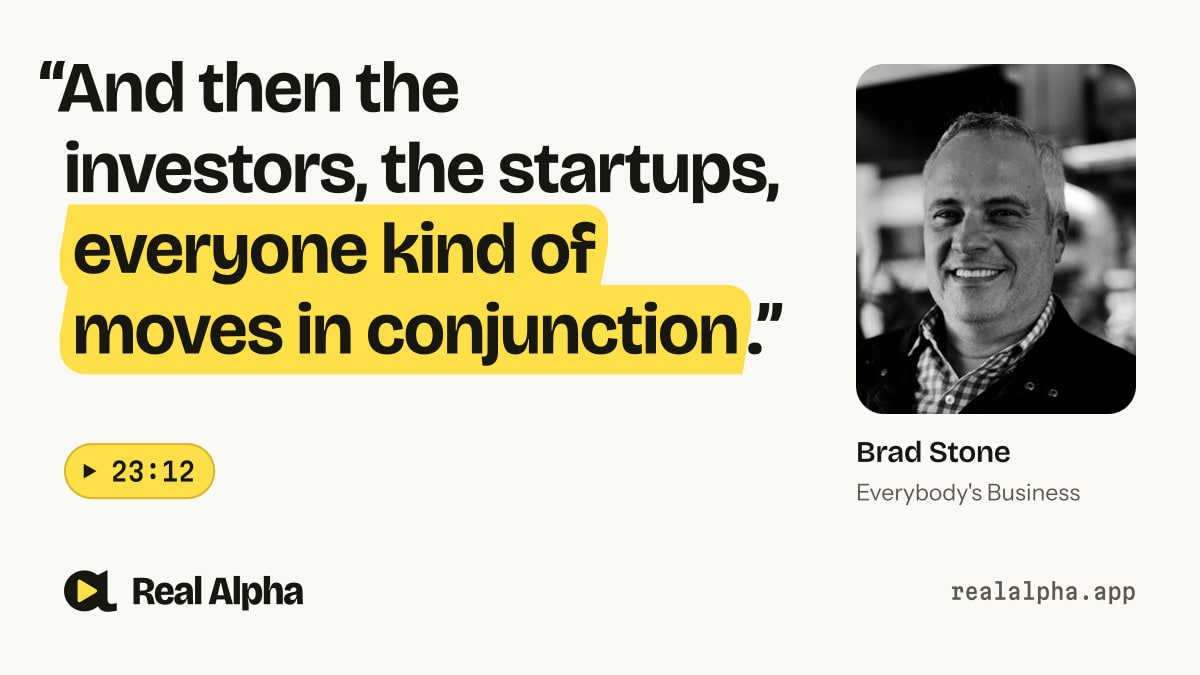
“And then the investors, the startups, everyone kind of moves in conjunction.”
 Brad Stoneat 23:12 · Everybody's Business
Takeaways Pro pick
- China’s plans directed investment toward clean technology and electric cars.
- Local incentives helped new factories and companies take shape quickly.
- Intense competition pushes Chinese firms to seek overseas markets.
One of Pro's picks, open to you here. Try Pro free for 7 days
One of Pro's picks. The rest of the summary and the 3 takeaways are in Real Alpha Pro; the video, the quote and the transcript stay free.
Read it with Pro, 7 days freeAbout this segment
Brad Stone describes how state plans, local incentives and coordinated investment helped China scale advanced factories. The same system also fuels fierce competition and pressure to find markets abroad.

Brad Stone is editor of Bloomberg Businessweek.
Authored acclaimed books on Amazon, Uber and Silicon Valley, and leads Bloomberg Businessweek’s editorial strategy.

Max Chafkin, Host · Features editor & tech reporter, Bloomberg
Wrote The Contrarian, a biography tracing Peter Thiel’s influence and Silicon Valley’s pursuit of power.
- SS
Stacey Vanek Smith, Host
From “The Downfall of Nvidia’s CEO | Everybody's Business”, Nov 13, 2026. Watch the full episode
Thanks. We'll look at and fix what's off.
Transcript
From the transcript Everybody's Business publishes with the episode.
- 22:22
The amazing speed at which these Chinese manufacturing companies have caught up. What is happening there? Because, I mean, part of it has to do with the size of the country. Part of it maybe has to do with government support for these industries. But what's happening? It's all that.
- 22:37
It's also kind of long-term thinking and a state-controlled economy. So, you know, the Chinese Communist Party, every five years or so, they release these long-term plans. And, you know, a decade, two decades ago, they looked at the country's pollution and its dependence on oil, and they said this constitutes a long-term strategic threat. And so like a conductor of the symphony, they said, you know, we need to bet on clean technology and we need to bring our auto industry to electric and hybrid cars. And so they released these five-year plans.
- 23:15
And then the investors, the startups, everyone kind of moves in conjunction. And so I visited factories, you know, in Huangzhou Bay that, you know, 10 years ago, it was just it was water. And there was infill and the local government created a lot of incentives and the company showed up. I toured a factory by a company called Zeker, which is owned by the Geely Automotive Group. And they weren't there a couple of years ago. And now there are these symphonies of automation and robotics. You mentioned dark factories.
- 23:43
The people are kind of there, but they're just watching. And the robotic arms are wheeling and pirouetting these car components into the air. And it's amazing.
- 23:53
One of the things that's really interesting about China is, like you said, they often call it the single party system, but it does enable long term planning. There are some real advantages there. China has some big disadvantages with AI. One is the lack of of chips. I mean, Alice is doing her part.
- 24:12
She did her part. But the other one is just... Allegedly. U.S. Companies have access to so much money, like so much investor money, almost endless. So U.S. Companies have this huge leg up when it comes to chips and it comes to money. And that's kind of driven the direction that the U.S. has taken in AI. In China, they don't have that. But what they do have is... this incredible, maybe the world's best manufacturing infrastructure, including all the people who know how to deal with it and just like really engineered for the highest end electronics and robotics. And so they really saw that as their edge. Even if they couldn't get the best chips and even if they didn't have endless money, they could make the stuff that the chips go in.
- 24:57
I have wondered, like Stacey, as I was reading your story, you know, China, because of the chip shortage, has taken maybe a more incrementalist approach, whereas you have these kind of expansive companies in the U.S. Tesla. Tesla, like a lot of the robots you saw are like more, less complicated than a humanoid robot. It's an arm or something. Yes, it's like AI enabled, but it's an arm. It's a factory robot. It's an old school manufacturing arm.
- 25:22
It's not that different from a robot that you would see in a U.S. factory. Maybe it's, you know, but maybe it's cheaper. Maybe it has a little bit more machine learning in it or whatever. And part of me wondered whether that constraint has worked to their advantage. We talked about this maybe a little bit with DeepSeek where, you know, if you don't have unlimited funds to buy as many GPUs as you want, if the only way you can get chips is by starting a shell company in Malaysia and, you know, whatever, then that maybe creates constraints that lead to more kind of incremental progress, whereas you have all these moonshot companies in the U.S.
- 25:57
Or something like that. Yeah, that's true. I don't know about the companies that you looked into, Brad, but a lot of the companies I looked into had gone public very recently. Even I went to this company called MechMind in Shanghai, which makes a lot of the robot arms you're talking about.
- 26:10
And they're getting into humanoid robots. They went public. It was like $ 1. 3- ish billion IPO. That's nothing. Yeah, exactly.
- 26:19
Come on, that's like really, you know, pico-anthropic. No, that's true. And he said, like, listen, there's just not the pressure to have a huge IPO as there is here. But what he said investors did want to see was basically almost immediate profitability. Like, Can you get to profit next year? It's like the opposite of a moonshot.
- 26:38
I will say that one of the downsides of this state orchestrated kind of innovation is that you just have hyper competition in China. And Stacey, in your story about robotics companies and in the EV market, there are so many startups and prices are depressed and just hyper competition. And what this is doing is kind of putting pressure on these companies to seek profits outside of China. And that's why you've got these wave of ex-Chinese imports of EVs.
- 27:08
In the U.S., we banned them. But in the West, the Chinese cars are pouring in. And it's a real kind of threat to Western automakers because these Chinese companies, they're almost like Amazons. They kind of come in and eat your margins and create a race. To the bottom.