The alpha, twice a week
That was 3 min.
Get the best new moments in your inbox every Wednesday and Saturday. It's free.
Check your inbox
We sent a link to your address. Click it to finish signing up. Not there in a minute? Look in spam.
or
Balance of Power · 3 min · Nov 23, 2026
Chip export controls are easier to enforce than software rules
 Patrick McHenry
 says Washington is tightening export controls, but monitoring remote access to chips is nearly impossible.
The episode’s best minutes
Full analysis- 9:59Nvidia's dependence on Huang raises questions about its AI story8 min
- 42:57Chip export controls are easier to enforce than software rules3 min
- 2 more moments in the full episode
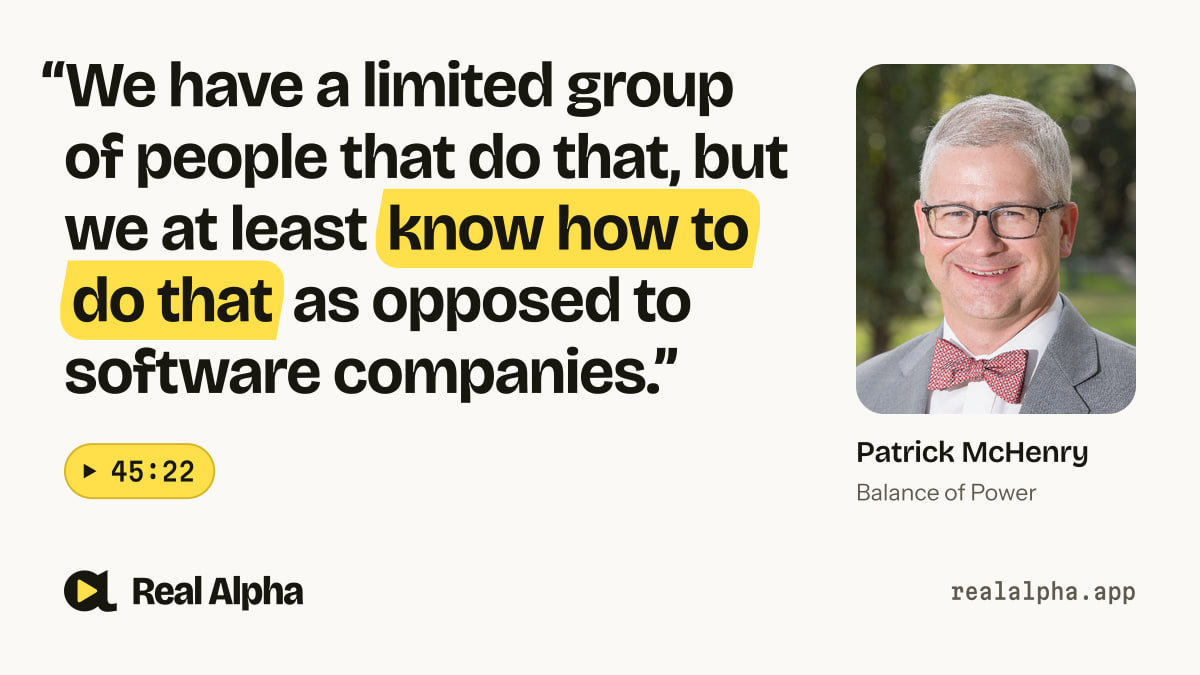
“We have a limited group of people that do that, but we at least know how to do that as opposed to software companies.”
 Patrick McHenryat 45:22 · Balance of Power
Takeaways
- Congress is pushing for tougher export controls on China.
- Tracking who accesses chips remotely is hard to enforce.
- Physical shipment controls are more practical than software rules.
About this segment
Patrick McHenry says Washington is tightening export controls, but monitoring remote access to chips is nearly impossible. Physical checks on shipments are more workable than rules for software and code.

Senior advisor, Lazard
Chaired House Financial Services, shaping U.S. policy on crypto, fintech and AI during two decades in Congress.

Joe Mathieu, Host · Washington Correspondent, Bloomberg
Co-anchors Bloomberg’s Balance of Power and covers Washington; founded and hosted SiriusXM’s POTUS political news channel.

Kailey Leinz, Host · Washington Correspondent, Bloomberg
Co-anchors Bloomberg’s Balance of Power, interviewing presidential candidates, administration officials, lawmakers and regulators on policy.
From “Nvidia Rehires Huang Amid Trump Push”, Nov 23, 2026. Watch the full episode
Answers “Should AI be regulated?” See all 145 answers
Thanks. We'll look at and fix what's off.
Transcript
From the transcript Balance of Power publishes with the episode.
- 43:10
Well, and obviously, and you were speaking to this a moment ago, that there are domestic competitors to NVIDIA. There's Chinese competitors as well, and China is obviously a major factor in this. Is there any doubt in your mind that tougher export controls are coming out of Congress? In the lame duck session, in the NDAA, does Jensen's return change that calculus or perhaps just reinforce the drive?
- 43:32
It reinvigorates the drive. For sure, it takes the drive which was already there and heightened and puts jet fuel on it. And so a couple things about that. We have a path of travel with export controls and outbound investment restrictions. The path of travel is far more restrictive, far more government intervention, far more blessing by the Treasury and the CFIUS committee. That has been significant. before Trump, but enhanced by Trump and the focus on China.
- 44:05
That's there. Number two, on AI, they have a huge concern, huge challenge of how they implement these rules. So President Biden had the diffusion rule on AI, which says we need to review these models before they're diffused across society. And then this administration came in and says that's not going to work. It's speech. It's software code. You can access the Internet, and that means that these things are not protected. So that doesn't work. And then we've come full circle now to a new rule by Commerce.
- 44:37
on export controls, saying basically we want to make sure that off-premises access to chips, which is called a data center, by the way, which is how we access everything, right?
- 44:49
We're going to have a review of people's access to that. I'm sorry, that's going to be an impossible... It's almost physically impossible for the U.S. government to know who's doing that.
- 44:58
So we're in this absurd theater of government trying to show control. So then you get into the physical aspects of... of export controls, which is where we've traditionally been, which is we look in the box. That box cannot leave the U.S. government and cannot go to a non-protected person. Oh, okay, we know how to do that. And we're okay with that. Not really good, but we're okay with that, right? Because we have a long list of people, of things we're very concerned about, right? Including agricultural products coming in and out of the country, right?
- 45:33
So we have this long list. We have a limited group of people that do that, but we at least know how to do that as opposed to software companies. And code and speech, which we have no clue on how to do this. So there's a lot of limitations on this. But now you're going to get back to the physical concern about export of chips. And NVIDIA is going to have even more scrutiny about this and a lot of legal ramifications about the decisions they've already made.
- 45:58
Wow.