The alpha, twice a week
That was 5 min.
Get the best new moments in your inbox every Wednesday and Saturday. It's free.
Check your inbox
We sent a link to your address. Click it to finish signing up. Not there in a minute? Look in spam.
or
Unsupervised Learning · 5 min · Nov 2, 2026
Chip scarcity gave AI clouds room to compete
Danila Shtan says hyperscalers have to divide scarce chips between internal use and customers, while AI infrastructure requires major investment.
The episode’s best minutes
Full episode- 39:13Chip scarcity gave AI clouds room to competePro pick 5 min
- 25:05Open-model inference still has major room to improvePro pick 3 min
- 53:19Nebius lets engineers use AI but keeps accountability human3 min
- 5 more moments in the full episode
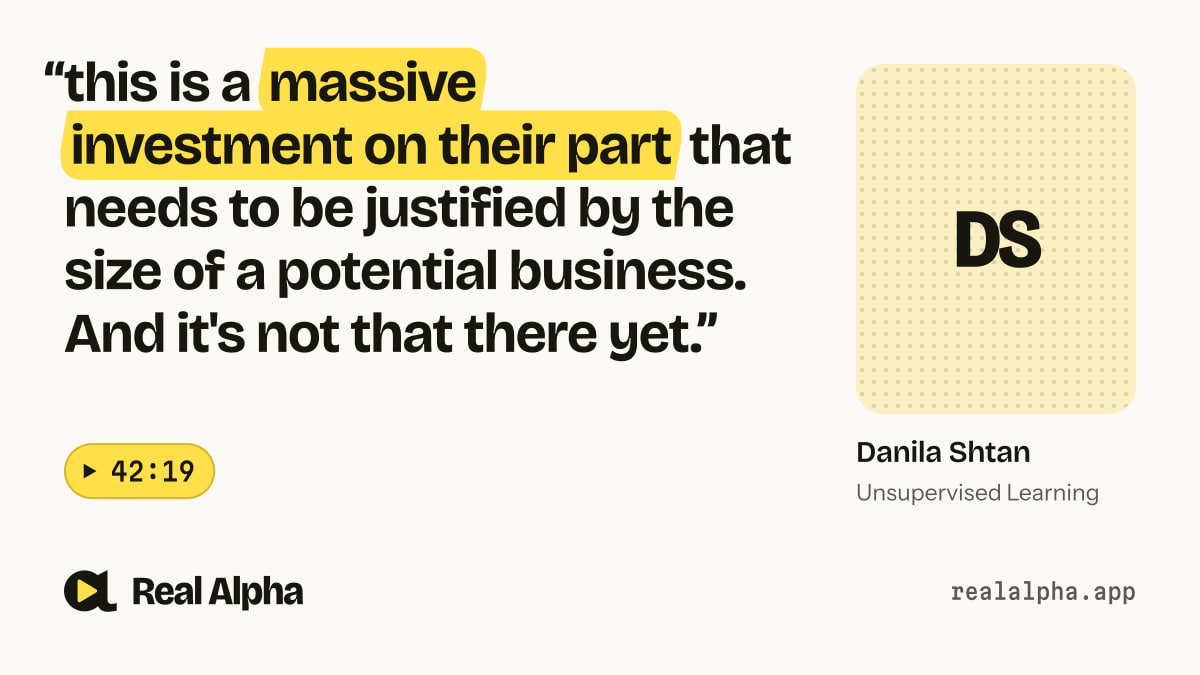
“this is a massive investment on their part that needs to be justified by the size of a potential business. And it's not that there yet.”
Takeaways Pro pick
- Hyperscalers balance external sales against their own AI demand.
- AI workloads require changes to networking, storage and throughput.
- Shtan expects hyperscalers to invest more when chip supply grows.
One of Pro's picks, open to you here. Try Pro free for 7 days
One of Pro's picks. The rest of the summary and the 3 takeaways are in Real Alpha Pro; the video, the quote and the transcript stay free.
Read it with Pro, 7 days freeAbout this segment
Danila Shtan says hyperscalers have to divide scarce chips between internal use and customers, while AI infrastructure requires major investment. He expects them to compete more aggressively once supply improves.
Danila Shtan is CTO of Nebius.

Jacob Effron, Host · AI Investor, Redpoint Ventures
Growth investor in Abridge, Ramp and Physical Intelligence; ex-Flatiron Health.
From “The Window Before AWS Wakes Up: Nebius CTO on Racing the Hyperscalers”, Nov 2, 2026. Watch the full episode
Answers “Is there still a GPU shortage?” See all 31 answers
Thanks. We'll look at and fix what's off.
Transcript
Transcribed by machine (Whisper) from the episode’s audio, so a word may be off here and there.
- 39:17
Why didn't the hyperscalers move into this market faster or win this market more convincingly early on, in this first chapter at least? First of all, sometimes there is an ocean that they didn't even try. Like, there is a solid, like, solid amount of business that hyperscalers get from out of this market. Like, huge deals, they are very competitive. Sometimes people say, oh, have you seen AWS prices?
- 39:45
Well, these are public prices. I assure you, like, for proper deals, they are doing proper prices and they're very competitive and, like, they're very aware of the market. I think, in a sense, like, there are two angles to that. First, like what I've mentioned before, a lot of these companies need to juggle like their internal consumption and what they can put for like for the broad market. And there is like we are in cheap shortage world, right? So like if NVIDIA could have bought, like could have produced like 10x the chips, probably this whole market would have be shaped differently because they were like Microsoft's and Google's of the world would both buy capacity for themselves and for the broader market to operate. This was part, like simply not enough capacity for their scale, right? Because there is not enough
- 40:42
capacity for their scale, this is a relatively small business for them. AWS revenue is what, like 100 billion or something? I mean, like a business for $2, $3, $4 billion, it's not insignificant by any margin. But compared to what their conservative, large-scale, established businesses, it's not that easy either. But your point is basically they get a chip allocation that is not as large as they'd want. They have to use a large amount of that for training themselves. There's only so big that the cloud business can be, given all that.
- 41:23
And yeah, it's interesting to figure out how to prioritize. Do you go after the few folks with large contracts or do you try and get this mid-market enterprise up-and-coming segment? But I guess you're kind of doomed either way if you only have a certain number of chips. Yes, exactly. And then at the same time, this becomes a relatively small part of your revenue portfolio and you're like, do I even need to allocate resources to that?
- 41:49
And that is especially a pressing question because, like, for the hyperscalers, it's not just a matter of, like, sales. It's also a matter of changing their infrastructure that was built at scale for other kinds of workloads. The networking, the, like, throughput performance, the storage performance, by the way, right, that I've mentioned earlier. So this requires, if you want to have it universally implemented through the whole stack, this is a massive investment on their part that needs to be justified by the size of a potential business.
- 42:31
And it's not that there yet. I think if we start getting out of this cheap shortage in, I don't know, two, three, five years, maybe, we will definitely see this shift. and they will pay more attention because this will become like increasing a large chunk of business and they will start investing. They will like reorganize and redesign their like internals to be more accommodating to these demands, et cetera, et cetera, et cetera.
- 43:03
And then with their whole sales power, they'll go and try to win this market. And the question is whether the novel players like us, for example, will be fast enough to grow and represent like significant competition when they get there. I'm like, I'm 100% sure that they will pay more attention in the future. Yeah. Our bet is that we'll be fast enough to be in the league with them and fight as equals rather than a small player trying to run in their trails.
- 43:39
Makes sense. I mean, what do you think happens to like,