The alpha, twice a week
That was 6 min.
Get the best new moments in your inbox every Wednesday and Saturday. It's free.
Check your inbox
We sent a link to your address. Click it to finish signing up. Not there in a minute? Look in spam.
or
Balance of Power · 6 min · Nov 11, 2026
Chip security failures need a process review
 Nikki Haley
 says officials had warning signs about the alleged relationship and asks what the administration did about them.
The episode’s best minutes
Full analysis- 4:17Chip security failures need a process review6 min
- 42:27Nvidia’s reliance on Huang creates key-person risk4 min
- One more moment in the full episode
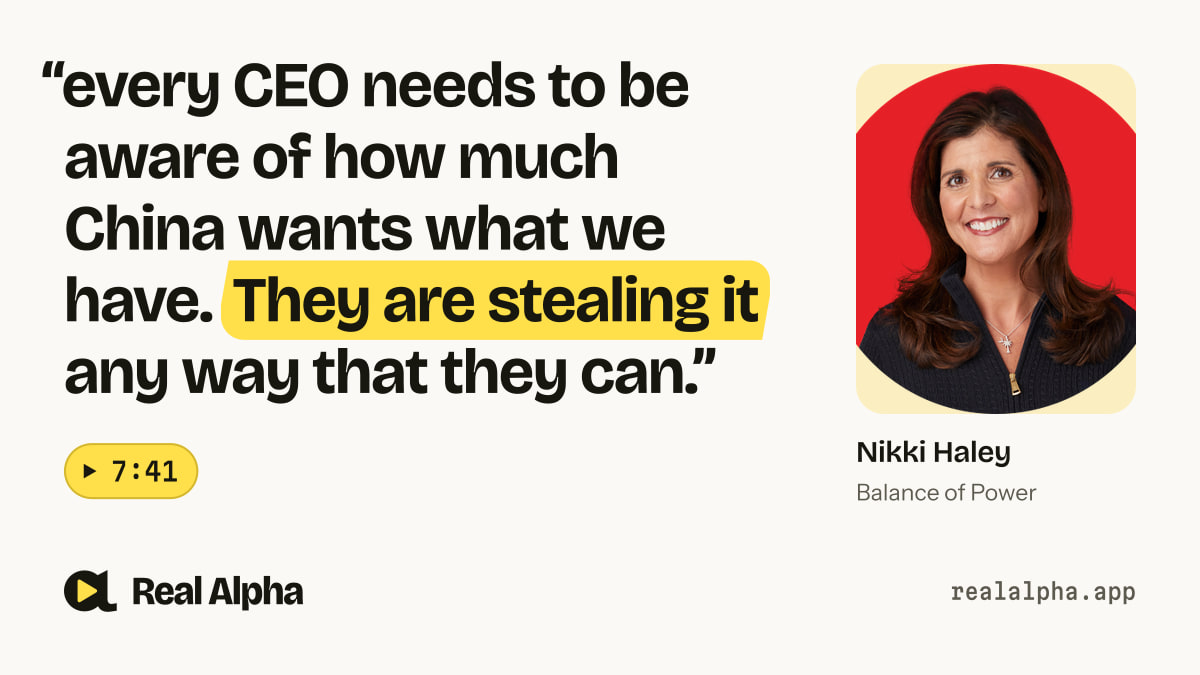
“every CEO needs to be aware of how much China wants what we have. They are stealing it any way that they can.”
 Nikki Haleyat 7:41 · Balance of Power
Takeaways
- AI and chip exports are national security issues.
- Haley says CEOs need to understand China’s interest in U.S. technology.
- She prioritizes finding where the process failed over assigning blame.
About this segment
Nikki Haley says officials had warning signs about the alleged relationship and asks what the administration did about them. She argues tech leaders need security briefings and the failures should be investigated without rushing to blame.

Walter P. Stern chair, Hudson Institute
Negotiated over $1.3 billion in UN savings and sanctions on North Korea as U.S. ambassador.

Joe Mathieu, Host · Washington Correspondent, Bloomberg
Co-anchors Bloomberg’s Balance of Power and covers Washington; founded and hosted SiriusXM’s POTUS political news channel.

Kailey Leinz, Host · Washington Correspondent, Bloomberg
Co-anchors Bloomberg’s Balance of Power, interviewing presidential candidates, administration officials, lawmakers and regulators on policy.
From “Huang’s Trump Ties Face Scrutiny”, Nov 11, 2026. Watch the full episode
Thanks. We'll look at and fix what's off.
Transcript
From the transcript Balance of Power publishes with the episode.
- 4:29
you're no stranger here. to sensitive issues like these, although this might be at a new level. I'm curious about what should happen and where there should be accountability inside the administration. If this relationship was known and Jensen Wong was not warned and was still brought on this trip to China, who should be fired if not Howard Lutnick?
- 4:53
There are a lot of questions here and a lot of questions that need to be answered. You know, the first thing I'll say is if you go back, they knew in 2024 that there. Was a red flag. And then by mid 2025, so over a year ago, you had some concern. My questions would be, what did Commerce do about it? What did the Secretary of State do about it? Was there a National Security Council meeting on it? What did the president do about it? And why didn't they tell Jensen Wong? And look at the activity.
- 5:27
AI has been a big part of not economic security, but that is also national security. So when we talk about this race trying to beat China, and we see that last year, that the US allowed H200 chips to be sold and almost allowed Blackwell chips to be sold, it calls into question, is this why China's OpenAI has progressed so much? And what could have been stopped? It just doesn't answer any questions. We have to find out what went wrong. I think we should assume everybody meant well. But something terrible in the process happened. And this really needs, this is not partisan. This is something that we need to look at from a national security perspective that affects our economy, but also affects where we go with this AI race.
- 6:22
Well, and when you talk about some of those restricted chips that had export controls around them eased, like the H200, if Jensen Wong was pivotal in convincing the administration to pull back on that. And it does turn out that he was influenced in some way by this individual. What should happen to him? Is this someone who can still be trusted to lead one of the largest, most national security and technologically intensive businesses in the world?
- 6:48
It's a tough situation because right now he has no successor. This is a very important company, which is all the more reason why attention should have been put on this. One, my first thought is that Trump shouldn't meet with President Xi next week to make a real point of how serious we're taking this. If he still thinks it's important to meet with him, he should absolutely bring it up. But it's hard to imagine that Jensen Wang was not influenced when you look at the actions that took place.
- 7:19
And why was this not part of the consideration? You know, the Chinese, working at the United Nations, The UN is the. Spy capital of the world. We knew that. We had to be very careful about every single person we interacted with, who we were talking to, whether it was in a gym class or at a restaurant. Because they are everywhere. And these tech CEOs need to understand everybody wants what we have. And they need to be briefed. They need to be told of the security concerns. And every CEO needs to be aware of how much China wants what we have. They are stealing it any way that they can.
- 8:02
Let's not hand it to them. We don't need to make this any easier than it looks like we just did.
- 8:08
It's pretty remarkable, Ambassador, to see the photographs of the state dinner here at the White House. Jensen Wong right across the table from President Xi. And apparently everyone at the table... The president from the United States and the president of China all knew about this while this was taking place. If it is learned that Jensen Wong knowingly took part in this relationship and helped the Chinese acquire this technology, is that treason?
- 8:41
Well, I don't think we should assume he knowingly did this. I mean, let's be clear, the Chinese are that good at it. They have police stations in China, Chinese police stations all over this country just for this, to be able to maneuver spies to get. What we need. I think it's more of how did we let this happen and why wasn't anything done to stop it? That should be the question. And Jensen Wong wasn't just one of the big tech CEOs.
- 9:09
Yes, he's that. He was a top advisor to Trump. Trump will openly admit that. And so I think what's more important, rather than pointing fingers right now, we need to look at where was the break in the process. We need to do that, one, from an administration standpoint, because everything Every tech CEO needs to be talked to about this. All of our key CEOs need to be briefed on this. But two, where do we go now with NVIDIA? Where do we go with the fact that Megaspeed was allowed to be a partner with NVIDIA, knowing that they were already being watched by commerce?
- 9:46
There's just more questions than answers. What I would say is don't rush to judgment and don't look at whose fault it is. Let's look at where did the process go wrong? It's the most important thing we can do to make sure it doesn't happen again.