The alpha, twice a week
That was 4 min.
Get the best new moments in your inbox every Wednesday and Saturday. It's free.
Check your inbox
We sent a link to your address. Click it to finish signing up. Not there in a minute? Look in spam.
or
The TWIML AI Podcast · 4 min · Nov 24, 2026
Choose the next step by how much uncertainty it can reduce
 Thore Graepel
 describes using probability to track beliefs and select the next reasoning move.
The episode’s best minutes
Full analysis- 6:58Search let AlphaGo find a move its policy network rejected3 min
- 15:19Choose the next step by how much uncertainty it can reduce4 min
- 23:05Separate stored knowledge from the reasoning processPro pick 8 min
- 5 more moments in the full episode
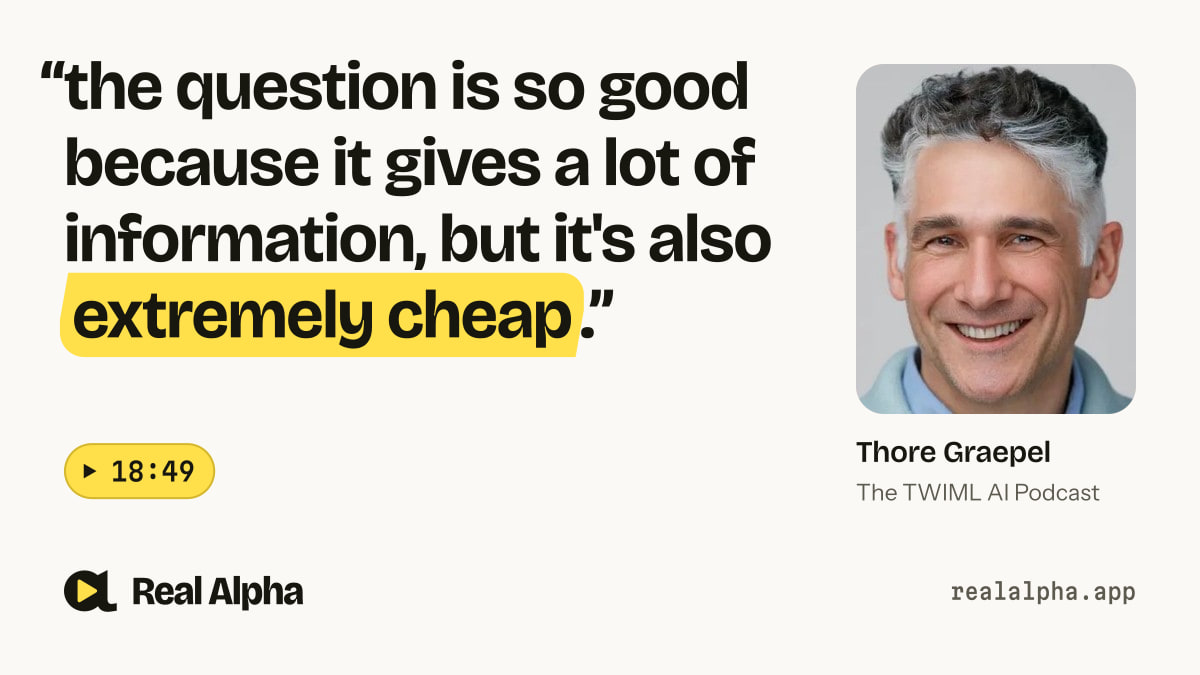
“the question is so good because it gives a lot of information, but it's also extremely cheap.”
 Thore Graepelat 18:49 · The TWIML AI Podcast
Takeaways
- Represent beliefs as probabilities, not just true or false.
- Choose steps for information gained relative to their cost.
- A useful question can make an expensive test unnecessary.
About this segment
Thore Graepel describes using probability to track beliefs and select the next reasoning move. A doctor might ask a cheap, informative question before ordering an expensive scan.

Thore Graepel is CEO and co-founder of Metis Reasoning and Chair of Machine Learning at UCL.
Co-created AlphaGo and now leads Metis Reasoning’s effort to build more reliable, evidence-grounded AI reasoning systems.

Sam Charrington, Host · Host, The TWIML AI Podcast
From “AlphaGo Researcher: LLMs Won’t Get Us to Reliable Reasoning. Here’s What Will.”, Nov 24, 2026. Watch the full episode
Thanks. We'll look at and fix what's off.
Transcript
Transcribed by machine (Whisper) from the episode’s audio, so a word may be off here and there.
- 15:22
When you think about the uncertainty estimation part of this mechanism, do you think of that as a challenging aspect of applying this approach? Or do you feel like that part is mostly solved in the ways that we'd want to apply it? No, I do believe that it is a difficult question, but I think probability theory is the right answer. You know, Ed Jaynes wrote this book, Probability, the Logic of Science.
- 15:58
And so in that sense... I would use probability here as a calculus of uncertainty. And under the hood, it becomes a sophisticated problem. You know, you want to, you have the reasoning process and you set out different hypotheses, you decompose a problem into sub-problems and so on. You find evidence that relates to these hypotheses. and now you need to formulate this in a probabilistic context so that you have consistent hypotheses associated with the different configurations of that system.
- 16:40
And for example, there could be a logical relationship. This hypothesis might imply that other hypothesis. And so then you need that to be reflected in the probabilities that you assign to these hypotheses so that jointly everything is consistent. And when you add more evidence, that you then update those probabilities in a coherent way so that they then after seeing that evidence represent a coherent belief state for you.
- 17:14
And it is that growing of that belief state through the reasoning process that is really at the heart of what I think reasoning should be. But once you have that, interesting things open up because now you can go beyond binary statements and you can actually give answers with a certain probability, which is very important to make good decisions. For example, a medical doctor might have a certain probability of thinking that it is one disease or another in the diagnosis task and that can be very important for making the right treatment decision.
- 17:55
But the uncertainty estimates also have the advantage that I can now choose my next reasoning move so as to maximize the reduction in uncertainty because I can now think about the different options I have and I can choose the option that reduces the uncertainty the most Or I can choose the option that for a given cost in time or computation or money reduces the uncertainty the most. I give you the doctor's example again.
- 18:33
You know, the doctor, you know, a patient comes in, the doctor could decide to either ask them a question. So what's wrong with you? What symptoms do you have? Or they could immediately ask, do an imaging scan or a biopsy. Right. Right. And why is one better than the other? Well, the question is so good because it gives a lot of information, but it's also extremely cheap. You know, you can just ask the question, you get the answer.
- 19:00
And so the bits per buck, so to speak, is very high for that question. And so you want to ask that question first and not first do the imaging, which could be completely pointless in light of the answer to that question. And so that's the kind of decision process that good reasoning is. It's a complex game that you play with the goal of reducing uncertainty by making the right kinds of choices about deductive and empirical moves that you make.