The alpha, twice a week
That was 7 min.
Get the best new moments in your inbox every Wednesday and Saturday. It's free.
Check your inbox
We sent a link to your address. Click it to finish signing up. Not there in a minute? Look in spam.
or
MTS · 7 min · Oct 29, 2026
Clinical trials are harder to speed up than drug discovery
 Ben Liu
 explains which parts of trials cannot be compressed and how AI can improve trial design and operations.
The episode’s best minutes
Full analysis- 2:32Drug development is the bottleneck to getting new medicines to patientsPro pick 4 min
- 7:44Clinical trials are harder to speed up than drug discovery7 min
- 15:00Asset-focused funds can spread risk across more drug trials4 min
- 2 more moments in the full episode
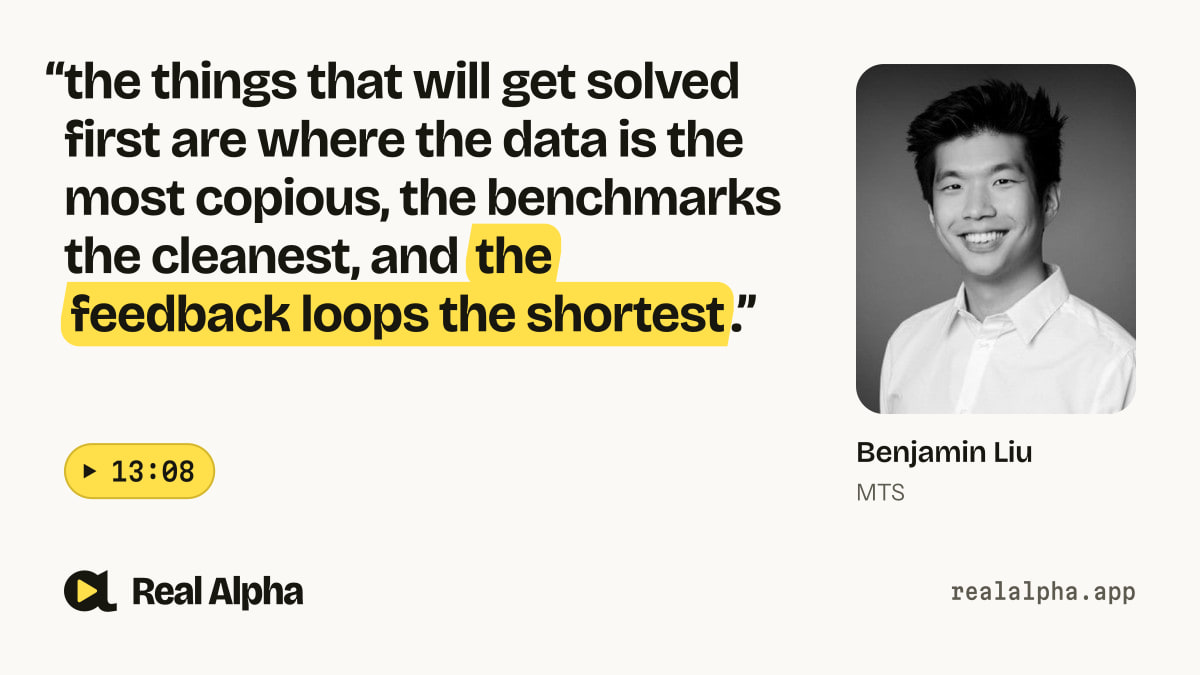
“the things that will get solved first are where the data is the most copious, the benchmarks the cleanest, and the feedback loops the shortest.”
 Benjamin Liuat 13:08 · MTS
Takeaways
- Some safety studies and endpoints require months or years of observation.
- AI can help match drugs to diseases and design more efficient trials.
- Clinical efficacy has longer feedback loops and more variability than drug design.
About this segment
Ben Liu explains which parts of trials cannot be compressed and how AI can improve trial design and operations. Longer feedback loops and less human data make clinical efficacy harder to predict.

Ben Liu is co-founder and CEO of Formation Bio.
Built Formation Bio to use AI and pharma expertise to speed clinical development and bring treatments to patients.

Theo Jaffee, Host · Co-founder & host, MTS
One of the first members of a16z's new media team; earlier hosted the Emergent Ventures-backed Theo Jaffee Podcast.

Sophia Dew, Host · Host, MTS
From “Major AI Health Breakthroughs Will Land in 1 to 3 Years | Ben Liu”, Oct 29, 2026. Watch the full episode
Answers “Will AI cure diseases?” See all 11 answers
Thanks. We'll look at and fix what's off.
Transcript
Transcribed by machine (Whisper) from the episode’s audio, so a word may be off here and there.
- 7:48
a lot faster? Yeah. So there are fundamental safety studies and regulatory kind of things that you just can't compress. So for example, if you want to test a drug in humans, that will be six to 12 months of exposure, you actually need kind of safety and talks in animals and also in humans in that same kind of duration. And it's for good reason, right? For a lot of these drugs, we don't know what the side effects could be. So you need kind of chronic talks. That's kind of really important. If your endpoint is, let's say, a one-year endpoint, that's something you can't kind of compress. But in the clinical trial process, there are certain things that just from a regulatory perspective you have to do, not just to ensure patient safety, but also you kind of might want to do in order to understand whether the drug's kind of a drug
- 8:39
that will likely work, right? So a lot of animal studies are required, but even if they weren't acquired, they typically are quite predictive translational models, right? So if you're going to test a drug that grows cartilage in joints, for example, you probably want to see whether it grows cartilage in a rat or a horse or a dog. Because if it does, you have a little bit more confidence that it will likely translate into humans, let alone from a safety perspective, right? So those are things that are currently required, and I think for good reason.
- 9:12
And it's really important that those things are important. There's tons you can do to make the process a lot more efficient. And so a big part of what we built as a company is the ability to run clinical trials more efficiently. So a lot of pharma and biotech companies hire contract research organizations or CROs. CROs are cost plus bill per hour business models. So the more billable hours you charge, the more revenue you earn.
- 9:39
So you can see how that creates a bit of a kind of an incentive misalignment where the more bill per hour kind of things, like so if you visit sites more often or you do source data verification manually, those are kind of billable hours. So having AI systems that help to disintermediate those cost plus bill per hour activities. But you also ask the question, when you discover a drug, what are some of the steps you need? And so one of the first kind of themes is to figure out for a given drug that goes after a specific target, what targets are relevant for a certain disease? And it's not that human teams don't do this well, but sometimes it's hard to do this very efficiently and exhaustively.
- 10:21
So what you typically want to look for is that for a given target, let's say a GLP-1 or a CATK or give your favorite kind of target, what are all the diseases where there's genetic evidence? So databases like UK Biobank, All of Us, FinGen, when a target has genetic implications for a disease, it's more likely to work in that disease, right? So one is like credentializing that target indication pair.
- 10:45
We have AI systems that automate that process, a tool called Atlas that looks at every drug and looks at target indication pairs and does what best in class kind of drug developers do, which is look across all of the genetic database, all the literature, proprietary of PerturbSeq data. What that means, PerturbSeq data is like you maybe have a system and you give someone a perturbation that might be kind of like a drug or knocking out a certain kind of gene and you see how it kind of responds.
- 11:15
And then even kind of real world data. And if we look at the target indication pairs that make the most sense, then if you have, let's say, a target going after disease, then you have to develop a study design that allows you to ascertain whether that drug has an effect that matters. And so that's the process of putting together a target product profile. I have a target and I have a product aimed at a certain population of patients.
- 11:43
And does that actual profile end up helping address what we call an unmet need in the industry? So a disease need that isn't currently being addressed. That's a lot of work, traditionally. And the reason why pharma companies are like 100,000 personal organizations because There's a lot of nuance running down each question and where's the white space. And we have a tool called Cassini that maps where the market opportunities are, the white spaces.
- 12:09
So a lot of the AI systems we develop help us pick the right drug, match the right disease, design the right trial, understand if you design that trial, does it hit a white space and serve kind of a patient need, and ultimately then run the trials cheaper and faster, all with the right human expertise needed. Right now, there's a lot of really good AI system, but without the human judgment and taste, it's really hard to know whether an idea is actually reasonably good or not so good.
- 12:38
And the benchmarks around the clinical trial process should take longer to resolve, whereas for protein binding or drug design, you're kind of shorter. And so those are some of the kind of opportunities and why clinical trials are such a challenge, such a bottleneck and will be probably the last in the results. What we kind of talked about last time is like this uneven frontiers kind of framework where in our industry, there's three consequential predictions, right? There's predictions related to drug design, predictions related to what might cause a toxic issue in a human, and predictions related to clinical efficacy.
- 13:13
And the things that will get solved first are where the data is the most copious, the benchmarks the cleanest, and the feedback loops the shortest. So the reason why we're seen drug discovery get increasingly more and more efficient. And arguably, we think it will be commoditized over time. It's because the progress there is happening so fast. Because the data is very copious. It's physics, it's chemistry. Understanding whether a drug binds a certain target, they're frankly minutes to days worth of experiments. Tox takes longer to resolve, but you know what a tox signal looks like? And these are weeks to months of experiments.
- 13:47
If every trial takes a few years, closing the loop just takes longer, and the variability is a lot higher. And the data around human-based perturbations don't largely exist yet, which makes that prediction harder. So what does that mean? And this goes to our earlier kind of conversation around our thesis. It's like, you're first going to have more good-discovered drugs, more good-discovered drugs that look pretty great, that don't cause a tox issue.
- 14:10
And the last thing to resolve is going to be clinical trials. And so what that means is our societies, and you're kind of beginning to see this, right? Like, our society is going to have drug abundance of ideas and of candidates. But until you actually empirically prove them out in clinical trials for safety and efficacy, that's going to be a fundamental bottleneck. And so we think capital sources like this need to exist that help to advance more of these drugs.
- 14:36
Again, not invest in an individual company, but in individual assets paired with the capital and capabilities.