The alpha, twice a week
That was 2 min.
Get the best new moments in your inbox every Wednesday and Saturday. It's free.
Check your inbox
We sent a link to your address. Click it to finish signing up. Not there in a minute? Look in spam.
or
The Conversation with Dasha Burns · 2 min · Nov 6, 2026
Clyburn says turnout investment can close the Black-white gap
 James E. Clyburn
 compares Black and white turnout in the previous election and says underinvestment in get-out-the-vote efforts contributed to the gap.
The episode’s best minutes
Full analysis- 17:00Southern campaigns need local knowledge, not just consultant models4 min
- 36:16Southern growth gives Democrats a path to the presidencyPro pick 3 min
- 50:00Clyburn says turnout investment can close the Black-white gap2 min
- 4 more moments in the full episode
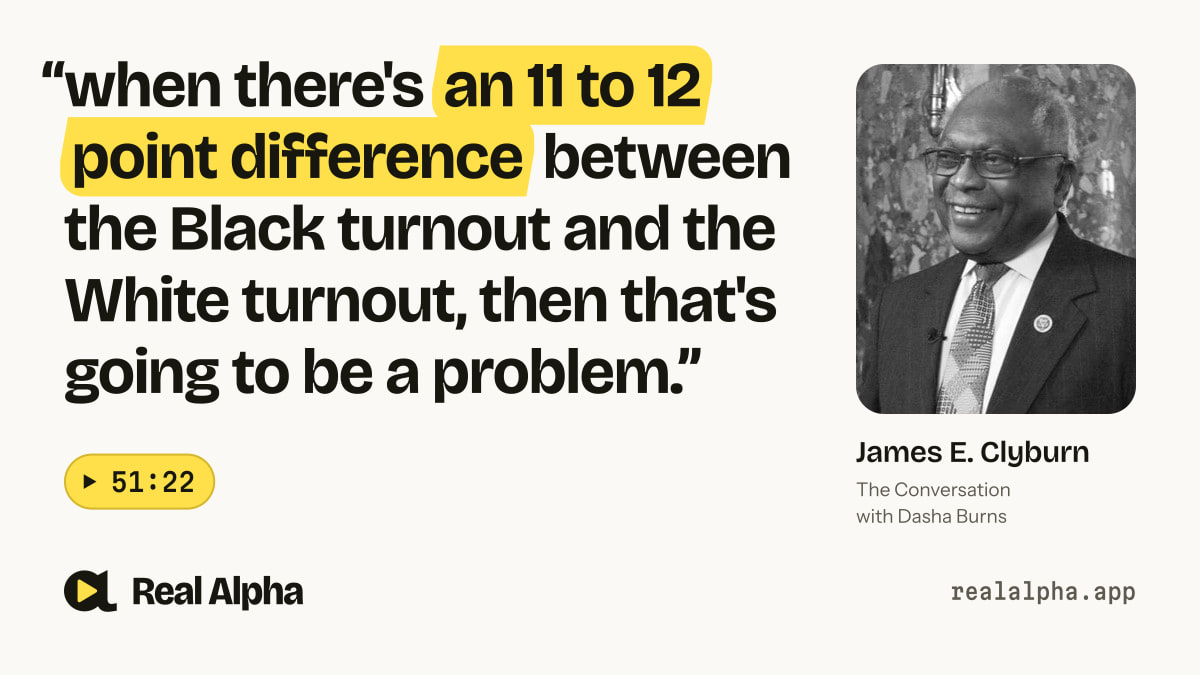
“when there's an 11 to 12 point difference between the Black turnout and the White turnout, then that's going to be a problem.”
 James E. Clyburnat 51:22 · The Conversation with Dasha Burns
Takeaways
- Clyburn cites 71% white turnout and 59% Black turnout.
- He says campaigns need to invest in get-out-the-vote work.
- He says Black turnout rose in his district this time.
About this segment
James E. Clyburn compares Black and white turnout in the previous election and says underinvestment in get-out-the-vote efforts contributed to the gap. He takes responsibility for doing more to mobilize voters this time.

James E. Clyburn is an U.S. representative from South Carolina.
Championed rural broadband, historic preservation and targeted federal investment while representing South Carolina in Congress since 1993.
- DB
Dasha Burns, Host
From “Jim Clyburn says he’d vote to expel Rep. Haley Stevens from caucus”, Nov 6, 2026. Watch the full episode
Thanks. We'll look at and fix what's off.
Transcript
Transcribed by machine (Whisper) from the episode’s audio, so a word may be off here and there.
- 50:04
impact the Black vote did have in this election. Given what we saw, do you think that the Black vote has the potential to be determinative in in 2028 both in the democratic primary and potentially in the general absolutely it always has been when the black vote turned out uh in what i would call uh appropriate numbers uh you know i think everybody should go vote i mean the same about this uh early on too and and the people on the in the social media world went crazy saying i was focusing on the wrong thing.
- 50:46
And what I said at the time was when I looked at the results of Kamala Harris's election, what I found that the white voters turned out at 71% and black voters turned out at 59%. That's just a fact. Now, the question is, why was that? A lot of it had to do with the fact that we were not investing resources in the kind of get-out-the-vote methods that I thought needed to be invested. And I've been saying that even before I ever made that statement.
- 51:24
As I said it here again today, when there's an 11 to 12 point difference between the Black turnout and the White turnout, then that's going to be a problem. That's not the case this past Tuesday. That was not the case. Right here in South Carolina, there's a big uptick in the turnout. Quite frankly, I lost, what, three or four counters in my district the last time. But not this time. Because that turnout was up.
- 52:01
And I said to people at the time, I didn't do enough to energize that African Americans vote. I think I did this time. All right, Congressman Clyburn, know we're going to be seeing a lot more of you and hearing a lot more from you in the coming weeks and months