The alpha, twice a week
That was 3 min.
Get the best new moments in your inbox every Wednesday and Saturday. It's free.
Check your inbox
We sent a link to your address. Click it to finish signing up. Not there in a minute? Look in spam.
or
The Cognitive Revolution · 3 min · Oct 8, 2026
Commodity memory pushed Positron to redesign its chip architecture
 Thomas Sohmers
 explains why Positron designed around cheaper commodity memory rather than premium memory.
The episode’s best minutes
Full analysis- 8:56A capability cap would also constrain compute and dataPro pick 3 min
- 32:57Commodity memory pushed Positron to redesign its chip architecturePro pick 3 min
- 54:27Agents could turn spreadsheets into custom softwarePro pick 6 min
- 5 more moments in the full episode
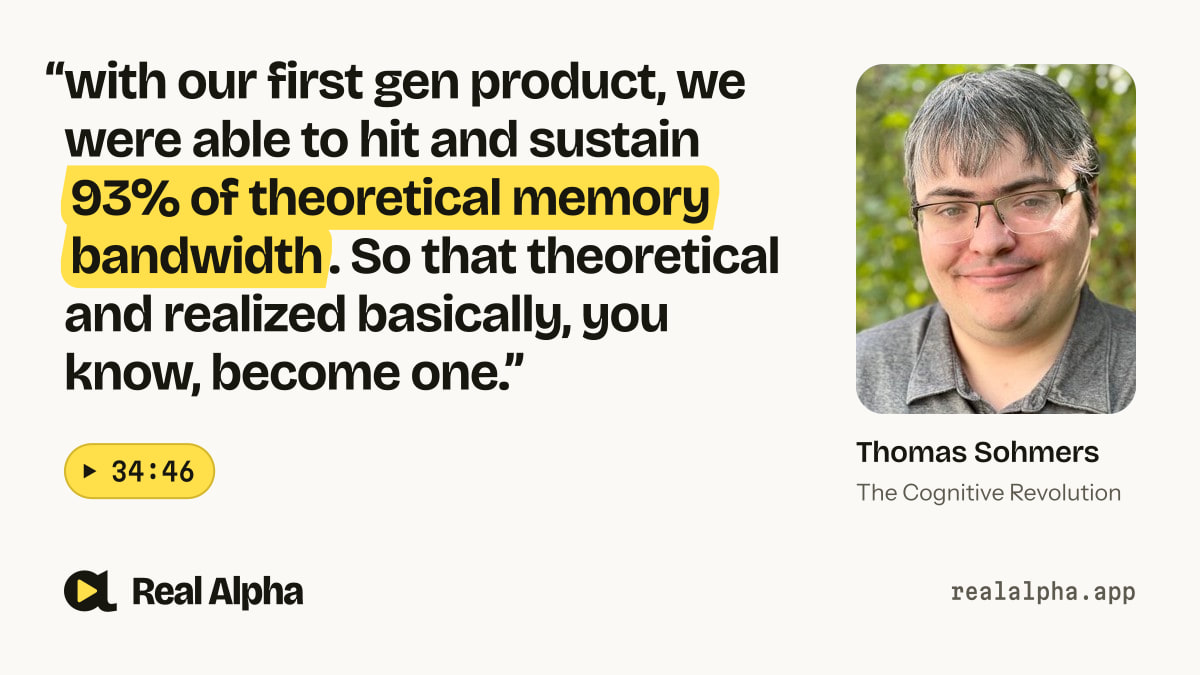
“with our first gen product, we were able to hit and sustain 93% of theoretical memory bandwidth. So that theoretical and realized basically, you know, become one.”
 Thomas Sohmersat 34:46 · The Cognitive Revolution
Takeaways Pro pick
- More agents and longer contexts increase memory demand.
- Positron says its first-generation chip sustains 93% of theoretical bandwidth.
- Its design supports 72 channels of LPDDR5X memory.
One of Pro's picks, open to you here. Try Pro free for 7 days
One of Pro's picks. The rest of the summary and the 3 takeaways are in Real Alpha Pro; the video, the quote and the transcript stay free.
Read it with Pro, 7 days freeAbout this segment
Thomas Sohmers explains why Positron designed around cheaper commodity memory rather than premium memory. Its first-generation product uses 93% of theoretical memory bandwidth, and its design scales to 72 memory channels.

CTO, Positron
Co-founded Positron AI, building inference chips on commodity memory; earlier founded REX Computing as a Thiel Fellow.

Nathan Labenz, Host · Host, The Cognitive Revolution
Founded AI video company Waymark and red-teamed GPT-4 before its release.
From “AI:AM: A Level We Shouldn't Pass? Notes from The Curve + Tokens vs. Salaries & Is SaaS Cooked?”, Oct 8, 2026. Watch the full episode
Thanks. We'll look at and fix what's off.
Transcript
Transcribed by machine (Whisper) from the episode’s audio, so a word may be off here and there.
- 33:02
models larger. So that eats into memory on one side. But then the other side, I think the main limiter today of AI being applied to most applications is context length and being able to hold more context per user and then scaling that out to drastically more users. And really, today, I would say that the driver of quote unquote users or individual sessions is actually just having more agents. I've gone from, you know, three, four months ago where I had probably on average two to four agents like running constantly in the background to where I'm now running 15 to 20. If you then multiply how many people are using AI and how many that concurrent, completely separate contexts adds up very quickly. That memory driver had us say, okay, we have to use the commodity number because that's the only thing that's going to be able to scale and be cost
- 33:50
effective. And when we set that as the constraint in our architectural design, we had to come up with very clever innovative solutions. And the two main pieces of that, the thing that we showed with our first generation product is being able to achieve extremely high memory bandwidth utilization from a compute architecture perspective. So while NVIDIA GPUs, I would say, on average, are getting between 30% and 40% memory bandwidth utilization in the actual decode forward path.
- 34:22
of a transformer model. So basically that means even though they advertise, you know, eight terabytes per second of theoretical memory bandwidth with, you know, a B300, you only actually are seeing, you know, something in the ballpark of like two terabytes per second of actual realized memory bandwidth. And that comes down to the whole bunch of GPU architecture details. It comes down to the reuse patterns that really don't exist in transformers that they designed the hardware architecture around for training and other workloads.
- 34:51
And so with our first gen product, we were able to hit and sustain 93% of theoretical memory bandwidth. So that theoretical and realized basically, you know, become one. And so that isn't that massive, you know, 3x improvement right there. But to really take advantage of, you know, the belief that models and everything are just going to get larger, we had to be able to scale to massive more channels.
- 35:16
And so we're partners with Credo Semiconductor, and I've developed a memory chip solution that allows us to go from the maximum number of LPDDR, the same type of memory that is in phones, laptops, etc., the max number of channels that you can find in any other products is on the order of 12 to 16 channels. And we go up to 72 channels of LPD-UR5X with this decoupled memory chip solution. Positron's next chip is called Asimov.
- 35:52
Prakash asked, what disappears in networking and coordination when a whole model fits on one chip?