The alpha, twice a week
That was 5 min.
Get the best new moments in your inbox every Wednesday and Saturday. It's free.
Check your inbox
We sent a link to your address. Click it to finish signing up. Not there in a minute? Look in spam.
or
Machine Gods · 5 min · Nov 6, 2026
Community consent could unlock more data center approvals
 Kevin Roose
The hosts argue that public opposition reflects communities demanding a say, not simply blanket rejection.
The episode’s best minutes
Full analysis- 12:44Community consent could unlock more data center approvalsPro pick 5 min
- 2 more moments in the full episode
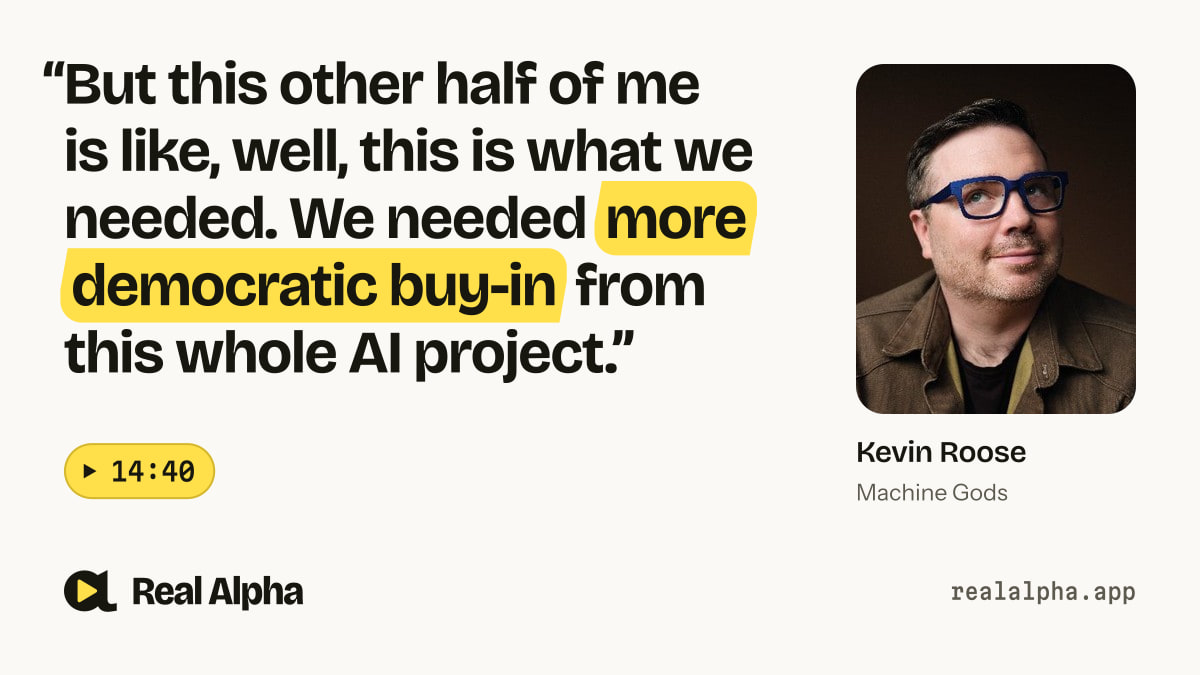
“But this other half of me is like, well, this is what we needed. We needed more democratic buy-in from this whole AI project.”
 Kevin Rooseat 14:40 · Machine Gods
Takeaways Pro pick
- Secrecy and NDAs have fueled public distrust.
- Communities want a say and benefits from projects.
- Casey expects more approvals through a better process.
One of Pro's picks, open to you here. Try Pro free for 7 days
One of Pro's picks. The rest of the summary and the 3 takeaways are in Real Alpha Pro; the video, the quote and the transcript stay free.
Read it with Pro, 7 days freeAbout this segment
The hosts argue that public opposition reflects communities demanding a say, not simply blanket rejection. Casey predicts more projects could win approval if companies negotiate openly and provide local benefits.

Kevin Roose, Host
Co-founder, Machine Gods Media
Wrote The Shift column at The New York Times; co-hosted Hard Fork.

Casey Newton, Host · Founder & editor, Platformer
Covered tech at The Verge, CNET and the SF Chronicle; co-hosted Hard Fork.
From “How the 2026 US midterms will change the AI industry”, Nov 6, 2026. Watch the full episode
Thanks. We'll look at and fix what's off.
Transcript
Transcribed by machine (Whisper) from the episode’s audio, so a word may be off here and there.
- 12:57
Yes. So Casey, what is your take on sort of whether this means that we are effectively pacing the frontier, whether this will amount to slowing down AI progress and whether that could actually be a good thing? So to state as clearly as I can, this is not pacing the frontier, right? Some of our listeners may remember the 2010s when not only did Democrats have control over the House and the Senate, but they had the presidency as well.
- 13:22
There was no meaningful tech regulation passed during that time. Now we're going to be in a situation with a lame duck president who is in a different party than the party that controls Congress. And are they going to be able to reach any sort of accord on regulation? Major open question. And keep in mind that the Democrats who just won are, for the most part, diametrically opposed to the Trump view of AI, which is that we need to go as fast as possible.
- 13:49
So there is this major schism right now between the kind of tech right, the sort of Musk, Sachs, Zuckerberg wing of the Republican Party, which has been dominating AI policy for the past two years, and the party that's just coming in. So my hope is that they'll be able to reach an agreement, but philosophically, these folks remain diametrically opposed. I guess I'm of two minds about the data center opposition and the results we saw in the elections this week.
- 14:15
You and I have both been somewhat critical of a lot of the opposition to data centers, some of which has been based on, I think, bad information, in particular the, like, water figures that people always throw around. And I personally think that there are things about the buildout that could be quite good, forcing upgrades to our electrical grid, bringing new tax revenue to places that have been, like, hollowed out by post-industrialization.
- 14:41
I'm worried that slowing that down risks, like, crashing the economy because so much of the American growth story right now is just AI infrastructure continuing to be built forever. But this other half of me is like, well, this is what we needed. We needed more democratic buy-in from this whole AI project. You know, how many times on this show have we said, like, this technology is just being controlled by too few people in too much secrecy?
- 15:12
These data centers showed up in these towns and cities. They were, you know, buried in NDAs and shell companies and code names. And, like, often people didn't really know they were happening until it was too late to object. And I think what we saw this week is just people saying, hell no. Like, that's, you know, maybe we will allow these data centers, but it's going to be on our terms, and you're going to have to talk to us before we do it, and there's going to have to be something in it for us and our community.
- 15:41
So, I guess that's what gives me some optimism, even though I remain somewhat skeptical of the larger opposition project to data centers. is like, this actually is what democratic buy-in looks like. And one of my hobby horses, the thing that I've been saying over and over again on my book tour is like, we just need people from more walks of life to get involved in what is happening in AI. And to me, this feels like people getting involved.
- 16:05
Absolutely. I agree with that. I felt very heartened by this, honestly, Kevin. I think that there has been so much bad government involved in the making of these data centers, thanks to all of the NDAs, the secrecies, ramming it through in the dark of night. And I think that's going to end. And I will make a prediction right now, which is I think that more American data centers are going to be approved in the next two years.
- 16:32
They're just going to be approved, having gone through a process that local communities feel good about, where it's not being done in secret, where the companies are making promises not to increase electricity bills, on providing real benefits to the community. The tech oligarchs are just going to have to pay up now, and I do believe that if they could just strike a better bargain, Americans, at least in some places, will probably come around.
- 16:58
So that is what should have been happening from the beginning. It's just it took maybe a blue wave for it to happen.