The alpha, twice a week
That was 4 min.
Get the best new moments in your inbox every Wednesday and Saturday. It's free.
Check your inbox
We sent a link to your address. Click it to finish signing up. Not there in a minute? Look in spam.
or
Bloomberg Law · 4 min · Nov 12, 2026
Companies face competing rules on privilege in congressional probes
Diana R. Shaw says courts may recognize companies’ common-law privileges in congressional probes, while Congress does not.
In this episode
Full analysis- 6:08Companies face conflicting demands over congressional subpoenas6 min
- 20:24ICE has the infrastructure to pursue mass deportationsPro pick 3 min
- 27:24DOJ staffing shortages are leaving some habeas cases undefended5 min
- 23:17Democrats cannot simply claw back ICE's appropriated funds3 min
- 17:22Democrats are organizing oversight around corruption, cost and chaos2 min
- 12:37Companies face competing rules on privilege in congressional probes4 min
- 3:52The White House is challenging Democrats’ rhetoric, not their topics2 min
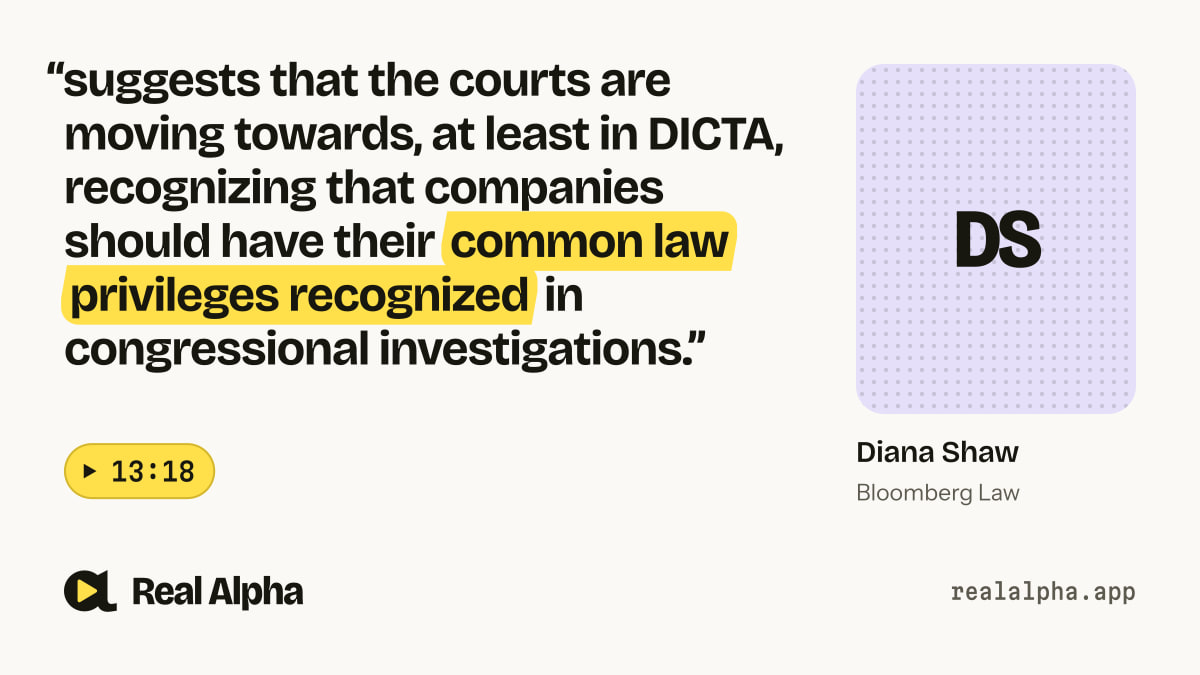
“suggests that the courts are moving towards, at least in DICTA, recognizing that companies should have their common law privileges recognized in congressional investigations.”
Takeaways
- Courts may recognize common-law privileges in congressional investigations.
- Congress does not recognize those privileges.
- A five-year limitations period may leave contempt exposure beyond this term.
About this segment
Diana R. Shaw says courts may recognize companies’ common-law privileges in congressional probes, while Congress does not. She notes a five-year limitations period for contempt charges, so exposure could outlast the administration.
Partner, Wiley Rein
Led State Department investigations as acting inspector general; now advises companies on congressional inquiries and oversight.
- JG
June Grasso, Host
From “White House Threatens Democrats Over Investigations | Bloomberg Law”, Nov 12, 2026. Watch the full episode
Thanks. We'll look at and fix what's off.
Transcript
From the transcript Bloomberg Law publishes with the episode.
- 12:40
litigation at the Supreme Court during Trump's first term over subpoenas for his tax records, I think. I mean, where has the Supreme Court come out on congressional subpoenas?
- 12:52
So the Supreme Court has found that Congress absolutely has the authority to issue congressional subpoenas. Most of the Supreme Court precedent that I track has to do with whether Congress recognizes common law privileges, right? And so whether these private companies will be able to claim any kind of attorney-client privilege and the like is And there's been some interesting case law over the past couple of years that suggests that the courts are moving towards, at least in DICTA, recognizing that companies should have their common law privileges recognized in congressional investigations. Of course, Congress does not recognize recognize that.
- 13:35
So here's another place where companies are sort of caught between a rock and a hard place. You know, Congress doesn't recognize their common law privileges. The courts seem to be suggesting that they should have common law privileges in congressional investigations. And so, again, this is another area where this could really be tested in the next two years.
- 13:55
Congress can make criminal referrals, right? But Is there any point in making a criminal referral? I mean, this Justice Department is certainly not going to move forward on any of them. It's a good question.
- 14:06
I mean, I would point out that the statute of limitations is five years. So some of these things could outlive at least this current administration. So companies... certainly. Should not take lightly the potential for, you know, a contempt charge and a criminal referral. Whether the Department of Justice would move speedily to act on one, you know, now is another question. But, you know, it wouldn't be without risk. And so that's something that companies and executives are going to have to weigh very carefully.
- 14:41
Do you think a lot of this is for public consumption, sort of performative on both sides? Or will we see this kind of aggressiveness come January 3rd? I mean, a lot of the questions, particularly on the DOJ memo, and if the Trump administration uses new tactics, will have to be decided by the courts. And that would go up and up, perhaps up to the Supreme Court for some of them. I think that's right.
- 15:09
I mean, I do think we're seeing some posturing here. You know, Democrats are coming out of a midterm feeling very strong, given the results, and the White House is positioning itself and preparing for an onslaught. At the same time, I fully expect there to be total pushback between the Democrats and the executive branch. I don't see the sort of conciliatory back and forth that we've seen in years past.
- 15:39
I don't know of anybody right now who's anticipating that that will be the sort of relationship that we'll see going forward. So Folks are gearing up for what is going to be a tense tug of war, I think, over the next couple of years. And what I hear from the folks I talk to on the Hill is that they fully expect it and they've got. A game plan for how to manage it. And a large part of that is their plan to go to the private sector and those outside of the executive branch who have had conversations and dealings to try to get at any source of information they can that doesn't require cooperation from the executives. But short of that, as you said, I think many of these issues are going to have to go to the court system. And again, as we've seen with so many issues over the last few years, it really will fall to the judiciary to
- 16:27
resolve some of these hot button issues.