The alpha, twice a week
That was 6 min.
Get the best new moments in your inbox every Wednesday and Saturday. It's free.
Check your inbox
We sent a link to your address. Click it to finish signing up. Not there in a minute? Look in spam.
or
Invest Like the Best · 6 min · Nov 24, 2026
Compute demand will make AI economics resemble energy markets
 Scott Wu
 argues compute is constrained but the value produced by tokens is already real, comparing compute to finite energy supply.
The episode’s best minutes
Full analysis- 3:09AI makes long-overlooked security flaws easier to findPro pick 7 min
- 32:23Devin is changing how large engineering teams ship softwarePro pick 5 min
- 20:56Compute demand will make AI economics resemble energy markets6 min
- 4 more moments in the full episode
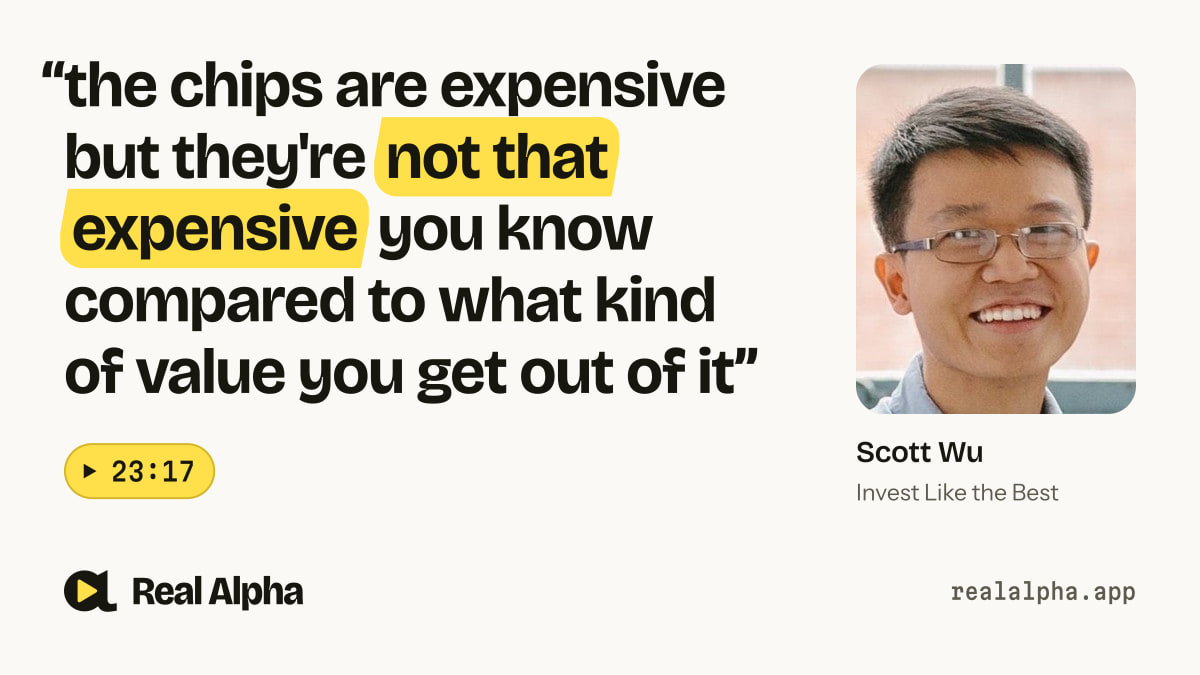
“the chips are expensive but they're not that expensive you know compared to what kind of value you get out of it”
 Scott Wuat 23:17 · Invest Like the Best
Takeaways
- Compute supply takes years to build and is currently constrained.
- More efficient compute can make the underlying resource more valuable.
- When frontier capacity is scarce, prices push users toward smaller models.
About this segment
Scott Wu argues compute is constrained but the value produced by tokens is already real, comparing compute to finite energy supply. Prices and model choice will balance supply and demand, not disprove AI's economics.

Scott Wu is cofounder and CEO of Cognition.
Co-founded Cognition, the company behind Devin, an autonomous software engineer; three-time IOI gold medalist.

Patrick O'Shaughnessy, Host · CEO, Positive Sum
Founded Colossus, the network behind Founders and Business Breakdowns.
From “This Is the Dark Age for Cybersecurity”, Nov 24, 2026. Watch the full episode
Answers “Is AI a bubble?” See all 99 answers
Answers “Is there still a GPU shortage?” See all 95 answers
Thanks. We'll look at and fix what's off.
Transcript
Transcribed by machine (Whisper) from the episode’s audio, so a word may be off here and there.
- 21:08
interesting problems in the field today, I was here a couple of weeks ago and went with a friend. We did, I think, six or seven meetings in a day and then more the next day. And every single conversation boils down to compute that we have this raw intelligence. It's going to keep getting stronger. But even the one we have, you know, Opus 5.5 or something, there is so much demand to use it in a variety of novel new ways and most new companies problem is how do I get compute and so I'd love you to opine on what you've learned through cognition given that you use a lot of compute what it's like today what you think the market gets right and wrong about the narratives around compute what you personally are doing about it I'd love you to just riff on as much detail as you can about this specific topic
- 21:51
for sure it's funny I think we've seen a lot of interesting movements in the markets with compute i mean actually the you know one i think back to is from i think start of 2025 where deep seek came out with a new model and for like a couple days if you remember this like NVIDIA prices just tanked and then eventually you're like okay actually you know the news that people are coming up with really powerful innovations on how to use the compute should make the compute more valuable not less valuable you know i think that continues to be the case first of all this is obviously the case that compute is very much supply constrained right now. And there's a lot of reasons for this. It's a multi-year supply chain. People have to commit in advance. And when it's an exponential curve, it's very scary, obviously, to try to
- 22:34
commit to something three years down the line of the exponential curve. And so you have these massive shortages. But that's clearly the case. I think the other thing which I think we have to call out is clearly the case is the value on the other end of the tokens is very, very clearly real. And so we can debate what the clearing price is of tokens or of PUDE or agents or whatever. A lot of that, of course, comes down to competitive dynamics.
- 22:59
It comes down to supply chain. It comes down to all of the different layers of the stack and what kind of edge and what kind of margins each of them have. But if you just ask the total question from start to finish, you know, does all this work in Silicon and all of this energy and electricity that we feed into it, is it just a... by the amount of end value that we get and the obvious answer is yes by like a lot you know and you see this in in all these organizations out there and that's before we talking about all the new things products that will be created things that will be delivered to customers and so on right um the the reality is you know the chips are expensive but they're not that expensive you know compared to what kind of value you get out of it and i think there's interesting comparisons of
- 23:38
businesses or you know sectors that have these kind of two settings where there's a fixed amount of supply and there's incredible amounts of value on the other hand i actually think one of the best examples of that is oil um or just energy itself until this recent wave you know in the last 30 years or so where the tech companies are the most valuable companies on earth it was primarily energy companies that were actually the most valuable companies in the world and they have a lot of similar dynamics right there's some fixed amount of oil we can produce more or less relatively but there's not an infinite amount that's coming out and we all know that the value of you know people being able to heat up their homes or you know all these like really critical processes that run in hospitals or every other institution out there.
- 24:16
The whole world. That depend on energy, of course, are incredibly valuable, right? And I guess my point is, what happens is prices can float, right? These things can go up and down. We'll see this probably with compute itself. The prices of compute will go up and down. The prices of tokens will go up and down. There'll be new innovations, and those will push the price of tokens down. There'll be new big models that come out or shortages in compute or lots more use cases and demand that people want, and those will push prices up.
- 24:42
But basically, I think that's less a debate on what happens in AI and more a debate on just like what parts of the stack end up capturing the value versus what ends up going to consumer surplus versus et cetera, you know, in this kind of like value chain rather than a question of is the premise of AI fundamentally flawed or something like that, right? And to even kind of like give more specific ways in which that will happen, let's say that the demand for compute over the course of the next year, you know, let's say we all think it's going to grow roughly 4x, but obviously there's variance and maybe it can 2x and maybe it can 10x, you know, it's something in that range, right?
- 25:18
And the reality is like there will be some adaptation. And if it 10x's and there's not enough compute online, what's going to happen is for better or for worse, prices are going to go up to the point where people are forced to use the smaller and cheaper models, right? And it's like you can't be using your frontier model for every single thing because there's just not enough compute in the world for everybody to use the frontier model.
- 25:38
And prices will move accordingly until demand actually meets supply at that clearing price, right? If it goes to 2x, then, yeah, maybe there will be all sorts of, you know, even more, you know, even bigger pre-trains and even more powerful models and more expensive training runs that get put in to deliver the next level of capabilities that will then kind of like accommodate, you know, the inference that people are serving.
- 25:58
In practice, we're kind of already navigating those humps, I think, every day. It's like, in some sense, when you decide whether you're going to use Astra or Fable or whether you're going to use an Opus or something or whether you're going to use an open source model, you are part of the kind of demand and supply equation of what's making the compute work out with the availability and with the amount of demand out there.
- 26:21
And the practical thing, which I think will very clearly continue to be true even as we scale this 10x or 50x, is that the total amount of output to produce with AI will more than justify all of the investment that comes in. So what are you doing about it? One advantage you could have, like OpenAI has shown us this,