The alpha, twice a week
That was 3 min.
Get the best new moments in your inbox every Wednesday and Saturday. It's free.
Check your inbox
We sent a link to your address. Click it to finish signing up. Not there in a minute? Look in spam.
or
Upstarts · 3 min · Oct 29, 2026
Compute financing could become a US geopolitical lever
 Evan Conrad
 expects GPU scarcity to last at least four to five years and argues US data-center policy can redirect capital flows.
In this episode
Full episode- 1:11GPU markets can make compute easier to finance4 min
- 7:15GPU clusters can fail in ways buyers may not expectPro pick 4 min
- 10:53Compute deposits can force startups to raise at huge valuationsPro pick 6 min
- 28:16GPU futures need to account for performance differences4 min
- 36:34B300 rental rates and workload value may converge soon2 min
- 22:59A $245 million compute deal is small by industry standards3 min
- 34:11Compute financing could become a US geopolitical lever3 min
- 20:25Conrad tried around 40 products while searching for a business3 min
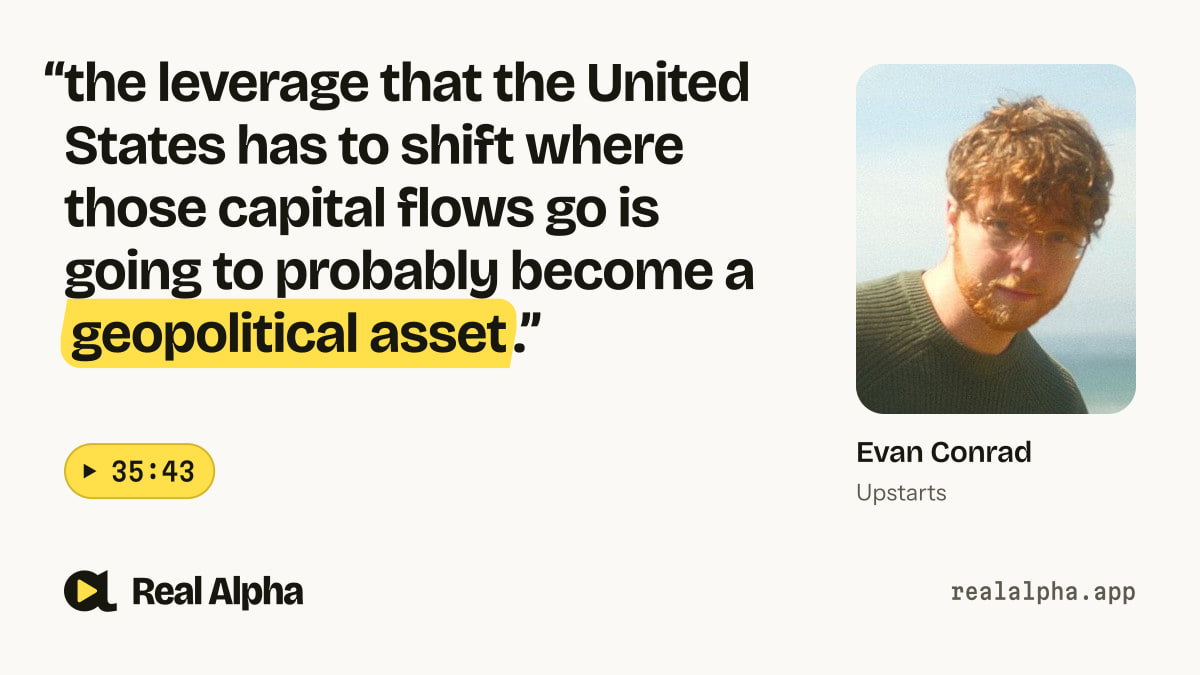
“the leverage that the United States has to shift where those capital flows go is going to probably become a geopolitical asset.”
 Evan Conradat 35:43 · Upstarts
Takeaways
- He expects GPU prices to keep rising for at least four to five years.
- He says data-center moratoriums may push compute investment abroad.
- He sees financing flows as a potential US bargaining lever.
About this segment
Evan Conrad expects GPU scarcity to last at least four to five years and argues US data-center policy can redirect capital flows. That could give compute capacity geopolitical weight.

Evan Conrad is CEO and co-founder of SF Compute.
Founded SF Compute, a GPU cluster exchange where buyers can resell unused compute time on contracts they can exit.

Alex Konrad, Host · Founder & editor, Upstarts Media
Ran Forbes' Midas List for ten years and co-created its Cloud 100 list; founded Upstarts in 2025.
From “The Accidental YC Founder Solving AI’s GPU Crisis | SF Compute’s Evan Conrad”, Oct 29, 2026. Watch the full episode
Answers “What will AI look like in the next few years?” See all 154 answers
Answers “Is there still a GPU shortage?” See all 32 answers
Thanks. We'll look at and fix what's off.
Transcript
Transcribed by machine (Whisper) from the episode’s audio, so a word may be off here and there.
- 34:17
which then reduces the experience of broken clusters. For people who are like, okay, well, I keep hearing that compute is going to be scarce for the foreseeable future. At the same time, data centers have become a big political talking point. And I hear about these huge cloud players talking about doing these multi-billion dollar projects that then may or may not actually happen. Yeah. What is your bet for sort of how this all shakes out and where you guys fit in that sort of bigger context moving forward?
- 34:47
First is I think GP prices are going to go up and to the right. I think it is correct that we are in a scarcity that demand is outpacing the supply. And that that continues. And that continues, yeah. I think that's locked in for the next, like, four to five years at least. When we think about compute as a commodity, what are the impacts, the ramifications of it being so important, so valuable? If you think that compute is going to be bigger than oil, you should probably assume that there are geopolitical impacts of it being bigger than oil.
- 35:19
And right now, one of the things that is happening is you've got data center moratoriums that are pushing compute out of the United States, But the AI labs are in the United States. The bottleneck for setting up new clusters is not actually power and land, but that's very useful to have. It's the credit and the revenue streams that finance the compute. And so one of the things I would assume will happen is the leverage that the United States has to shift where those capital flows go is going to probably become a geopolitical asset.
- 36:01
And the way to think about this is you've got projects like Stargate that are $500 billion. $500 billion is the entire GDP of many countries. You're talking about projects that could 5%, 10% growth of other folks' GDP. and if that project lands in their country, that is a really big deal. Our states are probably not acting in their best interest when they're blocking data centers, but the rest of the world is going to act in their best interest.
- 36:32
And that becomes a leverage point for the United States to use in geopolitical negotiations. Startups obviously think often in 10-year horizons.