The alpha, twice a week
That was 7 min.
Get the best new moments in your inbox every Wednesday and Saturday. It's free.
Check your inbox
We sent a link to your address. Click it to finish signing up. Not there in a minute? Look in spam.
or
20VC · 7 min · Nov 21, 2026
Compute needs a physical market to produce reliable indices
Kush Bavaria explains why fragmented compute supply and demand call for a marketplace, and why Ornn had to build a physical exchange to gather pricing data.
The episode’s best minutes
Full analysis- 27:44Compute needs a physical market to produce reliable indicesPro pick 7 min
- 17:32Older GPUs can serve specialized inference marketsPro pick 4 min
- One more moment in the full episode
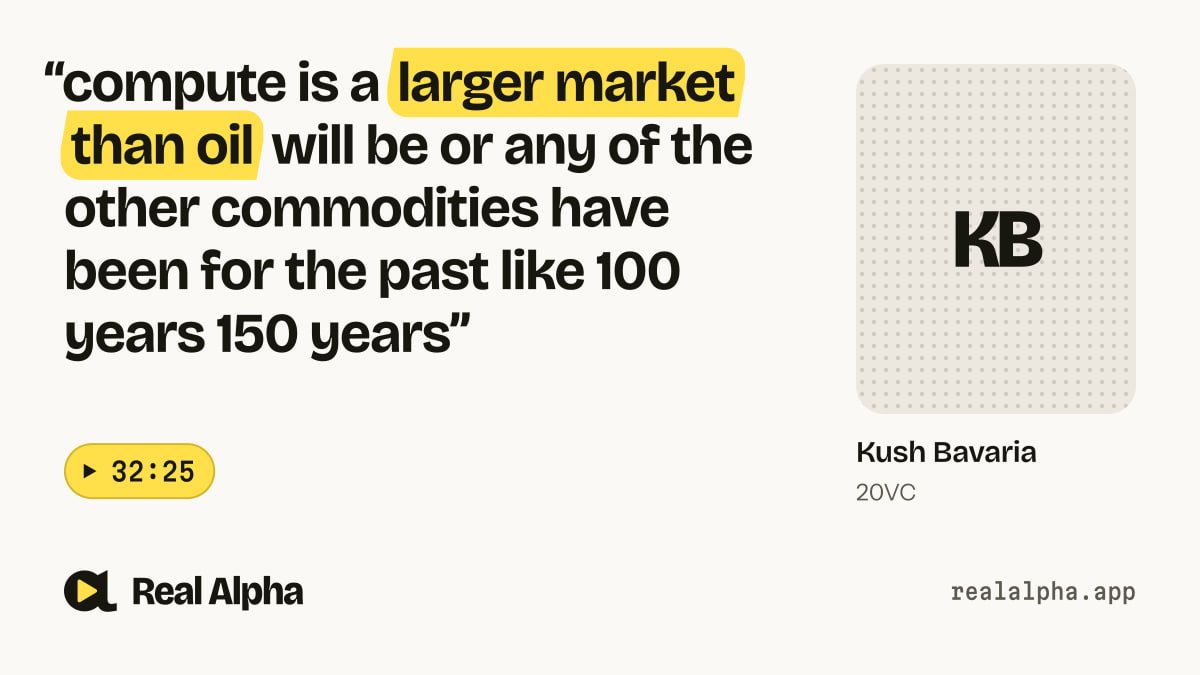
“compute is a larger market than oil will be or any of the other commodities have been for the past like 100 years 150 years”
Takeaways Pro pick
- Many suppliers and buyers are seeking comparable GPU capacity.
- A narrow, standardized compute product can anchor a reference price.
- Ornn needed to control capacity because providers would not share data.
One of Pro's picks, open to you here. Try Pro free for 7 days
One of Pro's picks. The rest of the summary and the 3 takeaways are in Real Alpha Pro; the video, the quote and the transcript stay free.
Read it with Pro, 7 days freeAbout this segment
Kush Bavaria explains why fragmented compute supply and demand call for a marketplace, and why Ornn had to build a physical exchange to gather pricing data. The data foundation is the hard part.
Kush Bavaria is cofounder and CEO of Ornn.

Harry Stebbings, Host · Founder, 20VC
Built a venture firm on his podcast; its third fund closed at $400M.
From “Why Neo-Clouds are Great Businesses & The State of Compute with Kush Bavaria, Co-Founder @ Ornn”, Nov 21, 2026. Watch the full episode
Thanks. We'll look at and fix what's off.
Transcript
Transcribed by machine (Whisper) from the episode’s audio, so a word may be off here and there.
- 27:56
experience yeah it was a very funny experience that is hilarious so if we get into it why does compute actually need a market it is purely just supply and demand that's how prices work for compute in the sense that there are many suppliers that sell basically the same good which is an NVIDIA gpu and there are many demanders who are demanding all the same good with different parameters associated with it some people need the location to be this some people need like three terabytes of rams that are two terabytes around but it's all kind of in this like same sort of bucket and if that's true that means there needs to be a market for this because there's many suppliers supplying the same things many demanders demanding the same thing and that's just purely a market if it's simply supply and demand is there no moat in this market i don't think neoclouds
- 28:39
essentially have a moat and people are trying to trying to find a moat today why do you think like Like CoreWeave is like, oh, we're doing post-training. Oh, we're doing like tokens. Well, they have to expand product to gain moat. Yes, that is what everyone's doing. They realize like early on there is no moat. And so now everyone's trying to expand to find some moat. Is that paradoxical to what you say earlier though, which is like, I would buy them, I would be long, and then they have no moat.
- 29:03
Yeah, but I think that's fine. I think they're still like, they're all good businesses. I want to be like the landlord. Like that's a great business to be in. But yeah, I mean, I don't think not having a moat as a need. Like the moat for the NeoClouds is like, I own the infrastructure. I completely understand you. We have demand, we have supply. Why have we not had a market for them before? Partly because the suppliers, there weren't that many.
- 29:25
I think early on in CPU land, there's only three suppliers, AWS, GCP, Azure, Oracle, maybe. Now there's 300 NeoClouds. Okay. And so we have massively fragmented supply side. And that means that we don't have a market? No, the fragmentation means that there is a market for it. Because there's so many different suppliers for it. I also think on the demand side now, there's 100x more demanders than there were for CPU products.
- 29:47
And they're all kind of asking for the same thing, all trying to go after the same gold vision. Like, oh, I'm going to build this. I'm going to build that. And so that creates literally like a way for people to bid on the price. GPUs today, all the neoclods have now started, what do they do now? Auctioning for the chips, which is like, it's a market. What has to happen then, if we think about it compared to a traditional oil market, what has to happen then for compute to trade like oil does?
- 30:19
I think today it will trade. A lot of people are like, so we build index products for compute itself. And then we do that by running a physical market where we use the data to actually build the index products. And similar to oil, where if you look at Brent in the Nordics, people always see how much of the global oil volume is Brent. And it turns out, I think it's 0.8%, 0.7% of the actual global oil volume, which is such a small fraction of the total oil that exists in the world. And if you think of compute, it's very similar to that. Because compute, there's all these different flavors, even gratings of quote unquote, like crude oil of a B300. But what you really need to figure out is you need to track a very specific type of that compute. And that becomes The index, so that becomes the default of which you track.
- 31:08
It doesn't have to be all of them, but it just has to be a very specific type. And then that becomes a reference price that everyone sort of mentions, and that becomes the sort of standard, the gold standard of what Compute is. And I agree. I think Eric said probably last week or a few days ago, he's like, oh, Compute is like, oh, there's all these different flavors. I totally agree with them. There's all these different flavors.
- 31:28
It doesn't mean that we have to somehow figure out a way to standardize all of them. Saudi oil is not the same as Venezuelan oil, and they all trade still, like everyone's the quotes off of like the Brent price or the WTI price or whatever that may be. So what is it then that is required to make it trade? It's like a standardization. It's like it's it's picking a very specific type of the compute and working like just getting that compute standardized.
- 31:54
How much of it is trust and relationships? I think a lot for the trading part of it is fully trust and relationships. What if it's like as numerical as demand and supply and auction? It is. So it's partly that. But what is the moat that S&P has or what is the moat that like a Moody's has? It is like trust and longstanding business. I totally get you. What is different about your business compared to an S&P and Moody's?
- 32:19
Building in a different market, we're earlier and we're faster moving and hungrier. That's what we say. But I think reality is like, we say like we want to be at the S&P for compute. That is like the part of like, that's the scale we want to get to, an even larger scale than that. And part of that's because I think compute is a larger market than oil will be or any of the other commodities have been for the past like 100 years 150 years and we really want to build the business in the same way where they run the physical exchange and they use that data to build out the actual index and then you build a bunch of data products on top of that and then you do ratings and all these other things on top of it or pause pause you meant that you're expanding product suite there how do you know what to start with why do you choose that and why do you choose what's coming
- 33:07
yeah part of it's we started with the index product because we think compute needs to be traded on a public market. And there needs to be futures, options, all these sorts of financial derivatives that sit on top of a GPU. Okay, so it's indexed on top of GPUs, product one. Yes. And in order to get that data, you need to run a physical exchange, a spot exchange. You need to run Brent in the Nordics for a compute. So we built that out.
- 33:28
And that requires figuring out, oh, how am I going to get chips? So we obviously don't have a ton of cash. And instead of building a neoclid, it's like, how do I get other people to give me cash to like, can they invest in chips? And then I monetize their chips for them, sort of running like an Airbnb style model. And so we started doing that where we're like, we find like other people to do it and we'll do like a sale lease back or all these sort of different like financial ways where like, and then a day like we will control the chips, but someone else like ends up investing in the chips or investing in the data center project and all these different ways to do it. What did you not expect you have come up against and found challenging? Going like this deep i never thought we would have to like go all the way to the chip level i thought we were just
- 34:08
going to be like a software data company why do you have to go to the chip there's no one that's going to stand or give you their data or standardize it for you so in order to get the data for the index you have to either go to like a bunch of neoclouds and say hey please give me your like transaction data of what you sold this for you think corey was going to give you that hell no like they're going to be like this is the most like valuable thing in the world for me i'm not going to hand this over to you we tried for like six months like oh can someone please like give their data and we had some to look to be honest like we had some people actually give us their data but at the end of the day we want to build a very robust market and part of that's like we need to have billions of dollars of data and having billions of dollars to compute you have
- 34:45
to either go to a neocloud or go do it yourself and we have this concept of like no one's going to come save us we got to save ourselves and part of that's we have to go do this ourselves and i didn't realize like you asked me a year ago we'd have to do this i didn't realize we'd have to but And now we kind of do.